6/12/2026
How to Choose an App Development Agency for Your Startup
Learn how to choose an app development agency for your startup, from strategy and UX to engineering quality, launch readiness, and fit.
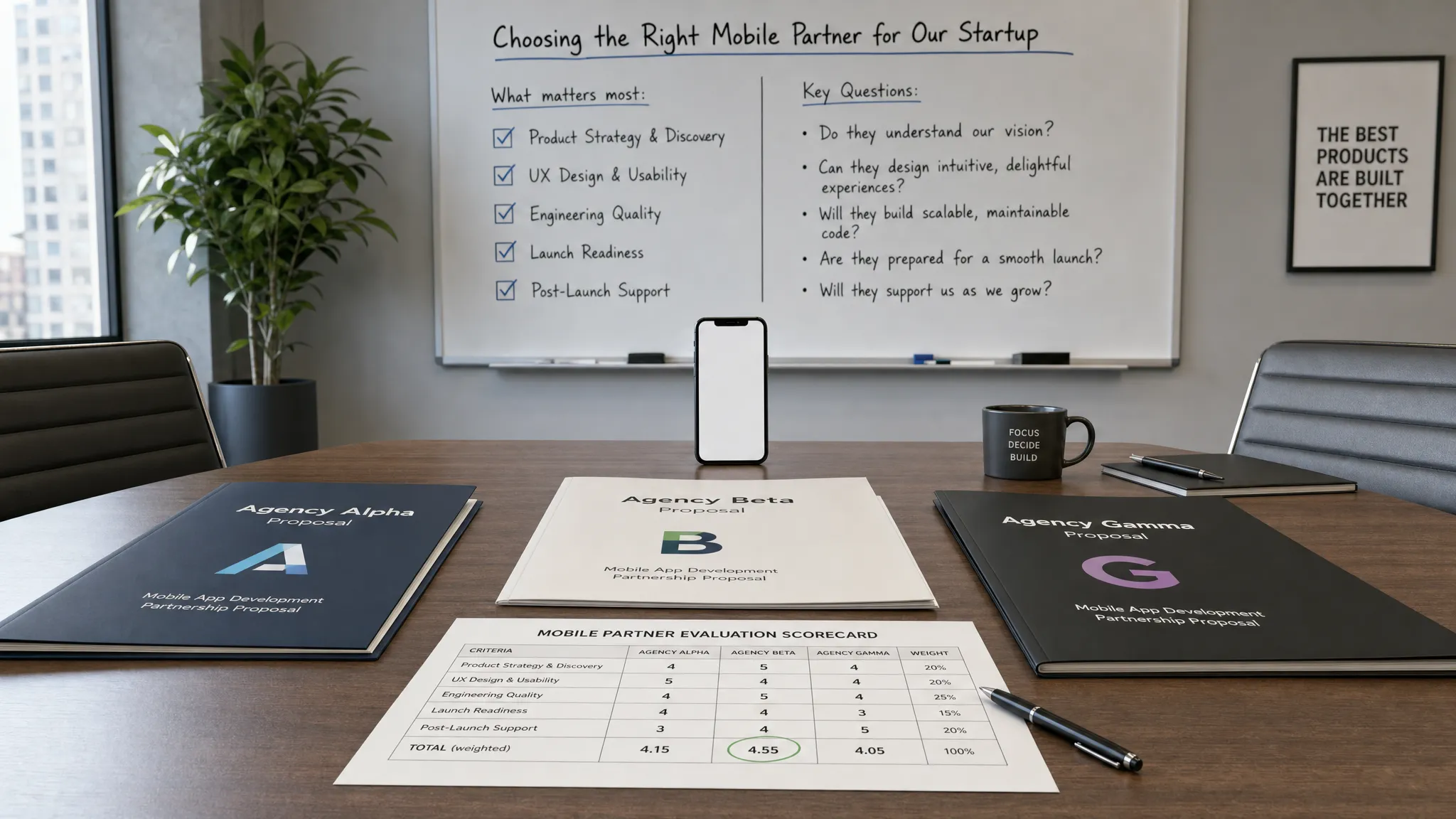
Choosing an app development agency is not just a vendor decision. For a startup, it is a runway decision, a product decision, and often a credibility decision with investors, early users, and future hires.
If you searched for an “app development agency near me,” location can matter. In-person workshops, overlapping hours, and local market familiarity can all help. But proximity alone will not tell you whether an agency can turn uncertainty into a focused MVP, make sound technical tradeoffs, pass App Store review, and keep your product stable after launch.
The better question is: which agency can help your startup ship the right mobile product with the least avoidable risk?
This guide gives you a practical framework for evaluating agencies before you sign, from product strategy and UX to engineering quality, launch readiness, contracts, and post-launch support.
Start by clarifying what you actually need
Before you compare proposals, define the shape of the product and the business outcome. Many agency selection problems start because founders ask for “an app” instead of describing the market, user, and launch milestone the app needs to support.
A strong agency can help sharpen the plan, but it should not have to guess the basics. Prepare a simple startup brief with:
- The target user and the painful problem you are solving
- The core action users must complete in the app
- Your V1 promise, meaning the smallest credible user win
- Known integrations, such as payments, maps, CRM, AI, analytics, or internal systems
- Security, privacy, or compliance constraints
- Your preferred launch window and funding milestone
- Your budget range or budget guardrails
- Existing assets, such as wireframes, research, branding, APIs, or prototypes
This does not need to be a 40-page specification. A clear two-page brief is often more useful than a feature dump. It lets agencies respond with strategy, risks, assumptions, and a realistic plan instead of a generic estimate.
If you are still shaping the product, review Appzay’s mobile app build checklist for funded startups before outreach. It will help you identify the decisions that should be made before development begins.
Decide whether local, remote, or hybrid makes sense
A nearby agency can be useful, especially when you want in-person workshops or your product depends heavily on local behavior. But modern mobile app development depends more on seniority, process, and shipping experience than physical distance.
Use location as one factor, not the deciding factor.
| Agency model | Best fit | Watch out for |
|---|---|---|
| Local agency | You need in-person product workshops, local market context, or close collaboration with non-technical stakeholders | Do not choose purely because they are nearby if their mobile portfolio is weak |
| Remote specialist agency | You need strong mobile engineering, faster access to specialized talent, or broader category experience | Confirm communication cadence, time zone overlap, and ownership expectations |
| Hybrid partner | You have internal product or engineering leadership and need an external team to accelerate delivery | Define decision rights, code ownership, review processes, and handoff expectations early |
If you are comparing nearby and remote options, use the same scorecard for all of them. A local agency with weak release practices is not safer than a remote agency with excellent mobile delivery operations.
For a deeper look at evaluating local partners, see Appzay’s guide on how to choose mobile app development near you.
Evaluate product judgment before technical execution
The best startup app agencies do not simply accept a feature list and start building. They help you decide what should be built first, what should wait, and what needs validation before engineering time is spent.
During early calls, listen for product judgment. A good agency should ask questions like:
- What user behavior proves this app is working?
- Which feature is most critical to activation or retention?
- What can be tested with a prototype before coding?
- Which assumptions could make the product fail?
- What should be excluded from V1 to protect timeline and budget?
Be cautious if an agency jumps immediately to screens, technologies, or total cost without exploring the product risk. For startups, the wrong scope can be more damaging than the wrong estimate.
A strong agency should help you build the smallest complete product loop, not the largest possible MVP. That means users can enter the app, understand the value, complete the key action, and receive a meaningful result. Everything outside that loop should earn its place.
Look for mobile-specific UX maturity
Mobile app design is not just web design on a smaller screen. It involves platform conventions, gestures, permissions, onboarding, offline states, loading states, push notifications, accessibility, and real-world conditions like low battery or poor connectivity.
When reviewing an agency’s design work, do not judge only the visual polish. Ask how they think through flows and states. A credible mobile UX process should include:
- User flow maps before high-fidelity screens
- Interactive prototypes for risky or high-value moments
- Edge states, including empty, loading, error, denied permission, and offline states
- Platform-aware patterns for iOS and Android
- Developer-ready handoff with annotations and acceptance criteria
- Retention thinking, not just attractive UI
If an agency shows only beautiful static screens, ask what happened after launch. Did users activate? Did onboarding convert? Did support tickets drop? Did retention improve? A product-grade design partner should care about outcomes, not just presentation.
Appzay covers this in more detail in its guide to what to expect from a great app design agency.
Assess engineering quality with evidence, not claims
Every agency says it writes clean, scalable code. Your job is to ask for proof.
You do not need to be a CTO to evaluate engineering maturity. You need to know whether the agency has a repeatable way to make technical decisions, test work, manage releases, and keep the app maintainable.
Ask the agency to explain:
- Why they recommend native iOS, native Android, React Native, Flutter, or another approach
- How they structure the app for maintainability
- How they handle authentication, APIs, local storage, and offline behavior
- What testing happens before a build reaches beta users
- How they use CI/CD for repeatable releases
- How they monitor crashes, performance, and backend health after launch
- How they document architecture and hand over code if needed
For a startup, engineering quality is not about overbuilding. It is about avoiding fragile decisions that force a rewrite after your first traction. Your agency should be able to explain where to move fast and where to be disciplined.
For example, if your product needs real-time sync, background processing, or heavy cloud integrations, backend architecture deserves early attention. Appzay’s cloud-based app development guide explains the core decisions that affect scalability and maintenance.
Confirm they can actually launch the app
A mobile app is not “done” when the last feature is coded. It is done when it is tested, approved, published, monitored, and ready for real users.
This is where many inexperienced agencies fall short. They can build screens, but they underestimate App Store and Google Play requirements, privacy disclosures, permissions, payment rules, metadata, beta testing, staged rollouts, and post-launch support.
A launch-ready agency should plan for:
- App Store and Google Play account setup or coordination
- Privacy labels, permission prompts, and policy alignment
- TestFlight and internal or closed testing workflows
- Real-device QA across relevant iOS and Android versions
- Crash reporting, analytics, and release monitoring
- Store assets, screenshots, descriptions, and positioning
- Staged rollout or phased release planning
- A support and hotfix process for the first days after launch
Discovery is also changing. Users may find your brand through app stores, Google, social platforms, and AI engines. If your launch strategy includes organic visibility, it can be useful to audit how your startup appears in AI-generated answers using an AI search visibility tool as part of broader launch readiness.
For app-specific visibility, Appzay’s guide to application store optimization explains how positioning, screenshots, metadata, reviews, and product quality work together to drive downloads.
Ask for the right evidence
A portfolio is useful, but it is not enough. You want to understand how the agency thinks and operates when the project becomes messy, because every real startup build has tradeoffs.
Ask shortlisted agencies for evidence such as:
- A relevant shipped app or case study, ideally with similar complexity
- A sample product brief, roadmap, or discovery deliverable
- A design handoff example with annotations and edge states
- A technical architecture note or decision record
- A QA plan or release checklist
- A sample weekly status update
- References from founders or product leaders
- A clear explanation of who will work on your project
The goal is not to collect documents for the sake of it. The goal is to see whether the agency has a real operating system for building mobile products.
Use a discovery sprint before committing to the full build
If the project is complex, do not jump straight from sales calls to a full development contract. A focused discovery sprint can reduce uncertainty and give both sides a better view of scope, timeline, and working style.
A useful discovery sprint should produce tangible outputs, not just meetings.
| Discovery output | Why it matters |
|---|---|
| MVP scope and feature priorities | Prevents overbuilding and aligns the app with the startup milestone |
| Core user flows | Shows how users will move through the product before screens are finalized |
| Prototype of risky moments | Tests usability and feasibility before engineering investment |
| Technical architecture outline | Identifies backend, integration, security, and scaling decisions early |
| Delivery roadmap | Converts the idea into milestones, sprints, and release gates |
| Risk register | Makes tradeoffs visible before they become expensive surprises |
A discovery sprint is also a working-style test. You will see whether the agency communicates clearly, challenges assumptions constructively, and turns ambiguity into decisions.
Compare agencies with a weighted scorecard
Founders often compare agencies based on price, confidence, and chemistry. Those matter, but they are not enough. A scorecard gives your team a more objective way to decide.
Here is a practical scoring model:
| Evaluation category | Suggested weight | What to look for |
|---|---|---|
| Product strategy | 20% | Can they sharpen the MVP, challenge assumptions, and protect runway? |
| Mobile UX quality | 15% | Do they design flows, states, prototypes, and platform-specific experiences? |
| Engineering depth | 20% | Can they justify stack choices, architecture, testing, CI/CD, and maintainability? |
| Delivery process | 15% | Do they have clear sprints, demos, acceptance criteria, and transparent reporting? |
| Launch readiness | 10% | Can they handle store submission, QA, monitoring, ASO, and rollout planning? |
| Team fit | 10% | Are senior people involved, and is communication direct and reliable? |
| Commercial fit | 10% | Are scope, pricing, change control, and ownership terms clear? |
Score each agency from 1 to 5 in each category, then multiply by the weight. This will not make the decision for you, but it will reveal whether a cheaper option is actually riskier or whether a premium option is justified by stronger evidence.
Watch for red flags
Some red flags are obvious, such as no portfolio or vague pricing. Others are more subtle. Pay attention to how the agency behaves before the contract, because that often predicts how they will behave during delivery.
| Red flag | Why it matters |
|---|---|
| They give a fixed price from a vague idea | The estimate may be padded, unrealistic, or likely to change later |
| They agree with every requested feature | Good partners help you prioritize, not just expand scope |
| They cannot explain their technical recommendation | Stack choice should follow product constraints, not agency preference alone |
| They separate design and engineering too late | Many mobile issues emerge where UX, data, and platform behavior meet |
| They do not discuss QA until the end | Testing must be part of delivery, not a final cleanup phase |
| They promise App Store approval or guaranteed downloads | Agencies can reduce risk, but they cannot control platform decisions or market response |
| They avoid IP, code ownership, or handoff questions | You need clear rights and access if the relationship changes |
| They have no post-launch plan | Your first real users will reveal issues that need fast attention |
A startup-friendly agency should be confident but not magical. If a proposal sounds too easy, ask what assumptions it depends on.
Review the contract like a founder, not just a buyer
The contract should protect the product, not just the transaction. Have qualified legal counsel review important agreements, especially if your app involves sensitive data, regulated workflows, or valuable IP.
Key points to clarify include:
- Scope and deliverables for each phase
- Milestones, payment schedule, and acceptance criteria
- Change request process
- Ownership of source code, designs, documentation, and assets
- Access to repositories, accounts, analytics, and deployment systems
- Confidentiality and data handling responsibilities
- Use of third-party libraries, APIs, and services
- Maintenance, support, and warranty expectations
- Termination, transition, and handoff terms
A strong agency will not be offended by these questions. Serious partners understand that startups need clean ownership, clear accountability, and the ability to raise funding or hire internally later.
Choose for the first year, not just the first release
Your first launch is only the beginning. After release, you may need to fix bugs, improve onboarding, respond to store feedback, optimize performance, add analytics, adjust pricing, support new OS versions, or scale backend infrastructure.
That does not mean you need a huge V1. It means your agency should build in a way that leaves you room to learn.
Ask how they support the first 30, 60, and 90 days after launch. You want to know who monitors issues, how fast hotfixes can be shipped, how product feedback becomes roadmap decisions, and how technical debt is tracked.
If an agency treats launch as the finish line, they may not be the right partner for a startup. Your goal is not just to publish an app. It is to create a product that can earn adoption, survive early usage, and improve based on evidence.
Frequently Asked Questions
Should I choose an app development agency near me? Choose a nearby agency if in-person collaboration, local market knowledge, or overlapping hours are important. But do not make geography the main criterion. Product judgment, mobile engineering quality, launch experience, and communication discipline usually matter more.
How long does it take to choose an app development agency? Many startups can run a focused selection process in two to four weeks if they prepare a clear brief, shortlist relevant agencies, run structured interviews, check references, and use a scorecard. Complex products may benefit from a paid discovery sprint before the full build.
What should an app development agency proposal include? A strong proposal should include scope assumptions, recommended phases, team roles, delivery cadence, timeline, pricing model, technical approach, key risks, ownership terms, and what is included after launch. Be cautious with proposals that list features but ignore risks and operating process.
Is it better to hire freelancers or an agency for a startup app? Freelancers can work well for narrow tasks or when you already have strong internal product and technical leadership. An agency is often better when you need end-to-end support across strategy, UX, engineering, QA, launch, and maintenance.
Should my agency build native apps or use cross-platform development? It depends on your product. Native can be better for performance-sensitive, hardware-heavy, or platform-specific experiences. Cross-platform can be efficient for many MVPs that need iOS and Android coverage quickly. The agency should explain the tradeoff based on your product, not a default preference.
What is the biggest mistake founders make when hiring an app agency? The biggest mistake is choosing based on the lowest quote or best-looking pitch without checking how the agency handles product scope, architecture, QA, release management, and post-launch support. Cheap delivery can become expensive if it creates rework.
Build with a partner who can take you from idea to App Store
The right agency should feel less like a contractor and more like a technical product partner. For a funded startup, that means helping you focus the MVP, design a strong mobile experience, make durable technical decisions, launch safely, and support the product after real users arrive.
Appzay partners with founders to design, build, and launch premium iOS and Android apps end to end. The team supports product strategy, UX design, native mobile engineering, cloud architecture, CI/CD, App Store optimization, release orchestration, and proactive maintenance.
If you are preparing to build a serious mobile product, talk to Appzay about turning your concept into a launch-ready app.