5/28/2026
Pick a Mobile App Development Partner Near You Without Regret
Searching mobile app development near me? Use this scorecard to pick a partner on UX, engineering, delivery risk, and launch support.
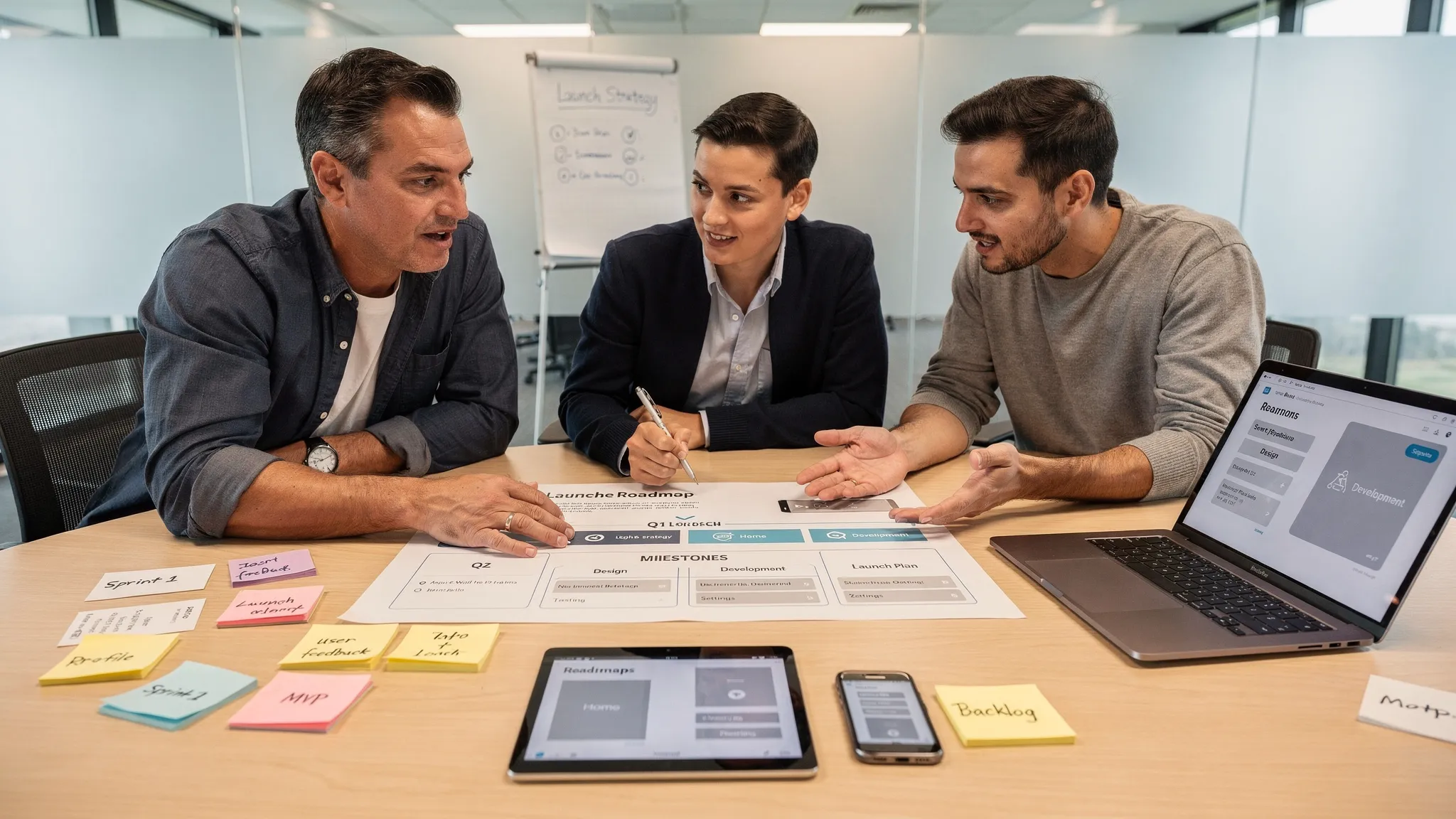
When founders search for mobile app development near me, they are usually looking for more than a nearby office. They want a partner who can understand the business, move quickly, communicate clearly, and ship a reliable iOS or Android product without burning precious runway.
Location can matter. In-person workshops, shared time zones, and local market context can make collaboration easier. But proximity alone does not guarantee product judgment, engineering quality, App Store readiness, or post-launch ownership. The better question is not simply “Who is closest?” It is “Which partner gives us the highest chance of launching the right product, at the right quality level, with the least avoidable risk?”
This guide will help you compare local, remote, and hybrid mobile app development partners with a practical framework built for funded startups and serious product teams.
What “mobile app development near me” should really mean
A local development partner is valuable when nearness improves outcomes. That might mean faster stakeholder alignment, easier workshops, stronger understanding of a regional market, or more convenient collaboration across product, design, and engineering.
But many app failures are not caused by distance. They happen because teams skip discovery, overbuild the MVP, choose the wrong architecture, underestimate store requirements, or treat launch as a handoff instead of an operational phase.
So when you evaluate mobile app development near you, define “near” in terms of working fit:
- Near your business goals, not just your ZIP code
- Near your users’ real workflows and pain points
- Near your preferred communication cadence and time zone
- Near the technical complexity of the product you need to build
- Near the level of ownership required from concept to App Store
For a funded startup, the best partner may be local, remote, or hybrid. What matters is whether they can reduce uncertainty across product strategy, UX, engineering, release, and support.
Start by clarifying the kind of partner you need
Before comparing agencies, decide what you actually need them to own. Some founders need a design prototype to support fundraising. Others need a production MVP for iOS and Android. Others already have a live app and need modernization, integrations, or release stability.
A mismatch here creates friction. A branding-focused local studio might produce beautiful screens but struggle with distributed systems architecture. A freelance developer might build a prototype quickly but lack QA, CI/CD, App Store submission experience, or post-launch support. A premium mobile app development agency should be able to connect product decisions to engineering realities from the start.
Use this table to narrow your search before requesting proposals.
| Need | Best-fit partner profile | Watch out for |
|---|---|---|
| Validate an idea before build | Product strategist, UX team, prototyping partner | Jumping into code before validating the core user loop |
| Build a funded MVP | End-to-end mobile app development agency | Agencies that separate design, backend, QA, and launch into disconnected handoffs |
| Improve an existing app | Mobile engineering team with QA and release experience | Cosmetic redesigns that ignore performance, crashes, and architecture |
| Build a complex app with integrations | Agency with backend, cloud, security, and mobile expertise | Teams that treat integrations as simple API tasks without failure planning |
| Launch on App Store and Google Play | Partner with store submission and release orchestration experience | Teams that finish development but leave review, rollout, and monitoring to you |
If you are still shaping the build path, Appzay’s guide to a mobile application development roadmap for funded startups can help you map the phases from discovery to launch.
Compare local options by evidence, not map rankings
Search results and map listings are useful for creating an initial shortlist, but they are weak signals of delivery quality. A nearby agency with a polished website may still lack the product depth or mobile engineering discipline required for your app.
Look for evidence that the team has shipped apps with similar complexity. That does not always mean identical industry experience. A healthcare app, a field sales app, and a marketplace app may share hard problems like authentication, offline behavior, real-time sync, payments, privacy, or push notifications.
Strong evidence includes portfolio case studies, live App Store or Google Play links, architecture explanations, release processes, client references, and examples of how the team handled tradeoffs. You want to know how they think when constraints collide, not just what the final screenshots looked like.
A good agency should be able to explain:
- What product risk they would validate first
- Which features belong in the MVP and which should wait
- How they choose between native iOS, native Android, React Native, Flutter, or another stack
- How they test critical flows before release
- How they prepare for App Store and Google Play review
- How they monitor crashes, performance, and user behavior after launch
If an agency cannot discuss these areas clearly during sales, they probably will not handle them well during delivery.
Evaluate product strategy before you evaluate code
Many founders assume the technical build is the hard part. In reality, the earliest product decisions often determine whether engineering time is used well or wasted.
A strong mobile partner should challenge the feature list. They should ask who the first users are, what problem the app solves, what behavior the MVP must prove, and which actions should happen in the first session. If the agency simply agrees to every feature, they may be optimizing for contract size instead of product success.
Good product strategy produces concrete artifacts. These may include a product brief, user flow maps, MVP scope, acceptance criteria, prototype, risk register, analytics plan, and launch assumptions. These documents are not bureaucracy. They are how teams avoid building six months of features before discovering that the core loop is unclear.
For a deeper view of what a complete partner should own, see Appzay’s breakdown of mobile app development services and what end-to-end really includes.
Look for mobile-specific UX maturity
Mobile UX is not just smaller web design. Users expect fast access, thumb-friendly navigation, clear permissions, resilient offline behavior, and flows that respect limited attention.
When reviewing an agency’s design work, do not only judge visual polish. Ask how they handle empty states, loading states, error states, weak network conditions, notification timing, accessibility, and platform conventions. These details determine whether the app feels trustworthy after the first five minutes.
A strong UX process should include interactive prototyping before development. This lets your team test the hardest moments early, such as onboarding, payment, booking, recording, messaging, or data entry. It also gives engineers a clearer build target, which reduces rework once development starts.
If the agency wants to move directly from a vague idea to sprint tickets, slow down. The best mobile teams design the app before they write code because unresolved flows become expensive once engineering begins.
Ask how they make engineering quality predictable
A reliable agency should be able to describe how they build, test, deploy, and maintain software. You do not need to be a CTO to ask smart questions.
Ask how they structure the codebase, manage environments, handle API contracts, run tests, review pull requests, automate builds, and prepare releases. If your app needs integrations, ask how secrets are protected, how failures are retried, how logs are monitored, and how user data is secured.
For funded startups, predictable delivery is more important than heroic effort. You want a team that can explain its quality gates in plain English. That includes test-driven engineering where appropriate, CI/CD pipelines, real-device QA, crash reporting, versioned releases, and a plan for post-launch fixes.
This is also where specialization matters. A general web agency may be excellent at websites but inexperienced with mobile release orchestration, App Store review, push notification permissions, background modes, device fragmentation, or battery impact. Those details matter because users judge your product by how it behaves on their phone, not by how clean the pitch deck looked.
Use a scorecard to compare agencies objectively
When several agencies seem credible, use a simple weighted scorecard. This prevents the decision from being dominated by sales chemistry, location, or the lowest estimate.
| Evaluation area | Suggested weight | What to look for |
|---|---|---|
| Product strategy | 20% | Clear MVP thinking, user flow design, measurable success criteria |
| Mobile UX quality | 15% | Platform-aware design, prototyping, edge states, accessibility awareness |
| Engineering depth | 25% | Native or cross-platform expertise, backend architecture, integration planning, testing |
| Delivery operations | 15% | Sprint cadence, transparent communication, risk management, documentation |
| Launch readiness | 15% | App Store and Google Play preparation, CI/CD, QA, monitoring, rollout plan |
| Post-launch support | 10% | Maintenance, bug triage, performance monitoring, iteration planning |
Score each agency from 1 to 5 in every category, then multiply by the weight. This does not replace judgment, but it makes tradeoffs visible. A nearby agency may win on collaboration but lose on mobile engineering. A remote specialist may win on technical depth but require a stronger communication process. The scorecard helps you decide which tradeoff is acceptable.
Review the proposal for hidden risk
A proposal should do more than state a price and timeline. It should show that the agency understands the product, the riskiest assumptions, the delivery plan, and what is excluded.
The best proposals usually include scope boundaries, key milestones, team roles, assumptions, dependencies, deliverables, change control, communication cadence, acceptance criteria, and launch responsibilities. If the proposal is vague, the project will likely become vague too.
Pay close attention to what happens after the first build is “done.” Does the agency include QA? Beta testing? Store assets? Submission support? Crash monitoring? Hotfix planning? App launch is not a single button press. It is a sequence of technical, operational, and product decisions.
Appzay’s app launch checklist for a smooth first release is a useful reference for understanding what should be planned before release day.
Know when local is worth prioritizing
There are situations where a local mobile app development partner can be especially useful. If your product depends on regional regulations, field research, local partnerships, in-person stakeholder workshops, or on-site user testing, proximity may reduce friction.
Local can also help when your executive team needs high-touch collaboration in the early stages. A half-day working session can sometimes resolve product ambiguity faster than a week of asynchronous comments.
However, do not overvalue local access if the app itself is technically demanding. A partner five miles away is not the right choice if they lack mobile architecture, native engineering, cloud integration, or release experience. The ideal partner is close enough to collaborate effectively and experienced enough to ship the product correctly.
For products tied deeply to customer support, CRM workflows, or operational automation, you may also need to coordinate mobile development with customer experience specialists such as Ridgeline Agency, especially when the app must connect cleanly to help desk, CRM, or AI-enabled service workflows.
Watch for red flags during the sales process
The sales process often reveals how the project will feel after kickoff. If the agency is disorganized before the contract is signed, it is unlikely to become more disciplined later.
Be cautious if you hear promises like “we can build anything” without discovery, fixed timelines based only on a short call, or recommendations for a technical stack before they understand the product. Also watch for agencies that avoid discussing ownership of source code, app store accounts, analytics, documentation, or post-launch support.
Other warning signs include no clear QA process, no release plan, no real mobile case studies, no senior technical involvement during scoping, and no willingness to say “no” to risky or unnecessary features. A good agency should help you make better decisions, not simply take orders.
What to ask before you sign
Use the final interview to pressure-test how the agency thinks. These questions reveal far more than a generic capabilities deck.
- What would you validate before writing production code?
- Which parts of this app are technically risky and why?
- What would you cut from the MVP if we had to launch sooner?
- How do you decide between native and cross-platform development?
- What does your QA process include before beta release?
- How do you handle App Store and Google Play submission?
- Who owns the source code, app store accounts, cloud accounts, and documentation?
- What happens during the first 30 days after launch?
- How will we know if the app is stable, fast, and retaining users?
- What would make this project fail, and how would you reduce that risk?
The quality of the answers matters more than the polish of the pitch. You are hiring judgment, not just capacity.
How Appzay approaches mobile app development partnerships
Appzay works with funded startups to design, build, and launch premium iOS and Android apps from concept to App Store. The goal is to act as a technical partner, not just a vendor, by connecting product strategy, UX design, native mobile engineering, cloud integration, CI/CD, release orchestration, App Store optimization, and ongoing support.
That end-to-end ownership is especially useful when founders need more than code. If you need a team that can help clarify the MVP, prototype the experience, build scalable architecture, manage launch readiness, and support the product after release, the evaluation criteria above are exactly the kinds of questions your partner should be ready to answer.
If you are comparing local, remote, or hybrid options, you can also read Appzay’s guide on how to hire a mobile app dev agency for predictable delivery.
Frequently Asked Questions
Is it better to hire mobile app development near me or work with a remote agency? It depends on what reduces risk for your project. A local agency may help with workshops and stakeholder alignment, while a remote specialist may offer stronger mobile engineering depth. Prioritize proven delivery, communication fit, and launch experience over distance alone.
How do I know if a local app development company is qualified? Ask for live app examples, case studies, technical explanations, QA processes, release plans, and references. A qualified partner should be able to explain product tradeoffs, architecture decisions, store submission requirements, and post-launch support clearly.
Should I choose the cheapest mobile app development agency near me? Usually not. A low estimate can become expensive if the agency under-scopes UX, backend work, QA, integrations, or launch support. Compare total delivery risk, not just the initial quote.
What should a mobile app development proposal include? A strong proposal should include scope, assumptions, milestones, deliverables, team roles, communication cadence, acceptance criteria, technical approach, QA plan, launch responsibilities, and post-launch support options.
Can Appzay work with startups outside its local area? Yes. Appzay supports funded startups with end-to-end mobile app development, including strategy, UX, iOS and Android engineering, cloud integration, launch preparation, and ongoing support.
Ready to choose the right mobile app development partner?
The best agency near you is the one that gives your app the strongest chance of succeeding in users’ hands. Proximity can help, but disciplined product thinking, mobile engineering depth, release readiness, and post-launch ownership matter more.
If you are building a funded mobile product and want a partner who can take you from concept to App Store, connect with Appzay to discuss your app, your timeline, and the risks worth solving before development begins.