6/2/2026
What to Expect From a Great App Design Agency
Learn what a great app design agency should deliver, from strategy and UX flows to prototypes, engineering handoff, and launch-ready design.
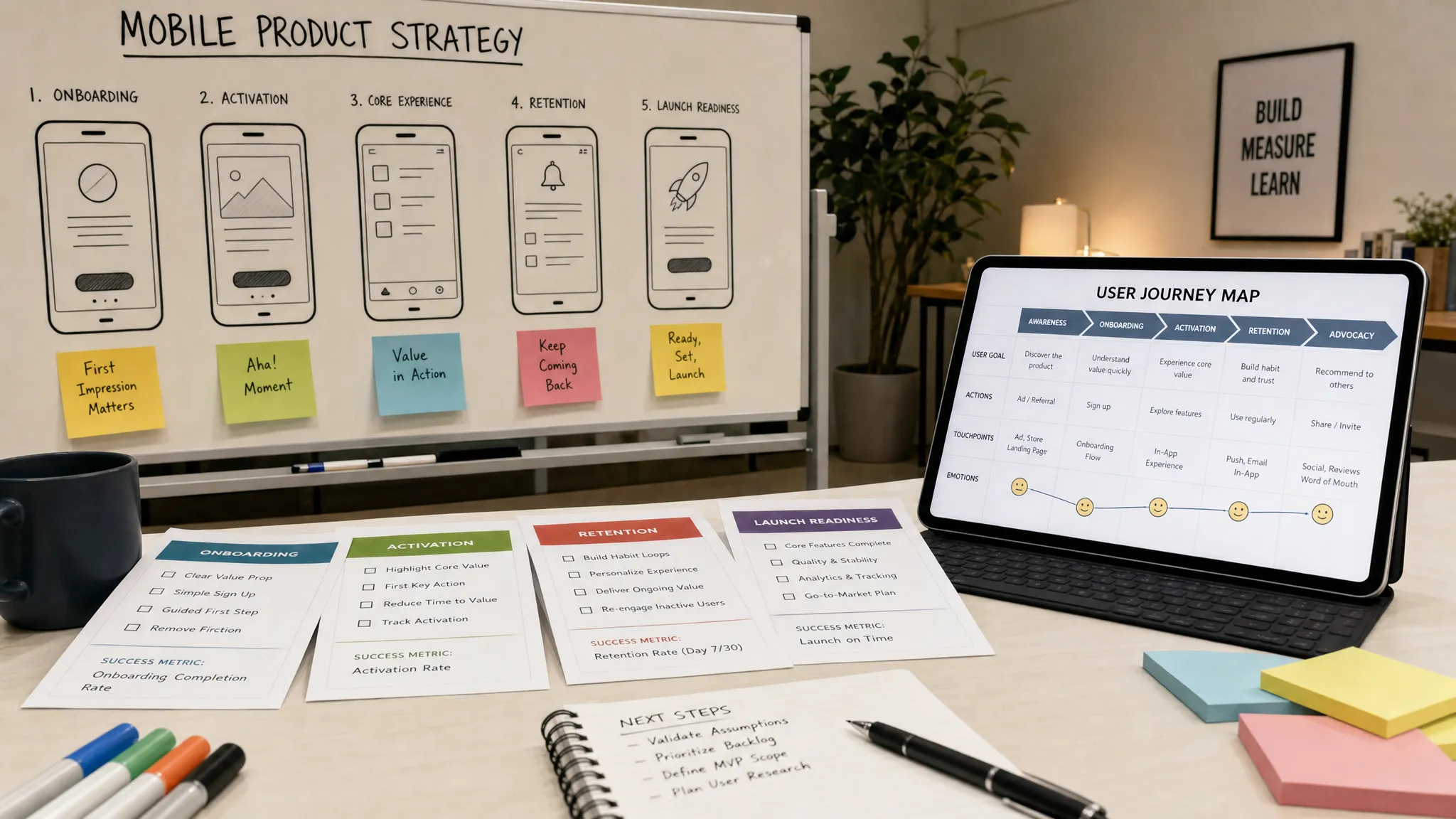
Choosing an app design agency is not about finding a team that can make attractive screens. For a funded startup, the real goal is to turn a product idea into a mobile experience that users understand quickly, trust enough to try, and return to because it solves a real problem.
A great app design agency should feel less like a visual vendor and more like a product partner. They should challenge assumptions, clarify the user journey, reduce development risk, and create design assets that engineers can actually build. The best teams understand that mobile design is tied to activation, retention, performance, platform guidelines, accessibility, App Store approval, and the business model behind the product.
Here is what to expect when you work with a strong agency, plus the signs that a design partner may not be ready for a serious mobile product.
They begin with the product outcome, not the color palette
A weak agency starts by asking what style you like. A great app design agency starts by asking what the app must accomplish.
Before mood boards or UI concepts, the team should want to understand your users, your market, your business model, and the behavior change you are trying to create. If the app is for consumers, they should ask what makes someone open it again after the first session. If it is for internal teams, they should ask which workflow is painful enough to justify new software. If it is a companion app, they should ask what the app does better on mobile than a website, email, or dashboard.
This product-first approach prevents one of the most expensive mistakes in mobile development: designing a beautiful interface around an unclear product loop. A polished app that does not guide users to value is still a retention problem.
| What the agency should clarify | Why it matters | Expected output |
|---|---|---|
| Primary user and use case | Prevents designing for everyone | User profile and main job-to-be-done |
| First successful action | Defines activation | Core onboarding and first-use flow |
| Repeat behavior | Supports retention | Primary product loop |
| Business model | Shapes payments, permissions, and trust | Monetization-aware UX decisions |
| Technical constraints | Avoids impractical designs | Feasibility notes and engineering questions |
If the agency cannot explain how design choices connect to product outcomes, you are likely buying screens rather than strategy.
Discovery should create decisions you can build from
Discovery is not valuable because it produces more documents. It is valuable because it reduces uncertainty before development becomes expensive.
A strong discovery phase often includes stakeholder interviews, user research, competitor analysis, App Store review mining, technical constraint mapping, and early MVP prioritization. The point is not to over-plan. The point is to identify which assumptions are risky enough to test before committing budget to full implementation.
For example, a marketplace app might need to test whether users trust provider profiles enough to book. A health app might need to test whether users understand privacy and consent. A field operations app might need to test whether workers can complete tasks quickly in poor network conditions.
Good UX research also looks beyond analytics. Real people bring context, habits, anxieties, and life experience into the way they use apps. Even reading firsthand reflections from sources like personal insight essays can remind product teams that users are not personas on a slide, they are people making decisions under real constraints.
If you are still validating demand, pair design discovery with structured research before building. Appzay’s guide to app market research explains how to test the problem, audience, willingness to pay, and mobile fit before you commit to an MVP.
They design user flows before individual screens
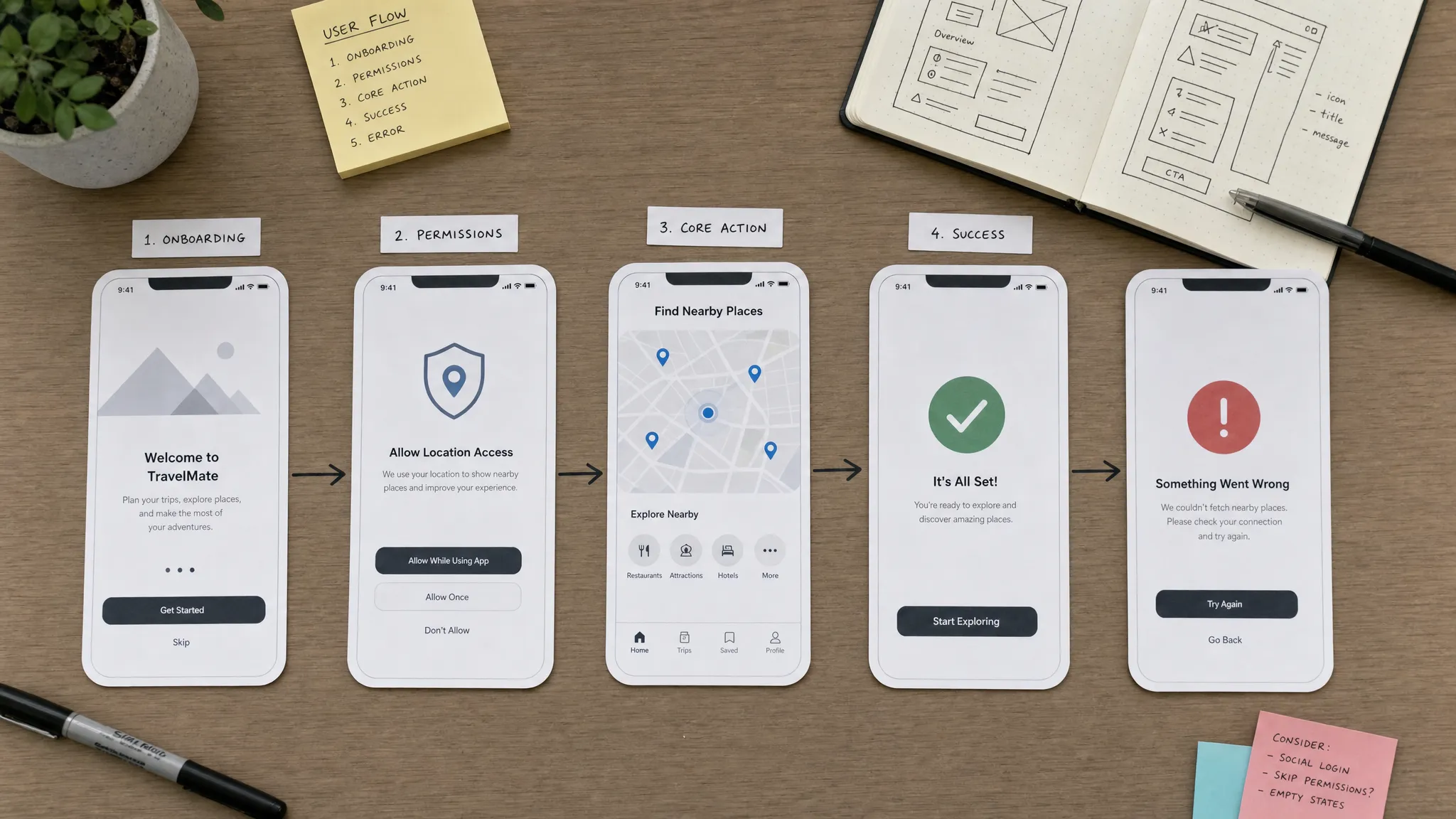
Mobile products succeed or fail in flows. A screen may look excellent in isolation, but the user experiences the app as a sequence of decisions, actions, confirmations, delays, errors, and returns.
A great app design agency should map the core journey before designing the full interface. For an MVP, this usually means identifying the smallest complete flow that delivers the app’s main promise. That flow might be booking a service, logging a workout, capturing a meeting, sending a payment, completing a delivery, or syncing field data back to a CRM.
The flow should include more than the happy path. Real mobile products need empty states, loading states, permission prompts, weak-network behavior, account recovery, error handling, and confirmation moments. These details are not design extras. They are what make an app feel reliable.
If your team is still shaping the primary journey, Appzay’s guide on how to design an app with clear user flows breaks down how to map outcomes, decisions, edge states, and metrics before engineering begins.
Prototypes should test risk, not just impress stakeholders
Interactive prototypes are powerful, but only when they are used for the right reasons. A prototype should not exist merely to make the pitch deck look more advanced. It should answer specific questions that could change the product direction.
For example, a prototype can test whether users understand onboarding, whether a multi-step form feels too long, whether a map interaction is clear, whether an AI response needs explanation, or whether a checkout flow creates trust. The agency should be able to say which risk each prototype is designed to reduce.
A strong prototype does not need every screen in the future product. It needs enough fidelity to test the moments where users may hesitate, misunderstand, or abandon the app. In many cases, a focused prototype saves weeks of rework because it exposes flawed assumptions before code is written.
This is especially important for funded startups under pressure to move fast. Speed is not just about starting development quickly. It is about avoiding the wrong build.
They involve engineering early
A great mobile app design process is not separated from engineering. Designers and engineers should collaborate before the final handoff, not after.
Early engineering involvement helps answer practical questions: Can this interaction perform well on older devices? Does this flow require offline support? Should sensitive logic live on the backend? Which permissions will trigger App Store scrutiny? Is native development required for this feature, or can a cross-platform approach support it well?
This collaboration protects both the design and the budget. It also prevents the common agency handoff problem where the design looks impressive, but developers must reinterpret half of it during implementation.
Expect a build-ready handoff to include:
- Annotated screens with behavior notes and acceptance criteria
- Core flow maps that show happy paths and edge cases
- Design system components, including typography, spacing, colors, buttons, inputs, and states
- Platform-specific guidance for iOS and Android patterns
- Accessibility notes for contrast, touch targets, text scaling, and screen reader behavior
- Asset exports and icon rules
- Analytics event recommendations tied to activation and retention
- Technical questions or assumptions that engineering must resolve before build
If screen planning is a current bottleneck, Appzay’s article on app screens planning explains how wireframes, state variants, and annotations can prevent costly development delays.
Great UI design builds trust, not just polish
Visual quality matters, especially for premium mobile apps. Users make trust judgments quickly, and sloppy UI can make even a strong idea feel unfinished. But great UI is not decoration. It is communication.
A strong app design agency should create an interface that makes hierarchy obvious, reduces cognitive load, and supports confident action. Users should know where they are, what just happened, what to do next, and how to recover if something goes wrong.
Trust-building design often shows up in small details: clear microcopy, visible progress, predictable navigation, helpful confirmations, understandable permission requests, and transparent privacy cues. For apps involving payments, health data, AI outputs, enterprise workflows, or personal information, these details can directly affect conversion and retention.
The agency should also design for accessibility from the start. Accessible design is not just a compliance checkbox. Larger touch targets, readable contrast, scalable text, clear labels, and predictable focus order make the product easier for everyone to use.
Appzay’s guide on how to design a mobile application users love goes deeper into first value, product loops, accessibility, performance, trust, and user-centered iteration.
They think about launch before development begins
A great app design agency understands that mobile design continues into launch readiness. The App Store and Google Play do not evaluate only code. They also evaluate claims, metadata, permissions, account flows, subscriptions, privacy disclosures, and whether the app behaves as expected.
Design decisions can affect review risk. For example, if the app asks for location access, the UX must explain why. If the app uses subscriptions, the paywall must be clear. If the app has user-generated content, reporting and moderation flows may be required. If the app uses AI, users may need transparency around generated outputs and limitations.
Launch-aware design also improves store conversion. Screenshots, preview flows, onboarding, value propositions, and in-app moments should tell a consistent story. If the App Store listing promises one thing and the first session delivers another, downloads may not translate into activated users.
A strong partner will consider store readiness, analytics, support flows, and post-launch iteration while the product is still being designed. For a broader view of what this looks like across strategy, engineering, QA, and launch, see Appzay’s breakdown of end-to-end mobile app development services.
The working relationship should feel structured and candid
Good design work requires creativity, but the process should not feel vague. A professional app design agency should give you a clear operating rhythm, including regular reviews, decision points, open questions, and visible progress.
You should know what is being explored, what has been decided, what is blocked, and what tradeoffs are on the table. The agency should be comfortable explaining why a design decision was made and what evidence supports it. They should also be willing to push back when a requested feature weakens the product or adds complexity without improving the user outcome.
For founders, this candor is valuable. A great agency does not simply say yes to every idea. It helps you make sharper decisions with the budget and timeline you actually have.
Red flags when evaluating an app design agency
Not every design partner is prepared for a production mobile product. Some are excellent at branding or marketing sites but weak at app flows, platform behavior, and engineering handoff.
Watch for these warning signs:
- They jump into visual design before understanding the user journey, business model, and MVP goal.
- They present attractive screens but cannot explain activation, retention, or core user behavior.
- They avoid edge cases, empty states, error states, and permission flows.
- They do not involve engineers until after final design approval.
- They copy web patterns directly into mobile without adapting for thumb reach, performance, or platform expectations.
- They treat accessibility as optional.
- They promise a fixed outcome without discussing scope tradeoffs.
- They hand off Figma files without acceptance criteria, annotations, or component rules.
- They ignore App Store and Google Play implications until submission week.
A red flag does not always mean the agency is bad. It may mean they are not the right fit for a funded startup building a serious iOS and Android product.
A simple scorecard for choosing the right partner
When comparing agencies, use a structured scorecard instead of relying on portfolio taste alone. Visual style is subjective. Delivery quality is not.
| Evaluation area | What to look for | Strong signal |
|---|---|---|
| Product strategy | Connects design to user behavior and business goals | Can explain the core product loop clearly |
| Mobile UX depth | Understands iOS, Android, gestures, permissions, and states | Shows flow-based case studies, not only static mockups |
| Prototyping | Uses prototypes to test risky moments | Defines what each prototype is meant to validate |
| Engineering collaboration | Designs with feasibility and handoff in mind | Involves technical reviewers early |
| Design system quality | Creates reusable components and state rules | Provides scalable patterns, not one-off screens |
| Launch awareness | Considers store review, ASO, analytics, and support | Designs onboarding, permissions, and store assets together |
| Communication | Makes decisions visible and tradeoffs explicit | Runs structured reviews with clear next steps |
If an agency scores well across these areas, they are more likely to produce design that survives contact with development, users, and launch.
Frequently Asked Questions
What does an app design agency do? An app design agency helps define the product experience, map user flows, create wireframes, design UI screens, build prototypes, prepare design systems, and hand off build-ready assets to engineers. A strong agency also connects design decisions to user behavior, business goals, and launch requirements.
How is an app design agency different from a general design studio? A general design studio may focus on branding, websites, or visual identity. An app design agency should understand mobile-specific UX, iOS and Android patterns, permissions, offline behavior, App Store expectations, performance constraints, and engineering handoff.
Should I hire a design-only agency or an end-to-end app partner? If you already have a strong internal engineering team, a design-only agency may work well. If you need strategy, UX, engineering, testing, deployment, and launch support, an end-to-end partner can reduce handoff risk and keep design decisions aligned with implementation.
What deliverables should I expect before development starts? Expect user flows, wireframes, prototypes for risky interactions, final UI screens, a design system, component states, accessibility notes, annotations, acceptance criteria, assets, and a handoff package that engineers can use without guessing.
How do I know if app designs are ready for development? Designs are ready when the core flow is complete, edge cases are defined, states are documented, components are reusable, platform-specific behavior is clear, analytics needs are identified, and engineers have reviewed the design for feasibility.
Build with a design partner who thinks beyond screens
A great app design agency should help you create more than a good-looking interface. It should help you define the right product, test risky moments, prepare for engineering, and launch with fewer surprises.
Appzay partners with funded startups to design, build, and launch premium iOS and Android apps end to end. From product strategy and UX design to native engineering, cloud integration, release orchestration, App Store optimization, and proactive support, the goal is to help founders move from concept to App Store with confidence.
If you are planning a mobile product and want a partner who can think like a technical co-founder, start the conversation with Appzay.