6/16/2026
How Funded Apps Go From Pitch Deck to App Store
Learn how funded apps move from pitch deck to App Store with a practical roadmap for strategy, UX, engineering, QA, launch, and iteration.
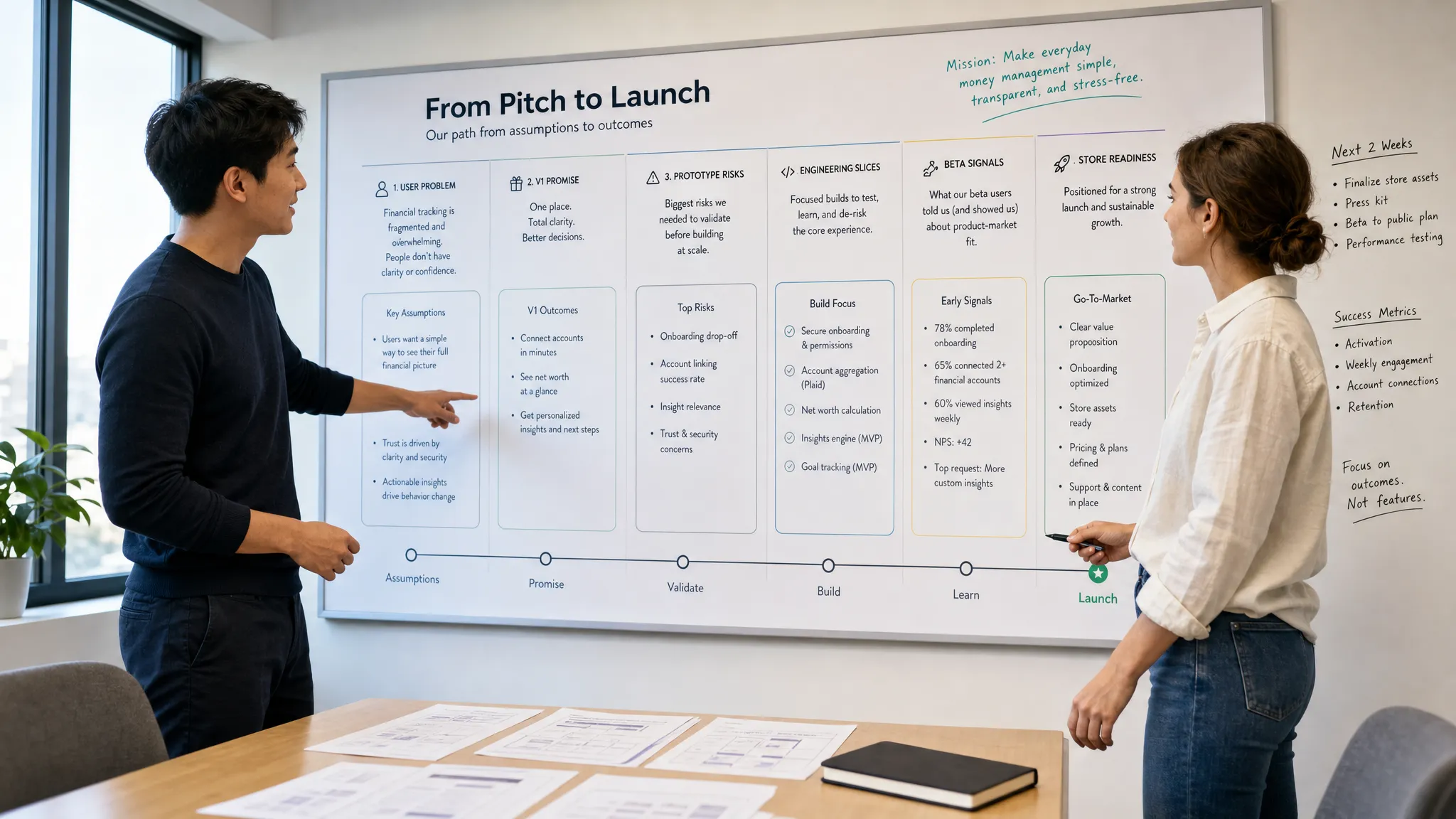
A pitch deck earns belief. A mobile app earns behavior. For funded founders, the move from pitch deck to App Store is the moment where narrative, scope, engineering, and launch operations have to become one execution system.
Funding changes the pressure. You now have a runway, investor milestones, early hires, customers waiting, and a sharper expectation that the product will prove a thesis. The biggest risk is not just building slowly. It is building an app that looks like the deck but fails to deliver the one user outcome that makes the business work.
The best funded apps treat the App Store launch as a product proof point, not a finish line. Here is how that journey typically works when teams want to ship a polished iOS and Android product without wasting the first budget.
Start by translating the pitch into product decisions
A pitch deck is designed to persuade. It simplifies the market, compresses the product vision, and makes the future feel inevitable. Development requires the opposite discipline: define constraints, reduce ambiguity, and decide what must be true in V1.
Before writing code, the team should convert each major part of the deck into a build artifact. This prevents the common founder mistake of asking engineers to interpret strategy from investor slides.
| Pitch deck element | Product translation | Launch-ready artifact |
|---|---|---|
| Problem slide | The painful moment the app must solve first | Primary user journey and MVP promise |
| Solution slide | The smallest complete workflow that proves value | Clickable prototype and acceptance criteria |
| Business model | Payments, subscriptions, credits, or lead flow | Monetization and compliance plan |
| Market slide | Scale, geography, and usage assumptions | Architecture and data model decisions |
| Go-to-market plan | Acquisition message and first user segment | Onboarding, ASO positioning, and analytics events |
| Funding milestones | Proof investors expect after launch | Release plan and post-launch metrics |
This translation step is where many funded apps either gain momentum or create hidden rework. If the deck says the product is AI-powered, real-time, marketplace-based, or enterprise-ready, those words must become specific technical and UX decisions.
For a deeper phase-by-phase view, Appzay also outlines a mobile application development roadmap for funded startups.
Define the V1 promise, not the V1 feature pile
Funded teams often have more ideas than time. Advisors suggest features. Investors ask about differentiation. Early customers request edge cases. The result can be a V1 roadmap that tries to prove everything at once.
A better question is: what is the smallest version that can make the company look right?
That does not mean shipping a thin demo. A funded app still needs credibility, performance, privacy, and a polished core experience. It does mean cutting anything that does not support the first proof point.
A strong V1 promise usually includes:
- A specific user segment, not everyone in the market
- One high-value job the app completes end to end
- A clear success metric, such as activation, repeat usage, booked meetings, completed orders, or qualified leads
- A narrow set of trust requirements, such as privacy, identity, payments, or data accuracy
- A post-launch learning plan for what to improve next
For example, a social fitness app might not need groups, challenges, creator tools, and nutrition plans in V1. It may need a fast onboarding flow, a habit loop, reliable activity tracking, and one sharing moment that drives referrals.
The goal is to launch the product that can create a real signal. Funded apps win by proving adoption, retention, or revenue fast enough to guide the next build cycle.
Prototype the risky moments before engineering
A beautiful mobile UI is not enough. The prototype should test the moments where users might hesitate, misunderstand, abandon, or distrust the product.
This is especially important for apps that involve money, personal data, location, AI output, health information, or marketplace interactions. Users do not just evaluate whether a screen looks modern. They evaluate whether the app feels safe, useful, and worth coming back to.
Good pre-code prototyping answers questions like:
- Can a first-time user understand the product promise in under a minute?
- Does the core action feel natural on a small screen?
- Are permission prompts timed only after users see value?
- Do empty, loading, and error states make the app feel reliable?
- Can the team explain every screen to engineering without guessing?
This stage should produce a screen map, user flows, component rules, copy, edge states, and acceptance criteria. If your team is still debating the core loop during sprint three, the build is already paying for decisions that should have happened in design.
Appzay expands on this in its guide to designing the app before writing code.
Choose the stack around the product risk
The right stack is not the trendiest framework. It is the one that fits the app's riskiest interaction, hiring plan, timeline, performance needs, and long-term roadmap.
Native iOS and Android can be the right call when the product depends on deep platform behavior, advanced performance, complex offline experiences, hardware access, or premium UX. Cross-platform can be effective when the product needs speed across both platforms, shares many flows, and does not depend heavily on platform-specific capabilities.
The backend deserves equal attention. Many funded apps fail later because the first version treats backend architecture as a shortcut instead of a product foundation. Authentication, data ownership, API contracts, background jobs, notifications, analytics, and admin workflows all influence the user experience.
Marketplace and listing products are a useful example. They need fast search, trustworthy detail pages, saved items, high-quality media, lead capture, and contact workflows that feel natural on mobile. A real estate experience such as a Dubai property platform with detailed listings and agent contact shows why search, comparison, media, and trust signals should be planned as core product architecture rather than decorative features.
| Technical decision | Why it matters before App Store launch |
|---|---|
| Native vs cross-platform | Affects performance, timeline, maintainability, and platform UX |
| API contract design | Prevents fragile dependencies between mobile and backend teams |
| Authentication model | Impacts privacy, onboarding, review readiness, and support |
| Offline and weak-network behavior | Protects the core journey in real-world conditions |
| Analytics events | Turns the launch into measurable product learning |
| Feature flags | Enables safer rollouts and faster iteration |
| CI/CD pipeline | Makes builds, testing, and releases repeatable |
This is where a technical co-founder mindset matters. The question is not just whether the app can be built. It is whether it can be launched, measured, maintained, and scaled without a rewrite after early traction.
Build vertical slices that prove the product works
Once strategy, UX, and architecture are clear, engineering should avoid a long phase where isolated screens are built without a working product loop. A better model is vertical slice delivery.
A vertical slice connects the user interface, business logic, backend, integrations, analytics, and error handling for one meaningful workflow. This lets founders test real progress early. It also exposes integration risks sooner than a screen-by-screen build.
For a funded startup, the first slices often include onboarding, the main value action, account handling, and one operational workflow. If the app involves payments, maps, AI, CRM sync, or real-time status, those risks should be spiked early rather than left until the end.
Modern mobile delivery should also include automated testing, code review, CI/CD, crash reporting, and environment management from the beginning. These practices are not enterprise ceremony. They are how small teams ship faster without turning every release into a fire drill.
Treat store readiness as a build requirement
App Store readiness is not a final-week task. Apple and Google review the product, metadata, permissions, account flows, payments, privacy disclosures, and technical stability. If store requirements are discovered late, they can trigger design changes, backend changes, legal review, or monetization changes at the worst possible time.
Funded apps should plan store readiness during product and engineering, especially around:
- Account creation, login, password reset, and account deletion
- Permission prompts for camera, microphone, contacts, photos, location, notifications, or health data
- In-app purchases, external payments, subscriptions, and digital goods
- Privacy disclosures and data collection explanations
- User-generated content, moderation, blocking, and reporting
- AI-generated outputs, safety constraints, and user expectations
- Demo credentials and reviewer notes for restricted apps
The simplest way to reduce review risk is to make the app understandable to a reviewer who has no context from your fundraising story. The app's listing, onboarding, permissions, and in-app behavior should all tell the same story.
If this is on your near-term roadmap, use a submission process like Appzay's App Store submission checklist before your first review attempt.
Run beta testing like a signal engine
Beta testing is not just a bug hunt. It is the first chance to see whether the product promise survives real devices, real networks, real users, and real impatience.
A strong beta program combines technical QA with product learning. Internal QA should cover device coverage, OS versions, permissions, weak networks, background behavior, edge states, and integrations. External beta users should be selected based on the first market segment, not general availability.
For funded apps, beta feedback should be tied to launch decisions. A founder should know which issues block launch, which issues can be patched after launch, and which requests belong in the post-launch roadmap.
Useful beta signals include activation completion, first value time, crash-free sessions, core action completion, repeated usage, support tickets, uninstall reasons, and qualitative comments. If users like the concept but do not complete the core action, the app is not ready for a confident launch.
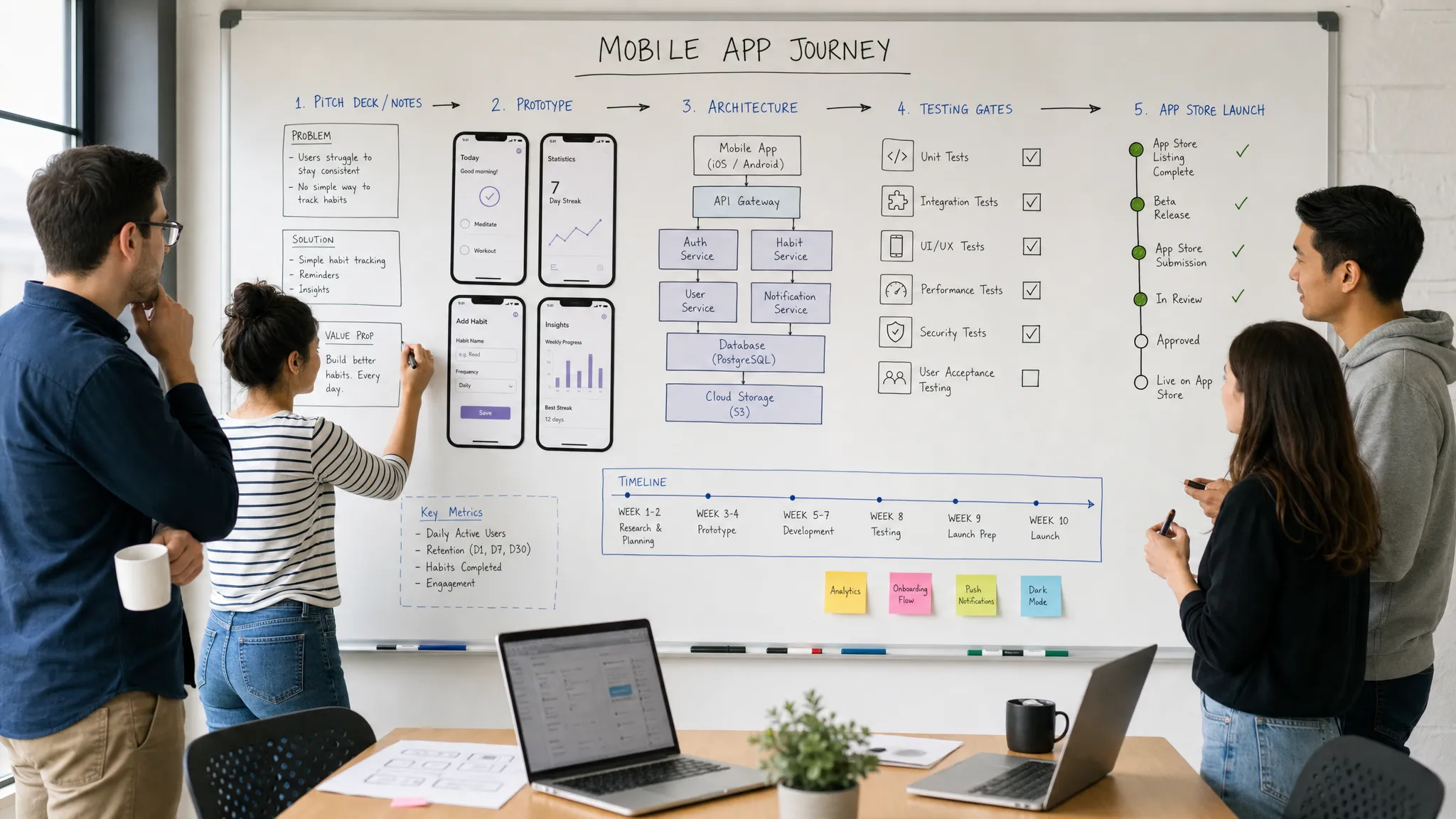
Prepare ASO before the app is live
Application Store Optimization starts before launch because the store listing is part of the product's first impression. The best listing does not just include keywords. It clarifies who the app is for, what outcome it creates, and why users should trust it.
Screenshots should not merely show interface art. They should explain the decision path a user takes before installing. The first screenshot should usually communicate the app's core value, while later screenshots can show workflow, trust, personalization, or proof points.
For funded startups, ASO should align with the investor narrative and the actual product experience. If marketing promises advanced automation but the app opens with a manual setup process, conversion and retention will suffer. If screenshots promote features that are hidden, incomplete, or unreliable, early reviews may damage momentum.
Appzay covers this broader discipline in application store optimization that drives more downloads.
Launch with control, not hope
A launch is a controlled release system. It should include staged rollout planning, monitoring, support ownership, incident response, and a first-week iteration plan.
The first 72 hours matter because store visibility, early reviews, press, investor updates, and customer conversations can all collide. Teams need to know who is watching crashes, who is answering support, who can approve hotfixes, and which metrics define a healthy release.
A practical launch plan should cover:
- Release ownership for product, engineering, QA, support, and marketing
- Store listing assets, reviewer notes, and compliance details
- Rollout percentage, geography, or invite strategy
- Monitoring for crashes, latency, API errors, and funnel drop-offs
- Support macros and escalation paths
- Hotfix process and rollback options where available
- First 7-day and first 30-day review cadence
The point is not to eliminate every surprise. The point is to make surprises observable and manageable. Appzay's mobile app launch checklist for 2026 can help teams structure this final push.
A realistic funded app timeline
Timelines depend on scope, integrations, compliance, team size, and the clarity of existing assets. Still, many focused funded MVPs can move from product definition to first public launch in roughly 8 to 16 weeks when the team makes fast decisions and avoids scope drift.
| Stage | Typical focus | Key output |
|---|---|---|
| Discovery | Product promise, users, risks, metrics | Product brief and prioritized scope |
| UX and prototype | Core flows, edge states, user testing | Build-ready designs and acceptance criteria |
| Architecture planning | Stack, backend, data, integrations | Technical blueprint and release plan |
| Engineering | Vertical slices, APIs, QA, CI/CD | Working iOS and Android builds |
| Beta and store prep | Real-device QA, feedback, listing assets | Release candidate and submission package |
| Launch and iteration | Rollout, monitoring, support, improvements | Stable public release and roadmap updates |
The fastest teams are not the ones that skip steps. They are the ones that make each step produce a decision, artifact, or tested assumption that reduces downstream rework.
Common mistakes that slow funded apps down
The most expensive mistakes usually feel reasonable in the moment. A founder says yes to one more investor-requested feature. A team delays analytics until after launch. A designer creates beautiful flows without backend constraints. An engineer starts building before the account model is clear.
Watch for these patterns:
- Building the pitch deck demo instead of the launchable product
- Treating MVP as a feature buffet rather than a proof point
- Choosing a stack based only on speed, not product risk
- Leaving store compliance, payments, or privacy until the end
- Shipping without instrumentation for activation, retention, and failures
- Underestimating admin tools, support workflows, and content operations
- Planning a launch date but not a release process
Funded apps are judged by outcomes, not effort. Every decision should protect the path to a reliable first release and a sharper next iteration.
What founders should bring to the build partner
A great app development partner can help shape strategy, UX, architecture, engineering, and launch. But founders still need to bring clarity about the business.
Before engaging a build team, prepare a concise product brief. It should explain the target user, the painful moment, the desired business outcome, the must-have integrations, key competitors, brand expectations, and any investor commitments tied to delivery.
You do not need to have every screen figured out. You do need to be ready to make decisions quickly. Funded apps lose time when product ownership is unclear, when every question requires a committee, or when new stakeholders rewrite priorities mid-build.
Frequently Asked Questions
How long does it take to go from pitch deck to App Store? A focused funded MVP often takes about 8 to 16 weeks from discovery to first launch, depending on scope, integrations, compliance needs, and decision speed. Complex products with real-time systems, regulated data, payments, or AI workflows may need longer.
Should funded apps build native or cross-platform? It depends on the product's riskiest interaction. Native is often better for performance-heavy, platform-specific, or premium UX products. Cross-platform can work well for many MVPs that need speed across iOS and Android with shared flows.
What should be validated before development starts? Validate the target user, core job, mobile fit, willingness to use or pay, and the smallest workflow that proves value. You should also prototype risky moments such as onboarding, permissions, payments, AI output, or marketplace trust.
When should App Store Optimization start? ASO should start before submission. Positioning, screenshots, descriptions, keywords, privacy messaging, and review strategy should align with the product experience before the app goes live.
What is the biggest risk for funded apps after launch? The biggest risk is launching without enough instrumentation to learn. If you cannot see activation, retention, failures, crashes, and user behavior by release version, it becomes difficult to decide what to fix or build next.
Turn your pitch deck into a store-ready mobile product
A funded app needs more than development capacity. It needs product judgment, mobile UX, scalable architecture, disciplined engineering, release orchestration, App Store readiness, and post-launch support working together.
Appzay partners with founders to design, build, and launch premium iOS and Android apps from concept to App Store. If you are ready to turn a funded idea into a polished mobile product, talk to Appzay about your roadmap, risks, and launch goals.