4/10/2026
Mobile Application Development Roadmap for Funded Startups
Mobile application development roadmap for funded startups: phases, timelines, deliverables, and launch checklists to ship an MVP faster with less risk.
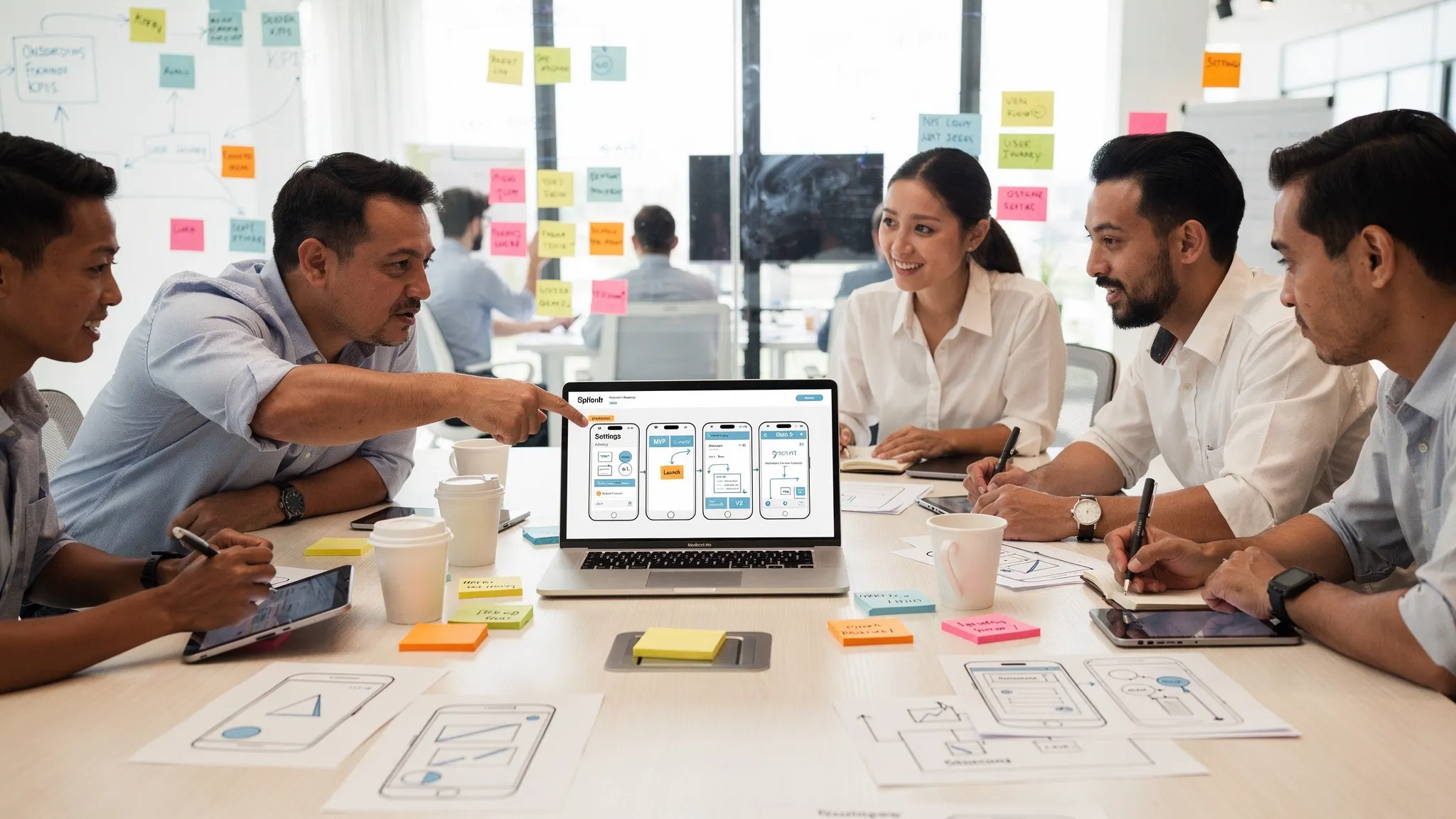
Fundraising turns “Should we build an app?” into “How fast can we ship a real product without painting ourselves into a corner?” The right roadmap for mobile application development helps funded startups move quickly, keep scope under control, and still set up a foundation that can scale when growth hits.
This guide lays out a practical, founder-friendly roadmap from concept to App Store and Google Play, including decision points, typical deliverables, timelines, and the most common failure modes to avoid.
What changes once you are funded
A funded startup is in a unique position. You can invest in quality, but you also face higher expectations from investors, early customers, and future hires.
In practice, funding usually increases the stakes in four areas:
- Speed with accountability: shipping matters, but missed dates and unstable releases now have real opportunity costs.
- Product clarity: you need a crisp MVP definition that connects directly to a business outcome (retention, revenue, or activation), not just a feature list.
- Scalability planning: not “premature optimization,” but enough architectural foresight to avoid expensive rewrites.
- Operational readiness: analytics, crash reporting, security, and release processes need to exist from day one, not after launch.
The mobile application development roadmap (overview)
A strong roadmap balances product, design, engineering, and go-to-market. Most funded teams benefit from thinking in phases with clear exit criteria.
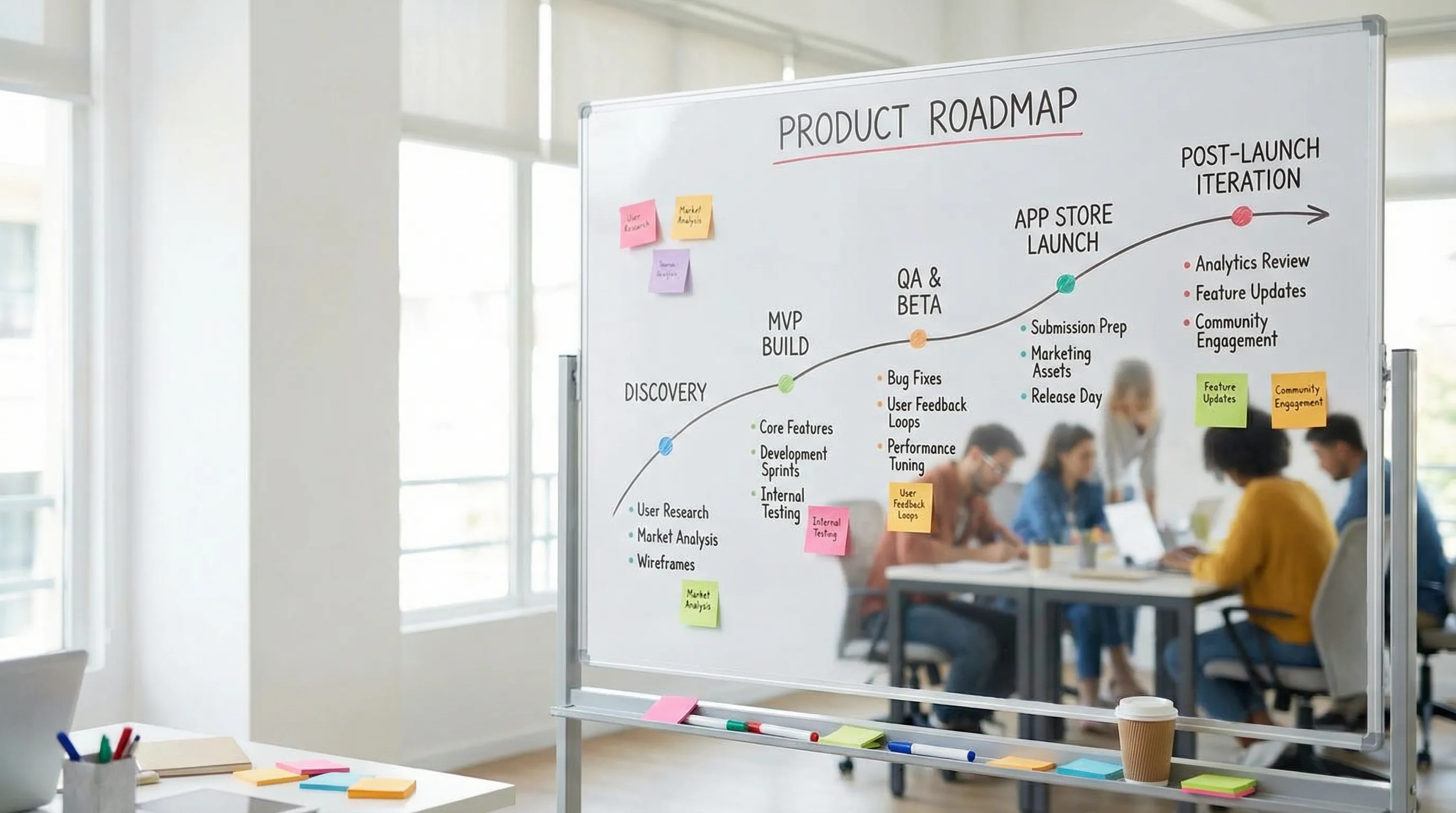
Typical phases at a glance
| Phase | Primary goal | Key outputs (examples) |
|---|---|---|
| 1. Discovery and alignment | Decide what to build and why | PRD-lite, success metrics, user journeys, risk register |
| 2. UX and prototyping | Reduce product risk before code | Wireframes, clickable prototype, design system basics |
| 3. Architecture and planning | Build the right foundation | Tech choices, data model, API plan, CI/CD plan |
| 4. MVP implementation | Ship a usable product | iOS/Android app, backend services, analytics, tests |
| 5. QA, beta, store readiness | Validate and harden | Test plans, beta builds, store listings, compliance checks |
| 6. Launch and iteration | Improve what matters | Release cadence, metrics review, backlog, scaling plan |
Your exact timeline depends on scope and complexity, but for many funded startups, a first MVP launch often lands in the 8 to 16 week range when scope is disciplined.
Phase 1: Discovery and alignment (1 to 2 weeks)
Discovery is where you “buy speed” later. The goal is not a huge document, it is shared clarity.
Key decisions to make early
Who is the user and what is the moment of value? The best MVPs identify a single, repeatable “aha” moment and build backward.
What is in the MVP, and what is explicitly out? Funded teams often lose time by keeping too many “nice to haves” emotionally in scope.
What does success look like in the first 30 to 90 days? Examples: activation rate, weekly retention, conversion to paid, cost per acquisition.
Discovery deliverables that keep teams aligned
- A lightweight product brief (problem, audience, differentiator)
- Core user journeys (happy path plus the top edge cases)
- Initial KPI targets and analytics plan
- A technical risk list (performance, offline needs, security, integrations)
If you are building anything involving sensitive data, start security thinking here. OWASP’s Mobile Application Security Verification Standard (MASVS) is a widely used baseline for what “good” can look like.
Phase 2: UX, prototyping, and UX validation (1 to 3 weeks)
Design is not just UI. For startups, it is risk reduction.
What “good” looks like in this phase
A clickable prototype that proves the flow: before you build, you should be able to test the onboarding, the primary workflow, and the main conversion action.
A small design system: typography, color, spacing, buttons, form states. This prevents inconsistent screens and speeds up future work.
Platform conventions respected: it is faster to meet user expectations than to retrain them. Apple’s Human Interface Guidelines and Google’s Material Design guidance are practical references.
A practical UX scope for an MVP
Keep design focused on:
- Onboarding and permissions (location, notifications, camera, etc.)
- Primary workflow screens
- Empty states and error states
- Basic settings and account flows
Phase 3: Architecture and delivery planning (1 to 2 weeks)
This phase prevents the two classic startup problems: a slow, fragile app, or an overbuilt system that never ships.
Mobile tech approach: native vs cross-platform
The “right” answer depends on your constraints.
| Option | When it fits best | Tradeoffs |
|---|---|---|
| Native iOS + native Android | Platform-specific UX, heavy device integrations, long-term flexibility | Two codebases, higher staffing needs |
| Cross-platform (for example, React Native) | Speed to market, shared UI, single product team | Some platform-specific work remains, performance tuning may be needed |
If you want to see how a cross-platform approach can work at scale, Appzay has examples in its portfolio, including OnMyWay (high-scale background GPS use cases) and the Dallas Mavericks app (real-time fan experience).
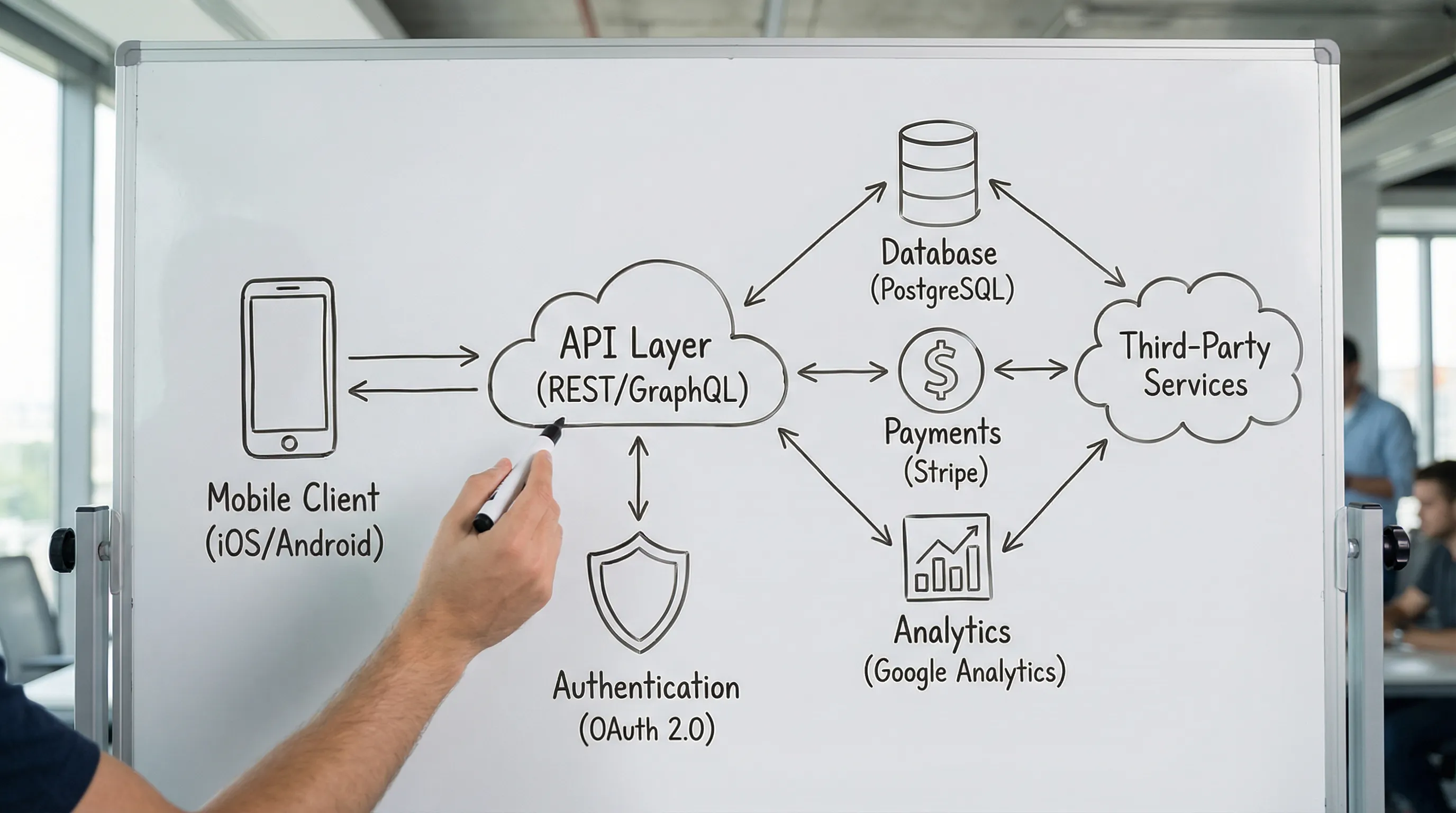
Backend and infrastructure: plan for “first scale,” not “infinite scale”
Funded startups should avoid two extremes:
- Building a single server with no observability, then scrambling when traffic spikes
- Designing a complex microservices ecosystem before product-market fit
A practical middle ground is a modular backend, clear API boundaries, and solid operational fundamentals: logging, monitoring, and a deployment pipeline.
CI/CD and release orchestration
Even an MVP should not rely on manual, one-off releases. A simple, repeatable pipeline reduces risk, especially when investor or partner demos are frequent.
At minimum, plan for:
- Automated builds
- Environment separation (dev, staging, production)
- Release notes and versioning discipline
- Rollback strategy for backend changes
Phase 4: MVP implementation (4 to 10 weeks)
This is where most time goes, and where scope control matters most.
Build in vertical slices
Instead of “finish all screens, then connect the backend,” build end-to-end slices:
- One user journey, fully working
- Instrumented with analytics
- Tested and reviewable
This reveals real integration issues early (auth, latency, data shape mismatches) and makes progress visible.
Engineering practices that pay off immediately
Test-driven or test-first where it matters: especially for business logic, fraud prevention, billing, and critical flows.
Performance budgets: define acceptable app start time, API latency targets, and crash-free thresholds.
Analytics and crash reporting from the first build: otherwise you launch blind.
Common MVP scope traps
- Too many roles and permissions before you have real users
- Multi-language, multi-region, and complex pricing on day one
- Custom CMS or admin tooling when a simple internal panel can do
- Overly complex offline mode (only build offline where it is core to value)
Phase 5: QA, beta, and store readiness (1 to 3 weeks)
A funded startup should treat launch readiness as a feature.
QA that matches real risk
Cover:
- Core flows (signup, login, purchase, primary action)
- Device coverage (common screen sizes and OS versions)
- Network variability (slow connections, timeouts, airplane mode)
- Accessibility basics (contrast, text scaling, VoiceOver or TalkBack)
App Store and Google Play requirements
Store review issues can delay launch, so address them early:
- Apple’s App Store Review Guidelines
- Google Play’s Developer Policy Center
If your app collects location, health, or other sensitive data, be especially careful with disclosures, permission prompts, and your privacy policy.
Beta testing
Use TestFlight (iOS) and Play testing tracks (Android) to validate:
- Onboarding completion rate
- Crash rate and top crash paths
- Latency hotspots and slow screens
- Confusing UX points based on user recordings or feedback
Phase 6: Launch, measure, iterate (ongoing)
Launch is the beginning of product truth.
Define a post-launch operating cadence
A simple cadence keeps teams focused:
- Weekly metric review (activation, retention, conversion)
- Biweekly release train (or a consistent rhythm your team can sustain)
- Monthly roadmap review tied to measurable outcomes
ASO basics you should not skip
Even for early traction, good store presence matters:
- Clear value proposition in the first two lines of the description
- High-signal screenshots showing the primary workflow
- A keyword strategy aligned with how users search (not internal feature names)
- Review prompts timed after value is delivered (not immediately after signup)
A realistic timeline for funded startups
Below is a common timeline pattern when the startup has a clear MVP and can make decisions quickly.
| Workstream | Typical duration | What can extend it |
|---|---|---|
| Discovery and scope | 1 to 2 weeks | Unclear MVP, too many stakeholders |
| UX + prototype | 1 to 3 weeks | Frequent direction changes, complex user roles |
| Architecture + planning | 1 to 2 weeks | Heavy integrations, strict compliance needs |
| MVP build | 4 to 10 weeks | Offline-first requirements, payments, complex media |
| QA + beta + store submission | 1 to 3 weeks | Store review rejections, device-specific bugs |
Risk checklist: what typically breaks funded mobile projects
The fastest way to protect timeline is to name the risks up front.
| Risk | What it looks like | Mitigation that works |
|---|---|---|
| MVP scope creep | “Just one more feature” every week | Lock an MVP definition, timebox iterations |
| Unclear ownership | Decisions stall, rework increases | Single DRI per domain (product, design, engineering) |
| No release discipline | Hotfix chaos, unstable demos | CI/CD, staging gates, release checklist |
| Weak observability | Users complain, team cannot reproduce | Crash reporting, structured logs, analytics events |
| Security and privacy late | Store rejection, legal exposure | MASVS-aligned checklist, permission and data audits |
What to prepare before you hire an agency (or build a team)
To get accurate estimates and reduce back-and-forth, bring:
- A one-paragraph product positioning statement
- The primary user journey (even as rough notes)
- The list of must-have integrations (payments, maps, CRM, ticketing, ads)
- Any constraints (launch date, regions, compliance, offline needs)
If you do not have these yet, that is normal. A good discovery phase exists to create them.
Frequently Asked Questions
How long does mobile application development take for a funded startup? Most funded startups can reach an MVP in 8 to 16 weeks if scope is tight, decisions are fast, and the team uses a repeatable release process.
Should we build native iOS and Android apps or use cross-platform? Cross-platform can be faster for many MVPs, while native can be better for highly platform-specific experiences or intensive device integrations. The best choice depends on performance, hiring, and timeline constraints.
What should be included in an MVP for a mobile app? An MVP should include only the flows required to deliver the core value, plus analytics, crash reporting, and basic security and privacy fundamentals. Everything else should be staged for later.
How do we avoid App Store and Google Play launch delays? Plan store requirements early, implement clear permission disclosures, test on real devices, and review Apple and Google policies before submission. Many delays come from privacy and compliance issues found too late.
Build your roadmap with an end-to-end delivery partner
If you are a funded founder and want a team that can take you from concept to App Store with a premium, engineering-first approach, Appzay provides end-to-end mobile app development, including product strategy, UX, iOS and Android engineering, distributed systems architecture, CI/CD, and proactive maintenance.
Explore Appzay at Appzay and, if it is helpful to see relevant builds, review the portfolio examples for OnMyWay and the Dallas Mavericks app.