6/27/2026
What a React Native Development Agency Should Deliver
Learn what a React Native development agency should deliver, from strategy and UX to architecture, launch readiness, and post-release support.
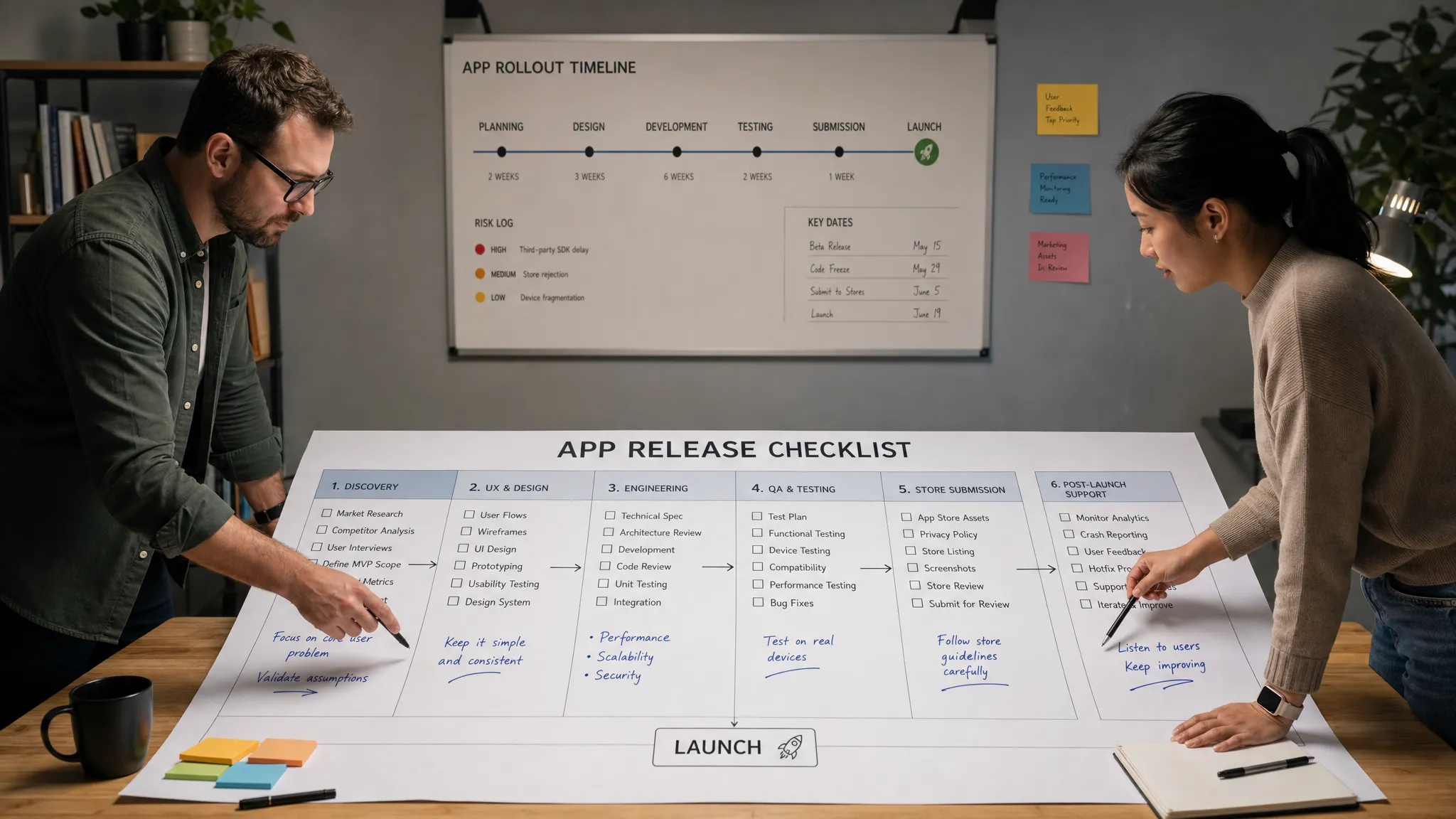
Hiring a React Native development agency is not just a way to get one codebase for iOS and Android. For a funded startup, it is a decision about speed, product quality, technical risk, and whether your team can learn from real users before the market window closes.
The right agency should deliver more than tickets completed or screens implemented. It should give you a clear path from product idea to App Store release, with enough strategy, engineering discipline, and launch support to make the app viable after version one.
That distinction matters. React Native can shorten development timelines, but it does not automatically create a maintainable product. Poor architecture, weak testing, unclear ownership, and rushed release processes can erase the advantage quickly. A strong agency knows how to use React Native to move faster without creating a fragile app that becomes expensive to change.
Below is what a React Native development agency should deliver if you are serious about building a mobile product that can scale.
A clear product strategy before development starts
A quality agency should not begin by asking only for a feature list. It should first understand the business model, user problem, acquisition strategy, operating constraints, and the assumptions that need to be validated.
For startups, the first version of an app is rarely about building everything. It is about building the right things in the right order. A React Native agency should help you separate the must-have workflows from the nice-to-have features, then translate that into a build plan with realistic sequencing.
The strategy phase should produce concrete decisions, not vague discovery notes. You should walk away with a shared understanding of who the app is for, what success looks like, what technical risks exist, and which features belong in the first release.
Useful strategy deliverables include:
- Product goals, user segments, and primary use cases
- MVP or version-one scope with clear exclusions
- Key user journeys and conversion points
- Technical risk assessment for platform-specific features
- Release roadmap with assumptions and dependencies
- Success metrics for launch and post-launch iteration
This is especially important for React Native because some requirements may influence the stack early. Heavy native integrations, complex animations, offline-first behavior, Bluetooth, background services, or real-time systems can all affect architectural decisions. A strong agency will raise those questions before development begins.
UX design that is ready for real engineering
Good app design is not just attractive screens. A React Native development agency should deliver user experience work that is detailed enough for engineers to build, test, and evolve.
That means mapping flows, edge cases, errors, loading states, empty states, permissions, onboarding, account creation, and recovery paths. The design should also consider the behavioral differences between iOS and Android users. React Native allows shared development, but users still expect each platform to feel familiar.
A polished Figma file is not enough if it ignores implementation complexity. The best agencies bring design and engineering together early, so UX decisions account for data models, API constraints, navigation patterns, accessibility, and performance.
For a deeper look at what separates strong design partners from surface-level UI vendors, Appzay's guide on what to expect from a great app design agency is a useful companion.
A strong UX delivery should include clickable prototypes, responsive layouts, component states, design tokens, and a practical design system that can grow with the product. This reduces ambiguity and prevents the common startup problem where design looks complete, but implementation reveals dozens of unanswered questions.
React Native architecture with explicit tradeoffs
A React Native agency should be able to explain the architecture it recommends in plain language. The point is not to impress you with tooling. The point is to show how the app will remain stable, performant, and adaptable as the roadmap expands.
React Native architecture decisions should not be copied from a generic template. They should match the product's expected complexity, team structure, budget, and timeline.
At minimum, the agency should clarify the following choices:
| Architecture decision | What the agency should explain | Why it matters |
|---|---|---|
| Expo or bare React Native | The tradeoffs around speed, native modules, updates, and control | This affects build workflow, integrations, and long-term flexibility |
| TypeScript structure | How types, modules, and shared utilities will be organized | Strong typing reduces defects as the app grows |
| Navigation approach | How flows, deep links, auth gates, and tabs will be handled | Navigation issues often become painful late in development |
| State management | What belongs in local state, server cache, global state, or persisted storage | Overcomplicated state creates bugs and slows iteration |
| Native integrations | Which features require native modules or platform-specific code | Not all mobile capabilities are equally simple in React Native |
| API and backend boundaries | How the app communicates with services, handles errors, and manages retries | Mobile reliability depends heavily on network behavior |
| Upgrade strategy | How the codebase will keep up with React Native releases | Neglected upgrades create security and maintenance debt |
React Native continues to evolve, including ongoing work around the framework's New Architecture. The official React Native documentation is the best source for understanding the framework direction, but your agency should translate those technical changes into practical product decisions.
If you want a more technical checklist, Appzay's article on React Native app development best practices for 2026 covers architecture, testing, CI/CD, observability, and maintainability in more depth.
Production-grade engineering, not just feature completion
A React Native development agency should deliver working software in a way that supports collaboration, quality, and future handoff. That includes clean code, sensible abstractions, code reviews, repeatable environments, automated checks, and predictable sprint delivery.
Founders often focus on visible progress, which is understandable. Screens, demos, and feature milestones are easier to judge than code quality. But the hidden engineering practices determine whether the app can keep moving after launch.
A production-grade engineering process should include testable user stories, pull request reviews, linting, formatting, unit tests where appropriate, integration tests for critical flows, and device testing on both iOS and Android. It should also include clear communication about tradeoffs. If a shortcut is taken to meet a date, you should know what debt was introduced and when it should be addressed.
Agile delivery should feel transparent, not chaotic. You should have access to sprint plans, backlog priorities, demo builds, known issues, and release status. The agency should be able to show progress through functioning increments, not just status updates.
Performance, reliability, and security built into the process
React Native apps can perform very well when they are built with discipline. They can also feel slow if teams ignore rendering patterns, image handling, unnecessary re-renders, startup time, memory usage, and device differences.
A serious agency should define performance expectations early and validate them throughout development. This is especially important for apps with media, maps, feeds, chat, financial workflows, marketplace browsing, or high-frequency interactions.
Performance and reliability work should cover startup time, navigation smoothness, API latency handling, offline states, crash monitoring, and graceful degradation when the network fails. Mobile users do not care whether an issue comes from the app, the backend, or the device. They experience it as one product.
Security should also be part of the delivery, not a final checklist. Authentication, session handling, secure storage, API communication, logging practices, permissions, and sensitive data exposure all need attention. The OWASP Mobile Application Security Verification Standard is a respected reference for mobile security expectations, and a qualified agency should be familiar with these principles.
Transparent deliverables at every milestone
One of the easiest ways to judge a React Native agency is to ask what you will receive at each phase. If the answer is only the app, the process is underdefined.
A strong agency should deliver artifacts that reduce uncertainty, make decisions visible, and help your company retain ownership. These deliverables are not bureaucracy. They are the operating system for building a product with fewer surprises.
| Phase | What the agency should deliver | What you should be able to verify |
|---|---|---|
| Discovery | Product brief, scope, risks, roadmap, assumptions | The team understands the business and can prioritize intelligently |
| UX and prototyping | User flows, wireframes, clickable prototype, design system | The app can be tested with stakeholders or users before full build |
| Technical planning | Architecture plan, stack decisions, integration map | The engineering choices match the product's complexity |
| Development | Working builds, reviewed code, sprint demos, backlog updates | Progress is visible and tied to agreed priorities |
| QA | Test plans, bug reports, device coverage, regression checks | The app works across realistic devices and scenarios |
| Release | Store assets, signing setup, build pipeline, submission support | The app is ready for Apple and Google review |
| Handoff | Repository access, documentation, credentials, runbooks | Your team can own, operate, and extend the product |
| Support | Maintenance plan, monitoring, issue triage, iteration backlog | The app can improve after launch rather than stall |

Launch readiness for the App Store and Google Play
A React Native development agency should understand that launch is its own discipline. Submitting an app is not the same as being ready to launch.
The agency should prepare store listings, screenshots, privacy details, permissions explanations, test accounts, release notes, build signing, and compliance requirements. It should also anticipate review issues based on platform guidelines. Apple's App Review Guidelines and Google's launch checklist for Android apps are essential references, but an experienced agency should turn those requirements into an operational release plan.
Launch readiness also includes internal distribution before public release. TestFlight, internal testing tracks, staged rollouts, feature flags, analytics validation, and crash monitoring can all help reduce launch risk. A good agency will avoid treating launch day as a cliff edge where everything happens at once.
App Store optimization should also be considered. This does not mean promising rankings, which no agency can honestly guarantee. It means preparing a store presence that clearly communicates value, uses relevant keywords naturally, presents strong screenshots, and supports conversion from store visit to install.
Handoff, ownership, and post-launch support
The best React Native agencies do not make clients dependent on them by hiding knowledge. They make the product easier to own.
You should have access to the source code, repositories, documentation, build credentials, deployment workflows, environment details, and key third-party accounts. If the relationship ends or your internal team grows, your company should be able to continue development without reverse-engineering the project.
Documentation should be practical. It should explain how to run the app locally, how environments are configured, how releases are made, where major decisions are documented, how integrations work, and what known technical debt exists.
Post-launch support is equally important. Apps need updates for operating system changes, dependency upgrades, device compatibility, performance tuning, bug fixes, user feedback, and roadmap iteration. A React Native development agency should have a plan for proactive maintenance, not just emergency fixes.
This is where premium partners separate themselves from build-only vendors. They think beyond the first submission and help founders create a product that can keep improving.
What founders should ask before signing
Before choosing an agency, ask questions that reveal how the team thinks. Portfolio quality matters, but process quality matters more once the project begins.
Strong questions include:
- How do you decide whether React Native is the right fit for this product?
- What architecture decisions will you make before development starts?
- How do you handle features that need native iOS or Android code?
- What testing is included before release?
- How will we receive builds and review progress during development?
- What documentation and ownership do we receive at handoff?
- How do you support the app after launch?
- What risks do you see in our roadmap, budget, or timeline?
The most useful answers will be specific. If an agency gives the same generic response to every question, that is a warning sign. A real partner should be able to discuss your product's constraints and explain where React Native helps, where it may require caution, and what tradeoffs should be made.
If you are comparing vendors now, Appzay's guide on how to evaluate a React Native mobile app development company can help you structure that decision beyond price and portfolio.
Red flags that an agency may underdeliver
Not every React Native agency operates at the same level. Some are strong at creating demos but weak at production delivery. Others can build features but struggle with product strategy, release operations, or long-term maintenance.
Watch for these warning signs:
| Red flag | Why it matters |
|---|---|
| They estimate immediately from a short feature list | The team may not understand flows, risks, or edge cases |
| They promise one codebase means no platform-specific work | Real mobile products often need iOS and Android nuance |
| They avoid discussing testing or CI/CD | Quality may depend on manual effort and luck |
| They cannot explain architecture choices clearly | The build may become hard to maintain |
| They treat App Store submission as an afterthought | Review delays and launch issues become more likely |
| They do not provide documentation or repository access | Your company may lack true ownership |
| They disappear after launch | The product may degrade as users, devices, and platforms change |
A good agency does not need to make everything sound easy. In fact, the best partners often identify hard problems early. That is not negativity. It is risk management.
The bottom line: delivery means reducing product risk
A React Native development agency should deliver more than a cross-platform app. It should deliver clarity, design quality, technical discipline, launch readiness, and long-term product ownership.
For founders, the key question is not simply whether an agency can build in React Native. Many teams can. The better question is whether they can help you make the right decisions before and during the build, then leave you with a product that is stable, scalable, and ready for iteration.
When React Native is used well, it can help startups move quickly across iOS and Android without compromising the user experience. But that outcome depends on the agency's process. Look for a partner that can connect strategy, UX, engineering, release orchestration, and post-launch support into one coherent delivery model.
Frequently Asked Questions
What should a React Native development agency deliver first? The first deliverable should be clarity. Before coding starts, the agency should provide a product strategy, scope definition, user flows, technical risk assessment, and a roadmap that explains what will be built, why it matters, and what tradeoffs are involved.
Is React Native always the best choice for a startup app? No. React Native is often a strong fit when a startup needs to launch on iOS and Android efficiently, but the decision depends on performance needs, native integrations, roadmap complexity, and team capabilities. A good agency should evaluate fit before recommending the stack.
How involved should founders be during development? Founders should stay closely involved in product decisions, sprint reviews, prioritization, and user feedback. The agency should own execution and technical guidance, but the product direction should remain aligned with the founder's market insight and business goals.
What happens after the app launches? After launch, the agency should help monitor stability, fix issues, respond to user feedback, update dependencies, support new OS versions, and plan product iterations. A mobile app is not finished at release. It enters a new phase of learning and improvement.
Build with a React Native partner that thinks beyond launch
If you are building a funded startup app, you need more than development capacity. You need a partner that can help shape the product, design the experience, engineer the app, prepare the release, and support the product as it grows.
Appzay partners with founders to design, build, and launch premium iOS and Android apps end-to-end, including product strategy, UX design, React Native and native mobile engineering, cloud integration, App Store optimization, and proactive support.