6/17/2026
How to Evaluate a React Native Mobile App Development Company
Learn how to evaluate a React Native mobile app development company for strategy, UX, engineering quality, launch readiness, and support.

React Native can be a smart way for a funded startup to reach iOS and Android users faster, but the framework does not remove the need for senior product thinking, careful architecture, and disciplined release management. In fact, the wrong partner can make React Native feel slow, fragile, or expensive even when the technology itself is a good fit.
That is why evaluating a React Native mobile app development company should go far beyond portfolio screenshots and hourly rates. You are not just hiring people to write JavaScript. You are choosing a team that will shape your product strategy, translate your roadmap into a maintainable mobile architecture, handle native edge cases, and help you ship through the App Store and Google Play without chaos.
The best evaluation process answers three questions:
- Can this company prove React Native is the right choice for our product?
- Can they build a scalable mobile app, not just an attractive MVP?
- Can they support the product after launch when real users, bugs, analytics, and roadmap tradeoffs appear?
Here is how to evaluate potential partners with the same level of rigor a technical co-founder or CTO would bring to the decision.
Start by testing their framework judgment
A strong React Native agency should not sell React Native as the answer to every mobile product. They should be able to explain when it is a high-leverage choice and when native iOS, native Android, or a different approach would be safer.
React Native is often attractive when you need a shared codebase, faster iteration, consistent product behavior across platforms, and a development team that can move efficiently across iOS and Android. It can be especially useful for marketplaces, SaaS companion apps, wellness apps, booking platforms, fintech interfaces, social products, and many startup MVPs where the core experience is built around data, workflows, accounts, messaging, payments, or content.
But React Native is not automatically ideal for every product. If your app depends heavily on advanced graphics, complex Bluetooth behavior, very low-latency interactions, unusually deep platform APIs, or highly specialized device integrations, your agency should surface those risks early. If they do not, that is a warning sign.
Before vendor calls, it helps to understand the technology fit yourself. Appzay has a detailed breakdown of React Native for mobile app development, including where it performs well and where founders should be cautious. You do not need to become an engineer, but you should be informed enough to recognize whether an agency is giving you thoughtful guidance or just repeating a sales pitch.
Evaluate the company like a long-term product partner
The right company should be able to move from ambiguity to shipped product. That means they need more than React Native developers. They need product strategy, UX design, backend thinking, release operations, testing discipline, and post-launch support.
A good first conversation should feel like a discovery session, not a quotation machine. The agency should ask about your target users, funding stage, launch timeline, revenue model, compliance needs, data sensitivity, roadmap, integrations, and product risks. If they jump directly to screens and estimates without understanding the business context, they may be treating your app as a task list rather than a product.
Use this scorecard to compare agencies consistently:
| Evaluation area | What to look for | Evidence to request |
|---|---|---|
| Product strategy | They challenge assumptions and help narrow the MVP | Discovery notes, product roadmapping examples, workshop process |
| React Native expertise | They understand performance, native modules, upgrades, and platform differences | Code samples, architecture walkthroughs, senior engineer access |
| UX and prototyping | They design mobile flows for real usage, not just polished static screens | Clickable prototypes, user journey maps, design system examples |
| Backend and cloud thinking | They can plan APIs, authentication, data models, and scale points | Architecture diagrams, integration examples, deployment process |
| Quality assurance | They use testing, code review, crash monitoring, and release checks | QA plan, test strategy, sample pull request workflow |
| Launch readiness | They understand App Store and Google Play submission requirements | Release checklist, ASO process, previous launch examples |
| Ownership and support | You retain access, documentation, and a maintainable codebase | Handoff plan, documentation samples, maintenance agreement |
For a broader technical lens, Appzay also explains how to compare mobile app development firms like a CTO, which is useful if you are evaluating multiple proposals that look similar on the surface.
Look for product strategy before pixel-perfect design
Many founders confuse app design with app development. A beautiful prototype is valuable, but it does not prove the company can make hard product decisions or ship a stable application.
A capable React Native partner should help you define the smallest credible version of the product. That does not mean building a weak MVP. It means identifying the core user journey that must work exceptionally well at launch, then pushing lower-priority features into later releases.
During evaluation, ask how they would approach scope reduction. Strong teams can explain tradeoffs clearly. For example, they may recommend launching with one payment flow instead of three, one onboarding path instead of several, or a simplified admin workflow until real usage patterns are clearer. Weak teams simply agree to everything, then let complexity show up later as missed deadlines or brittle code.
You should also ask how design decisions are validated before development starts. Interactive prototypes, user-flow reviews, technical feasibility checks, and early architecture discussions can prevent costly rework. This is especially important in React Native because one design choice can affect navigation structure, state management, animation performance, native dependencies, and API design.
Inspect their React Native engineering depth
React Native development quality varies dramatically. Two agencies can both claim React Native expertise, but one may build a maintainable product while the other creates a codebase that becomes painful after the first major release.
A serious React Native mobile app development company should be comfortable discussing architectural choices in plain language. You do not need to know every library or pattern, but you should hear evidence that they have opinions formed by real shipping experience.
Key engineering areas to investigate include:
- Architecture and modularity: The codebase should be organized so new features can be added without creating fragile dependencies across the entire app.
- TypeScript usage: Modern React Native teams often use TypeScript to reduce runtime errors and improve collaboration across the codebase.
- State management: The agency should choose state tools based on product complexity, not default to whatever is trendy.
- Navigation: Mobile navigation should account for deep links, authentication state, platform conventions, and future growth.
- Native module strategy: The team should know when to use existing libraries, when to write native code, and when a native-heavy feature changes the technical risk profile.
- Performance profiling: They should test startup time, list rendering, memory usage, animation smoothness, and network behavior on real devices.
- Upgrade planning: React Native moves quickly, so the codebase should be built with dependency maintenance and framework upgrades in mind.
One useful question is: What would make you recommend native iOS or Android instead of React Native for our product? A credible partner will answer honestly. They might still recommend React Native, but they should understand the boundary conditions. If you are still comparing technology options, Appzay’s guide to native app vs React Native can help frame that conversation.
Ask how they handle quality, testing, and releases
Speed is one of the reasons founders choose React Native, but speed without engineering discipline creates technical debt. A polished demo is not the same as a production-ready app.
Ask each company to describe its quality process from the first sprint through launch. You are looking for a workflow that includes code reviews, automated checks, regression testing, device testing, crash reporting, and structured release management. The details will vary by project, but the presence of a repeatable process matters.
A mature team should also talk about CI/CD and release orchestration. In practice, that means they can automate builds, manage environments, prepare staging versions, coordinate TestFlight and Google Play internal testing, and avoid last-minute release confusion. For funded startups, this is not a luxury. It protects investor timelines, launch campaigns, and user trust.
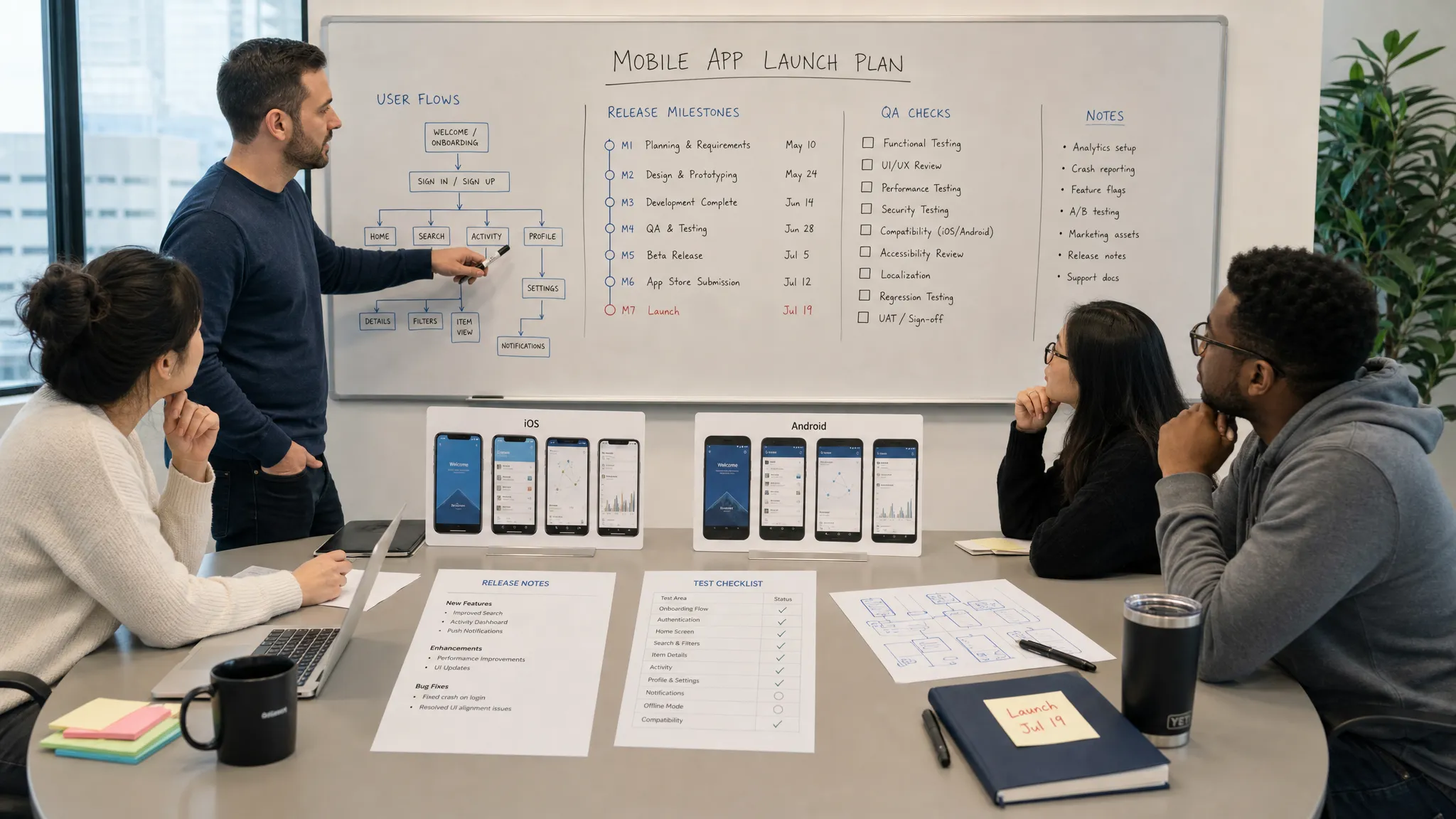
Do not be afraid to ask for artifacts. A good agency can show anonymized examples of release checklists, QA workflows, sprint boards, architecture diagrams, or pull request standards. If all they can show is final app screenshots, you still do not know how they work.
Review their launch and App Store experience
React Native app development does not end when the code compiles. Your agency should understand what it takes to launch on both major platforms.
A strong partner can help prepare app metadata, store assets, privacy details, permissions explanations, build signing, review submissions, and staged rollout plans. They should also understand that launch timing can be affected by app review, rejected builds, missing privacy disclosures, payment rule issues, or unclear feature descriptions.
Ask how they manage the final 10 percent of launch. This is where inexperienced teams often struggle. The app may appear finished, but account setup, push notification credentials, analytics, crash reporting, production API configuration, legal links, store screenshots, and release notes still need careful coordination.
If your app has a marketing or customer acquisition component, product and growth teams should align before launch. For example, a healthcare startup building a tool for practices may need the app experience, website, SEO, ads, and patient communication flows to work together. In that context, collaborating with a specialized partner such as a healthcare practice marketing agency can help connect the mobile product to the broader acquisition strategy.
Validate security, compliance, and data ownership
Security should not be treated as something to bolt on later. Even consumer apps often handle sensitive information such as location, payments, identity data, health details, private messages, or business records.
A qualified React Native company should ask what data the app collects, how users authenticate, how permissions are handled, how APIs are protected, and what happens if a device is lost or compromised. They should also have a clear view of backend security, not just client-side code.
For regulated industries such as healthcare, finance, insurance, and education, the evaluation should go deeper. The agency does not have to replace your legal or compliance advisors, but it should know when compliance requirements affect architecture, logging, data retention, third-party services, and access controls.
Ownership matters too. You should know who owns the source code, design files, app store accounts, cloud infrastructure, analytics accounts, and documentation. A premium development relationship should leave your company in control of its product assets.
Watch for proposal red flags
A proposal can reveal a lot about how a company thinks. Low detail, vague assumptions, and unrealistic timelines are often bigger risks than a higher price from a more disciplined team.
Common red flags include promises of guaranteed approval, fixed timelines without discovery, no discussion of backend architecture, no mention of testing, no plan for post-launch support, and resistance to code ownership or documentation. Another warning sign is a proposal that prices only the build while ignoring deployment, store submission, monitoring, and maintenance.
Also be cautious when an agency positions React Native as cheaper simply because it uses one codebase. React Native can reduce duplicated effort, but it still requires strong engineering, platform-specific QA, native dependency management, and careful product decisions. The real benefit is not cheapness. It is the ability to move quickly with a shared foundation while still delivering a high-quality mobile experience.
Ask these questions before signing
Use your evaluation calls to move beyond sales language. The best agencies will welcome detailed questions because they know informed clients make better product partners.
- Who will define the MVP scope, and how do you prevent feature creep?
- Which parts of our product create the most React Native risk?
- How do you decide between Expo, bare React Native, and native modules?
- What is your process for performance testing on real devices?
- How do you structure CI/CD, staging builds, and app releases?
- What testing is automated, and what testing is manual?
- How do you handle App Store and Google Play submission issues?
- What documentation will we receive at handoff?
- Who owns the code, accounts, infrastructure, and design files?
- What support is available after launch?
Pay attention not only to the answers, but also to the confidence and specificity behind them. Senior teams tend to explain tradeoffs. Less experienced teams tend to give simple assurances.
Choose the company that reduces product risk
The best React Native mobile app development company is not necessarily the one with the flashiest portfolio or the lowest estimate. It is the one that reduces uncertainty across product, design, engineering, launch, and growth.
For funded startups, the stakes are usually bigger than building version one. You need a product that can help validate the market, support investor conversations, onboard early users, and evolve after launch. That requires a partner who can operate like a technical co-founder, not just a vendor accepting tickets.
When comparing companies, look for a team that can explain why React Native fits your product, define a realistic MVP, design usable mobile flows, engineer for maintainability, manage releases, and stay involved after the first version reaches users. If a company can prove those capabilities before you sign, you are far more likely to get the speed benefits of React Native without sacrificing quality.
Frequently Asked Questions
How much technical knowledge do I need to evaluate a React Native agency? You do not need to be a developer, but you should understand the major risk areas: product fit, architecture, testing, native integrations, launch readiness, and ownership. A good agency will explain these topics clearly without hiding behind jargon.
Should I choose the cheapest React Native development company? Usually not. A low initial estimate can become expensive if the team underestimates complexity, skips testing, or creates a codebase that needs to be rebuilt. Compare proposals based on risk reduction, clarity, and long-term maintainability.
Is React Native good enough for a serious startup app? Yes, for many products. React Native can support high-quality startup apps when the product fit is right and the engineering team is experienced. The key is evaluating whether your specific app has performance, native API, or compliance requirements that change the recommendation.
What should be included in a React Native app proposal? A useful proposal should include discovery assumptions, scope, milestones, design process, engineering approach, backend responsibilities, QA plan, launch support, ownership terms, and post-launch maintenance options.
How do I know if an agency can support my app after launch? Ask about monitoring, crash triage, dependency updates, operating system updates, app store changes, roadmap planning, and response times. Post-launch support should be part of the conversation before development begins.
Build your React Native app with a partner that can ship
If you are evaluating agencies for a funded startup, Appzay can help you move from concept to App Store with product strategy, UX design, native iOS and Android engineering, cloud integration, release orchestration, and proactive support.
Bring your idea, constraints, and launch goals. Appzay will help you pressure-test the plan, choose the right mobile approach, and build a product designed for real users from day one.