4/22/2026
What a Premium Mobile App Development Agency Delivers
Learn what a premium mobile app development agency delivers, from strategy and UX to CI/CD, store launch, and post-launch support for startups.

Funded startups rarely fail because they cannot “build an app.” They fail because they ship the wrong thing, ship it too slowly, or ship something that breaks trust at the exact moment growth starts.
A premium mobile app development agency is built to reduce those risks. Not with buzzwords, but with clear deliverables: product decisions that hold up under scrutiny, design that earns retention, engineering that survives real traffic, and release operations that keep shipping predictable.
Below is what you should expect a premium partner to deliver (and what “premium” actually looks like in practice).
1) Product clarity, before code commits you to the wrong plan
A premium agency does not treat discovery as a formality. The goal is to prevent expensive rework by turning assumptions into decisions.
Typical premium discovery outputs include:
- A crisp definition of the primary user, primary job-to-be-done, and success metrics (activation, retention, conversion, or a single north-star metric).
- A versioned scope, with explicit “not now” decisions so V1 stays shippable.
- A technical feasibility pass for risky areas (background location, camera pipelines, offline mode, payments, realtime sync, etc.).
- A delivery plan that matches reality, including milestones, QA time, App Store review time, and integration dependencies.
When this is done well, founders get something more valuable than a document: they get constraints. Constraints make shipping possible.
| Discovery area | What “standard” often looks like | What “premium” looks like | Why it matters |
|---|---|---|---|
| Scope | Feature list | A prioritized V1, plus explicitly cut items | Protects timeline and budget |
| Requirements | Vague PRD | Testable acceptance criteria and edge cases | Prevents “done but not usable” |
| Risk | Addressed later | Risk register and early spikes | Avoids late surprises |
| Metrics | “We’ll add analytics” | Event plan tied to decisions | Lets you iterate with evidence |
2) UX that reduces time-to-value (and makes the app feel inevitable)
Premium UX is not “pretty screens.” It is a system that helps users succeed quickly, repeatedly.
You should expect:
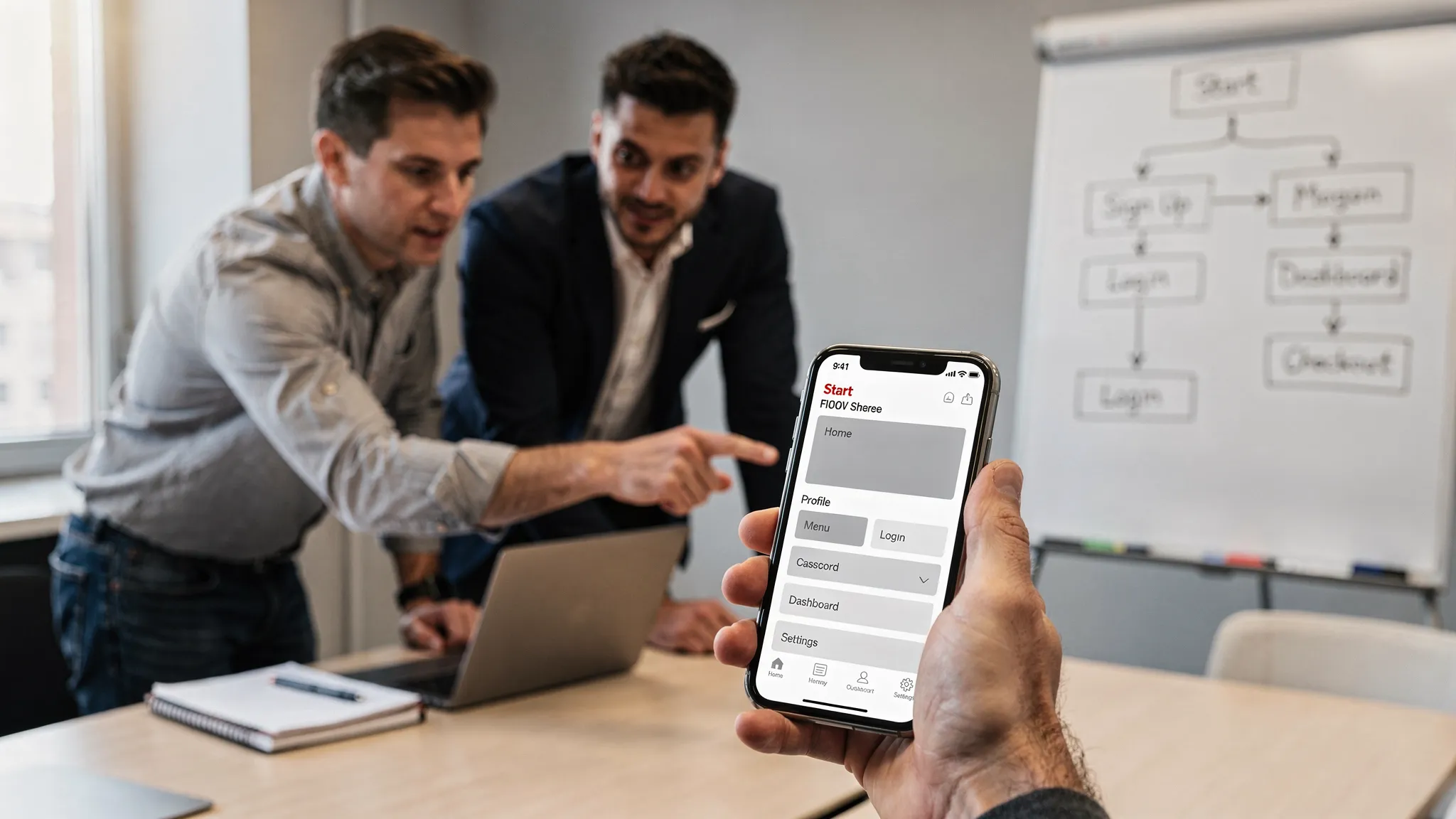
- Interactive prototyping that validates core flows before engineering locks them in.
- A UX approach that optimizes for time-to-value, not feature count.
- A design language that can scale (components, typography, spacing rules, and reusable patterns).
- Accessibility and platform conventions that prevent friction (Apple Human Interface Guidelines and Material Design patterns).
A good litmus test: the agency should be able to explain why a screen exists, what user action it drives, and how you will measure whether it works.
3) Technical strategy that matches your business, not the agency’s preferences
Premium teams earn trust by making tradeoffs explicit.
That includes:
- A clear recommendation on native iOS and Android vs cross-platform, tied to your constraints (performance, camera/media needs, offline requirements, platform-specific UX, team composition, timeline).
- A documented architecture approach that supports your likely next phase (new features, more developers, more traffic, or more compliance).
- Defined boundaries between app, backend, and third-party services so ownership is clear.
If you want a practical reference point for evaluating native vs cross-platform decisions, Appzay has a dedicated guide on when native mobile app development beats cross-platform.
4) Engineering quality you can feel, and measure
“Premium engineering” is not subjective. It shows up as fewer regressions, smoother releases, and faster iteration.
Expect a premium agency to deliver:
- A codebase structure that is understandable by the next team (including your future in-house hires).
- Automated testing where it counts, plus realistic device testing for the edges.
- Performance budgets for key interactions (startup time, scroll performance, media pipelines), with profiling when needed.
- Thoughtful data handling (offline caching, sync conflicts, background tasks) instead of fragile happy-path logic.
For teams building on React Native, quality hinges on architecture and release discipline as much as UI. A useful complement is Appzay’s guide to React Native app development best practices for 2026.
5) Release operations that make shipping routine (CI/CD, staging, rollouts)
Many “good” apps struggle at the finish line because release is treated as a manual, last-week scramble.
A premium agency typically delivers:
- CI/CD pipelines that produce repeatable builds.
- Environment separation (development, staging, production) and sane configuration management.
- Release checklists and ownership (who does what, when).
- A plan for staged rollouts, hotfixes, and versioning.
This matters because app businesses are not built in the first release. They are built in the 10 releases after that.
If you want the tactical details of store readiness, Apple’s App Review Guidelines and Google Play’s Developer Program Policies are worth skimming early, not the week you submit.
6) App Store readiness that includes policy, metadata, and reviewer empathy
A premium agency does not just “upload a build.” They help you clear the real blockers:
- Privacy disclosures, permission prompts, and purpose strings.
- Account deletion requirements (where applicable) and reviewer access.
- Subscription rules and paywall behavior.
- Accurate metadata, screenshots, and a listing that matches the in-app experience.
The difference is accountability. Premium teams treat App Store submission as a deliverable with a standard, not a gamble.
7) Security and privacy practices appropriate for 2026 expectations
Even if you are not in a regulated industry, users and platforms expect baseline protections.
A premium agency should help you make sensible calls on:
- Data minimization (collect less, retain less, reduce breach impact).
- Secure auth flows and session handling.
- Secrets management and safe logging.
- Dependency hygiene (especially in cross-platform stacks).
If you do operate in a regulated space, or your customers do, you may also need dedicated compliance workflows beyond engineering. Some teams complement development with an AI compliance automation platform like Naltilia to streamline evidence collection, risk assessment, and remediation tracking.
8) Production observability (so you can fix what users feel)
Premium delivery includes visibility into what happens after launch:
- Crash reporting and alerting.
- Performance monitoring (slow screens, network bottlenecks, ANRs).
- Analytics instrumentation aligned to product questions (not vanity events).
- Clear on-call or support processes for the first weeks after release.
This is what turns “we think users dropped off” into “we know the drop happens after step 2, on older devices, when network latency is high.”
9) Post-launch partnership: iteration, maintenance, and scaling
Shipping V1 is a milestone, not the finish line.
A premium mobile app development agency should be prepared to support:
- Rapid iteration cycles after launch (weekly or biweekly releases when appropriate).
- Ongoing OS updates (iOS and Android changes that can silently break behavior).
- Refactoring and performance work as usage grows.
- Cloud scaling and distributed systems needs when your backend becomes the bottleneck.
This is also where premium teams feel like technical co-founders: they can say, “This feature is expensive right now, here’s a smaller version that proves the value first.”
What “premium” looks like across the lifecycle (quick checklist)
Use the table below as a buyer’s checklist when comparing agencies. It focuses on tangible deliverables, not promises.
| Phase | Premium deliverables you should be able to ask for | Proof you can request |
|---|---|---|
| Discovery | V1 scope boundaries, risk register, milestones | Sample discovery outputs (redacted) |
| UX | Interactive prototype, component-based UI approach | Prototype walkthrough, design system snippet |
| Build | Architecture notes, code review process, testing approach | Example PRs, testing summary |
| Release | CI/CD overview, submission packet, rollout plan | CI screenshots, checklist, past release notes |
| Post-launch | Monitoring plan, maintenance cadence, ownership model | Incident process, support SLA discussion |
For a deeper, CTO-style evaluation framework, Appzay also published how to compare mobile app development firms like a CTO.
Common red flags (even when the portfolio looks good)
A premium agency can explain their work. Watch for these signals that you may be buying “output” instead of outcomes:
- They cannot articulate tradeoffs, only preferences (“We always use X”).
- They avoid talking about testing, CI/CD, or release ownership.
- Discovery is rushed, or they push you straight into a build without validating core flows.
- They optimize for feature count, not time-to-value.
- They cannot describe how they will measure success after launch.
Frequently Asked Questions
Is a premium mobile app development agency only for large companies? No. Premium is often most valuable for funded startups because mistakes are amplified by speed. The cost of rework, delays, and shaky launches is usually higher than the cost of doing it right.
What deliverables should I insist on before development starts? At minimum, a V1 scope with explicit exclusions, an interactive prototype of core flows, and a risk register that calls out technical unknowns (and how you will de-risk them).
How do I verify engineering quality without being technical? Ask for examples of past PRs (redacted), their testing strategy, how releases are automated, and what happens when a production issue appears. The clarity of their answers is the signal.
Do premium agencies only build native apps? Not necessarily. A premium team can deliver high quality with native or cross-platform, but they should justify the choice based on performance needs, platform surface area, and long-term maintenance.
What should post-launch support include? At least crash monitoring, a triage process, OS update readiness, and an agreed cadence for maintenance and iteration. The first 30 to 60 days after launch usually require the most attention.
Build with a premium partner that ships, launches, and supports
If you are turning a funded idea into a real iOS and Android product, the safest path is a partner that owns the whole lifecycle, from product strategy and UX through engineering, CI/CD, and store launch.
Appzay is a premium, end-to-end mobile app development agency that partners with founders to design, build, and launch high-quality apps. Explore how Appzay works at appzay.com.