6/28/2026
Mobile App Development Strategy for Faster Launches
Build a mobile app development strategy that cuts launch time, protects quality, and helps funded startups reach iOS and Android users faster.
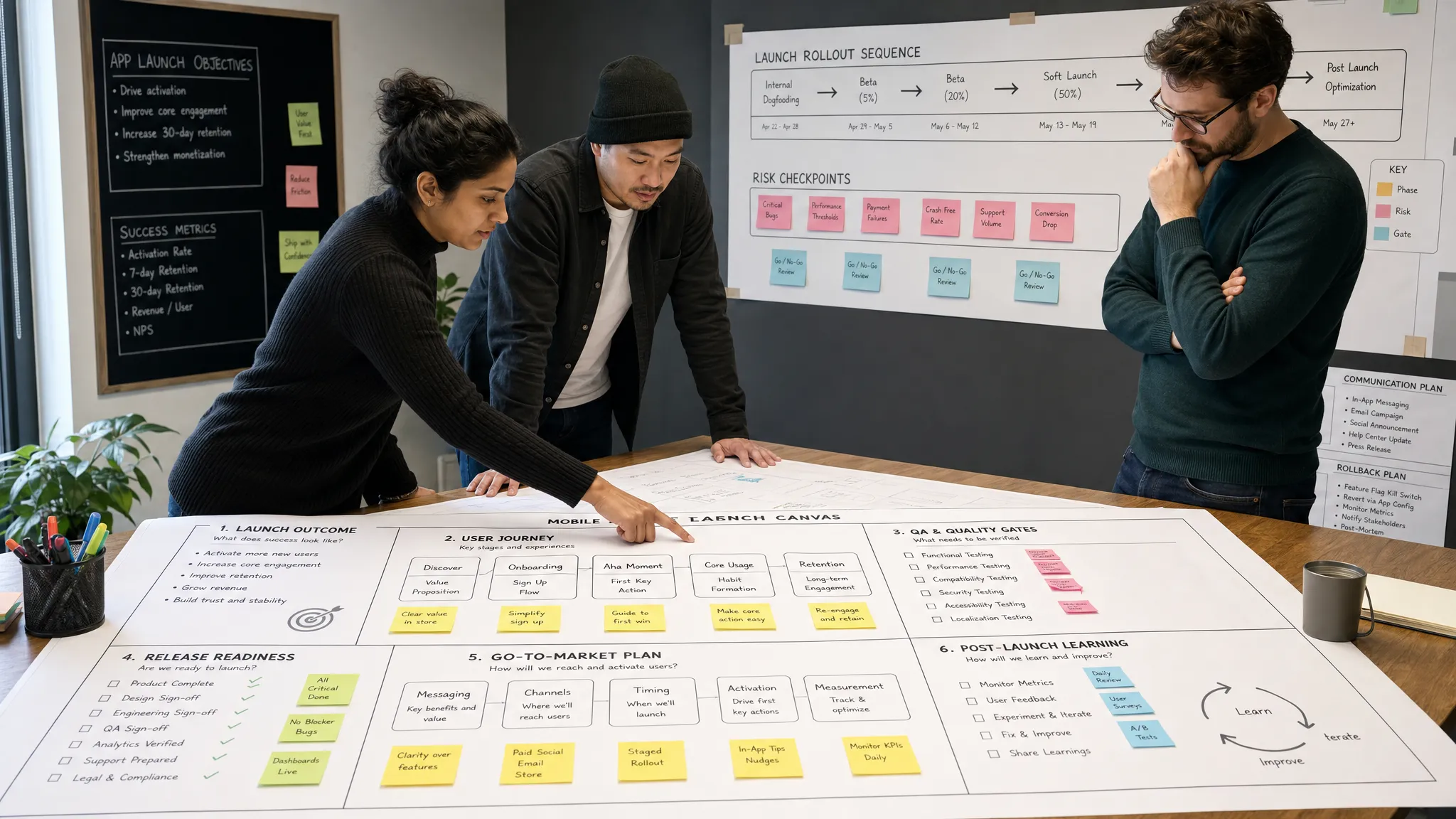
A faster mobile launch rarely comes from asking engineers to “move quicker.” It comes from making fewer late decisions, validating the riskiest assumptions earlier, and aligning product, design, engineering, QA, and release work around the same outcome.
That is what a strong mobile app development strategy does. It turns a funded startup’s idea into a sequence of decisions that reduce rework, protect quality, and get a useful iOS and Android product into users’ hands sooner.
For founders, the goal is not simply to ship fast. The goal is to launch fast enough to learn, raise confidence, and capture market timing without creating technical debt that slows every release afterward.
Start with the launch outcome, not the feature list
Many app timelines expand because teams begin with a backlog instead of a launch outcome. A backlog answers, “What could we build?” A strategy answers, “What must be true for this first release to matter?”
Before wireframes or sprint planning, define the first launch in business terms. For a consumer app, that might mean proving repeat usage in a specific audience segment. For a marketplace, it might mean completing the first reliable supply and demand transaction. For a B2B mobile tool, it might mean proving that a field team can complete one high-value workflow without support.
A useful launch outcome should include three parts:
- A primary user behavior the app must enable, such as booking, tracking, messaging, purchasing, or creating.
- A measurable success signal that proves the behavior is working, such as activation rate, completed transactions, retained sessions, or successful onboarding.
- A constraint that keeps the first version focused, such as one geography, one user role, one integration, or one payment flow.
This changes the entire development conversation. Instead of debating whether a feature is “nice to have,” the team can ask whether it directly supports the launch outcome. If it does not, it becomes a post-launch candidate.
For funded startups that need a broader phase-by-phase view, a structured mobile application development roadmap can help connect discovery, UX, architecture, build, and launch into one operating plan.
Choose the right first-release shape
A faster launch does not mean releasing an unfinished product. It means choosing a narrower product shape that still feels complete to the intended user.
The strongest first releases are usually “thin but complete.” They support one valuable journey from start to finish, including onboarding, core action, confirmation, error handling, analytics, and support paths. They do not attempt to satisfy every future segment on day one.
| Strategy choice | How it speeds launch | What to avoid |
|---|---|---|
| One primary user segment | Reduces edge cases, messaging variants, and onboarding complexity | Designing for every possible customer persona |
| One core workflow | Keeps UX, backend, and QA focused on the highest-value path | Shipping many partial workflows with weak polish |
| One launch market or use case | Simplifies compliance, localization, payments, and support | Expanding geographic or operational scope too early |
| One measurable activation event | Aligns analytics and iteration around a real signal | Tracking many vanity metrics without a decision framework |
| One post-launch expansion path | Keeps the architecture extensible without overbuilding | Building speculative features before user evidence exists |
This approach is especially important for mobile because app users make quick judgments. A narrow app that performs well is more valuable than a broad app that crashes, confuses users, or fails review.
Treat product strategy and UX as timeline tools
Design is often misunderstood as the visual phase of app development. In a fast launch strategy, UX design is a decision engine. It exposes ambiguity before engineering resources are committed.
Interactive prototypes are particularly useful because they let founders, investors, users, and engineers react to the product flow early. A prototype can reveal that onboarding asks too much, that a checkout path has too many decisions, or that a key action is buried in the interface. These issues are much cheaper to fix before implementation.
A launch-focused UX process should answer practical questions:
- What is the shortest path from install to first value?
- Which screens are essential for the first successful session?
- What happens when the user has no data, poor connectivity, or an error?
- Which platform conventions should differ between iOS and Android?
- Which design components will repeat across the product?
The last point matters more than many teams expect. A lightweight design system, including buttons, form fields, navigation patterns, states, and typography rules, speeds implementation and reduces inconsistencies. It also helps both iOS and Android teams build with parity while still respecting native platform expectations.
If your MVP is still taking shape, Appzay’s guide to mobile app design and development for funded MVPs goes deeper into connecting core user behavior with UX and engineering decisions.
Make architecture serve the launch plan
Architecture can either accelerate a mobile launch or quietly delay it. The risk is not only underengineering. Overengineering can be just as damaging when teams build for imagined scale before proving the product’s first market.
A practical architecture strategy should optimize for three things: the first launch, the next few releases, and the technical risks that would be expensive to fix later.
For a mobile app, that often means deciding early how the app will handle authentication, data storage, offline behavior, push notifications, media, payments, deep links, analytics, and API versioning. These choices shape the build plan and reduce surprises during QA.
A faster strategy does not ignore scalability. It defines where scalability truly matters. For example, a social or marketplace app may need careful planning around real-time updates, messaging, moderation, and distributed systems. A productivity MVP may need more attention on offline sync and data integrity. A subscription app may need clean handling of entitlements, receipts, and account states.
The key is to invest deeply where failure would block launch or damage trust, while keeping everything else simple enough to ship.
Parallelize without creating chaos
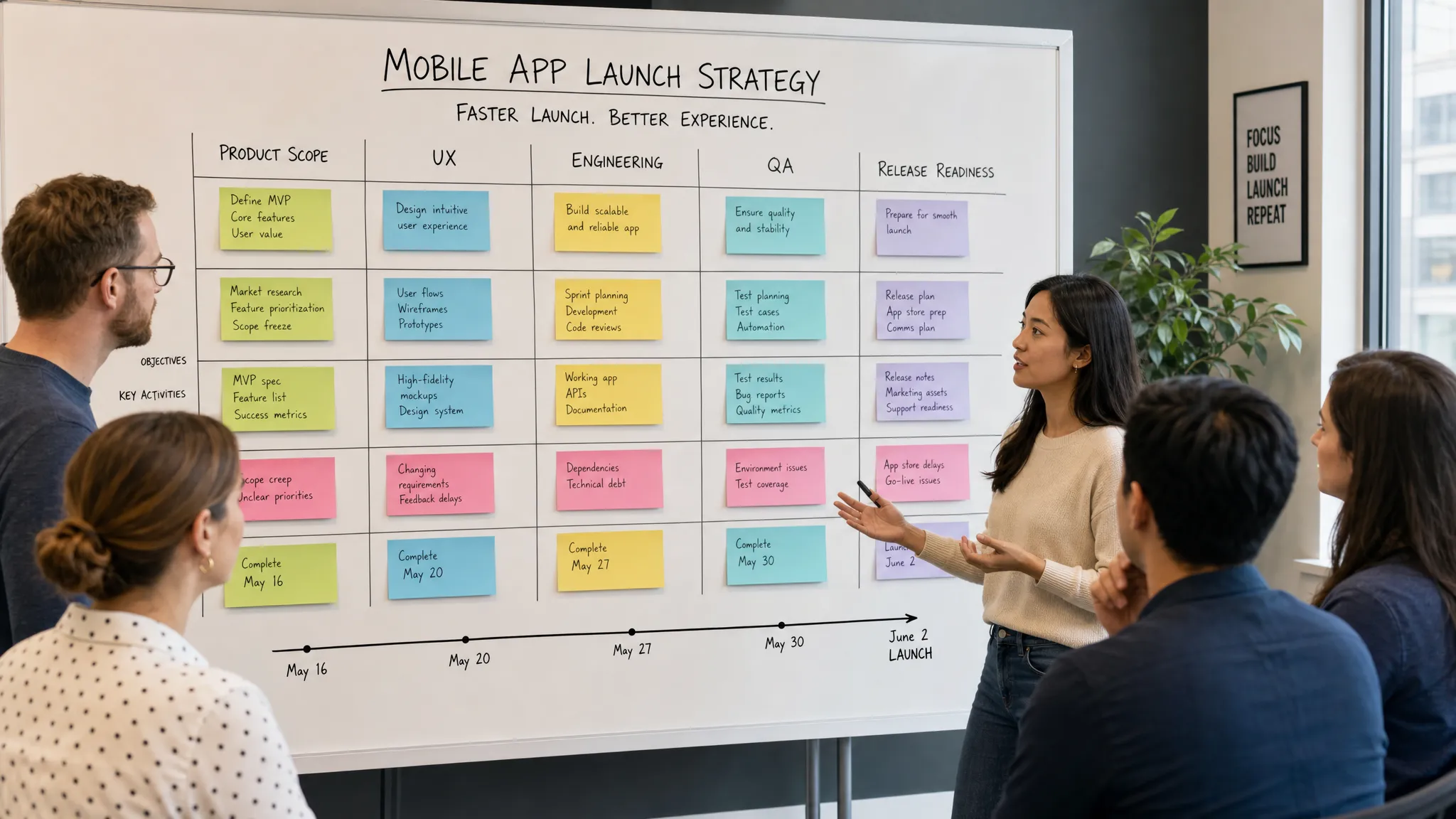
Compressing a mobile timeline requires parallel work, but parallel work only helps when dependencies are clear. Otherwise, teams create more meetings, more rework, and more merge conflicts.
A strong mobile app development strategy defines which workstreams can move at the same time and what each one needs from the others.
For example, backend engineers can begin API scaffolding while designers finalize secondary screens if the core data model and user flows are already stable. QA can begin test planning before development is complete if acceptance criteria are written clearly. App Store assets can be drafted before the final build if positioning, screenshots, and feature names are stable enough.
This is where a documented workflow becomes valuable. A strategy defines the decisions. A workflow turns those decisions into repeatable execution. For a more process-oriented breakdown, see this guide to a mobile development workflow for faster product launches.
Use release gates instead of deadline panic
Fast launches fail when the team treats the launch date as the only gate. By the time the deadline arrives, unresolved issues pile up: unstable builds, missing analytics, unclear store assets, incomplete QA, and last-minute platform problems.
Release gates solve this by defining proof of readiness at each stage. They help the team move quickly because everyone knows what “done” means before the next phase begins.
| Release gate | Proof of readiness | Why it speeds launch |
|---|---|---|
| Scope gate | Core user journey, success metric, and excluded features are documented | Prevents late feature expansion |
| UX gate | Prototype covers onboarding, core flow, empty states, and error states | Reduces redesign during implementation |
| Architecture gate | API contracts, data model, integrations, and platform decisions are agreed | Prevents rebuilds and blocked sprints |
| Build gate | Core functionality works on target devices with tracked issues | Keeps QA focused on real defects |
| Beta gate | TestFlight or Google Play testing build is ready with feedback process | Finds real-world issues before public release |
| Store gate | Metadata, screenshots, privacy details, and review requirements are prepared | Avoids submission delays |
| Rollout gate | Monitoring, support, rollback plan, and post-launch ownership are defined | Protects the first user experience |
This does not mean adding bureaucracy. Each gate should be lightweight and practical. The point is to replace subjective confidence with observable readiness.
Plan QA as a launch accelerator
QA is often squeezed at the end of mobile development, which is one of the fastest ways to slow a launch. Late QA finds issues when they are most expensive to fix and when the team has the least time to make thoughtful tradeoffs.
A faster approach brings QA into the strategy from the beginning. Test cases should be mapped to the core user journey, platform requirements, device coverage, integrations, and edge cases that matter most for launch.
Automated testing can help, especially for unit tests, critical business logic, and regression-prone flows. Manual testing is still essential for mobile because real devices, gestures, interruptions, permissions, network changes, and platform behaviors can reveal issues that automation misses.
For funded startups, the most useful QA question is not, “Is the app perfect?” It is, “Are there any defects that would prevent the target user from experiencing the core value of the app?”
That framing helps teams fix launch-blocking issues first and avoid spending critical time on low-impact polish that can safely wait for a later release.
Prepare App Store and Google Play requirements early
Store submission can become a hidden bottleneck if it is treated as an administrative task at the end. Apple and Google both require accurate metadata, privacy details, content disclosures, screenshots, and compliance with platform policies.
Reviewing the Apple App Review Guidelines and Google Play policy guidance early can prevent avoidable delays. This is especially important for apps involving payments, health, finance, user-generated content, location, subscriptions, children’s data, or account deletion.
A launch strategy should assign ownership for store readiness well before the final build. Product and marketing teams need time to define positioning. Designers need time to create screenshots. Engineers need time to support privacy requirements, permissions, account management, and any platform-specific rules.
Store readiness is not only about approval. It also affects conversion. The first public impression of your app often happens on the App Store or Google Play listing, not inside the app itself.
Design the first release for fast iteration
The fastest launch is not the one that ships and stops. It is the one that creates a reliable feedback loop.
Your first release should include the instrumentation needed to understand user behavior. At minimum, teams should know whether users install, onboard, reach first value, complete the core action, encounter errors, and return. Crash reporting and performance monitoring are equally important because early users may not report issues directly.
Feature flags can also support faster learning by allowing teams to enable, disable, or test specific functionality without waiting for a full app review cycle in every case. They should be used carefully, but they can reduce risk during staged rollouts and beta testing.
A strong post-launch loop usually includes:
- Activation and retention metrics tied to the launch outcome.
- Crash, performance, and backend reliability monitoring.
- A process for triaging user feedback into bugs, usability issues, and product opportunities.
- A release cadence for fixes and improvements after launch.
This is where strategy and deployment meet. If your team needs a deeper operational view, Appzay’s app deployment guide for fast, safe releases explains how repeatable deployment practices reduce risk across iOS and Android releases.
Know what not to rush
A faster mobile launch should never come at the expense of trust. Some areas deserve deliberate attention because mistakes can harm users, trigger rejection, or create expensive cleanup work.
Security and privacy are at the top of that list. Authentication, permissions, sensitive data handling, payment flows, and account deletion should be addressed clearly. Accessibility also deserves early consideration because retrofitting accessible navigation, contrast, labeling, and interaction patterns can be harder later.
Performance is another area where early decisions matter. Users may forgive a missing advanced feature, but they are less forgiving of slow launch times, broken forms, frozen screens, or excessive battery usage.
Finally, do not rush the first-run experience. Onboarding is where users decide whether the app is worth their attention. A concise, clear path to first value can do more for launch success than several extra features.
A practical strategy model for faster launches
If you want a simple framework, think of your mobile app development strategy as six connected decisions.
| Strategic decision | Key question | Output |
|---|---|---|
| Market focus | Who is the first release for? | Primary segment and launch context |
| Product focus | What is the first valuable behavior? | Core journey and MVP scope |
| UX focus | How does the user reach value quickly? | Prototype and design system |
| Technical focus | What must be stable, scalable, or secure now? | Architecture plan and integration map |
| Delivery focus | How will teams build in parallel safely? | Sprint plan, ownership, and gates |
| Release focus | How will the app launch, learn, and improve? | Store plan, rollout plan, and post-launch metrics |
The power of this model is that it keeps speed tied to clarity. Every decision either reduces uncertainty, removes rework, or protects the user experience.
Frequently Asked Questions
What is a mobile app development strategy? A mobile app development strategy is the plan that connects product goals, user experience, technical architecture, delivery workflow, QA, and release readiness. Its purpose is to help teams build the right first version faster without sacrificing quality.
How can a startup launch a mobile app faster? A startup can launch faster by narrowing the first release to one valuable user journey, validating UX with prototypes, planning architecture around real launch risks, parallelizing workstreams, testing continuously, and preparing App Store and Google Play requirements early.
Should we build for iOS and Android at the same time? It depends on your audience, budget, and timeline. If both platforms are essential for the first market, parallel planning is important. If one platform has a clear user or revenue advantage, launching there first may reduce complexity and speed up learning.
What slows mobile app launches the most? Common delays include unclear MVP scope, late UX changes, unresolved API decisions, weak QA planning, missing store assets, unexpected platform policy issues, and adding features too close to release.
How early should app launch planning begin? Launch planning should begin during discovery, not after development. Store requirements, analytics, beta testing, rollout strategy, and support ownership all influence product and engineering decisions.
Build faster without building carelessly
A faster launch is not about shortcuts. It is about sequencing the right decisions, focusing the first release, and creating a delivery system that prevents avoidable rework.
Appzay partners with funded founders to design, build, and launch premium iOS and Android apps from concept to App Store. If you need a technical partner that can help shape product strategy, UX, engineering, deployment, and post-launch support, visit Appzay to explore how an end-to-end mobile app development team can help you move faster with confidence.