6/21/2026
Mobile App Design and Development for Funded MVPs
Explore mobile app design and development for funded MVPs, from UX scope to engineering, launch, and scaling without wasting runway.
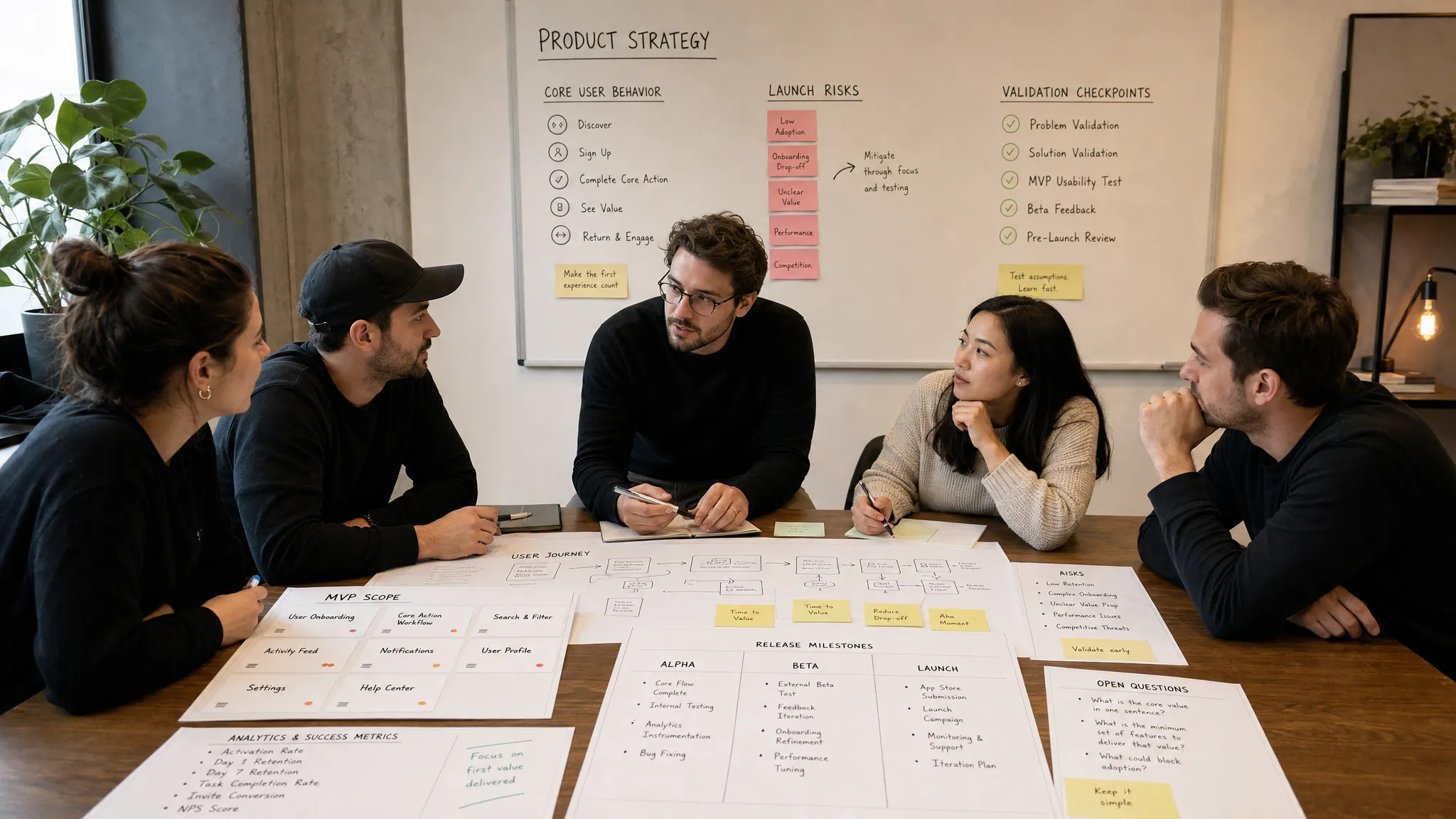
A funded MVP has a different job than a scrappy prototype. It is not just there to prove that an idea could work. It needs to help you learn from real users, impress investors and partners, survive App Store scrutiny, and create a technical foundation you can build on after launch.
That is why mobile app design and development for funded MVPs should be treated as one integrated product process, not two separate phases handed from designers to engineers. When design decisions ignore technical constraints, timelines slip. When engineering starts before the user experience is clear, teams build features that look complete but fail to create adoption. The strongest MVPs bring product strategy, UX, architecture, native engineering, testing, and launch planning together from the start.
For funded founders, the goal is not to build the biggest first version. It is to build the smallest credible product that can win a real user behavior, collect evidence, and support your next milestone.
What makes a funded MVP different?
A funded MVP usually has more pressure than an early no-code experiment. You may be working toward a seed extension, Series A narrative, pilot commitments, or a launch window tied to market timing. You likely have enough runway to build properly, but not enough to waste months on avoidable rework.
That changes how the MVP should be planned.
A funded MVP needs to be lean, but it also needs to feel trustworthy. Users should not sense that they are testing a fragile demo. Investors should see a product that can become a company. Your engineering team should not be forced to throw everything away after validation.
The right mindset is strategic compression. You compress scope, not quality. You reduce feature count, not product coherence. You avoid overbuilding, but still make deliberate choices about architecture, analytics, security, onboarding, performance, and release operations.
If you are still deciding what belongs in the first version, Appzay’s guide to a lean mobile app MVP that can still win is a useful companion. This article focuses on how design and development should work together once you are ready to build.
Start with the user behavior, not the feature list
The most common funded MVP mistake is starting with a backlog. A backlog feels productive because it turns uncertainty into tickets. But if the team has not defined the core behavior the product must create, those tickets can become expensive guesses.
Before designing screens or writing code, clarify one sentence:
What must a user successfully do in the app for this MVP to matter?
For a marketplace, that might be completing a first transaction. For a fitness app, it might be finishing a guided session and returning the next day. For a fintech app, it might be connecting an account and understanding one valuable insight. For a social product, it might be inviting a friend and receiving a response.
Once that behavior is clear, every design and engineering decision becomes easier. Navigation can be simplified around the core loop. Onboarding can remove anything that delays activation. Analytics can track the moments that prove or disprove the product thesis. Engineering can prioritize reliable execution of the path that matters most.
A funded MVP should not ask, “What features can we afford?” It should ask, “What is the minimum complete experience that lets us observe the behavior we need?”
Product strategy turns funding into focus
Funding can create a dangerous illusion: because you can afford more, you should build more. In reality, the best use of funding is to buy speed, quality, and decision clarity.
Product strategy should translate your business thesis into a buildable plan. That includes defining your primary user segment, the job to be done, the core value moment, the success metrics, and the constraints that matter. Constraints may include budget, timeline, compliance exposure, integrations, team availability, or investor milestones.
A practical funded MVP strategy usually answers these questions:
- Who is the first user we need to satisfy, and who can wait?
- What action proves the app is valuable?
- What must be native mobile, and what can be deferred?
- Which integrations are essential for launch?
- What quality bar is non-negotiable for trust?
- What evidence do we need within 30, 60, or 90 days after release?
This is where founders should be careful with “nice to have” features. A feature can be small in isolation but expensive in system impact. For example, adding social sharing may sound simple until it requires permissions, invite flows, abuse handling, deep links, referral tracking, and support states. A good mobile app design and development partner will help evaluate features by their impact on the product system, not just their apparent size.
UX design should make the MVP feel obvious
Funded MVP design is not about decorating a limited product. It is about making the essential product experience feel inevitable.
The first UX deliverable should be a clear journey map. This maps how users enter the app, understand the value, take the first meaningful action, recover from errors, and return later. From there, wireframes and prototypes can test whether the flow is simple enough before engineering begins.
This matters because mobile users are impatient. Small points of friction, such as a confusing permission request, a vague empty state, or a long onboarding sequence, can distort your MVP data. If users drop off because the experience is unclear, you may misread a UX issue as a market issue.
Nielsen Norman Group’s guidance on usability testing is a helpful reminder that even small rounds of user testing can uncover major usability problems early. For funded MVPs, testing a clickable prototype with a handful of target users can prevent weeks of building the wrong flow.
Strong MVP UX usually includes:
- A short onboarding path focused on activation
- Clear empty states that explain what to do next
- Permission prompts timed around user intent
- Error states that help users recover
- A design system foundation for consistent UI
- Prototype validation before full development
If your team has not yet translated the concept into flows, Appzay’s article on how to design the app before you write code offers a deeper pre-development framework.
Development decisions that protect future velocity
The development side of a funded MVP has to balance two truths. First, the product will change after launch. Second, poor early engineering choices can make every later change slower.
That does not mean you need enterprise-scale infrastructure on day one. It means the architecture should be intentional. Native iOS and Android engineering, cloud integration, APIs, data models, CI/CD, analytics, and release workflows should be designed around the expected next stage of the company.
A throwaway MVP might hardcode assumptions just to ship. A funded MVP should avoid hardcoding the assumptions most likely to change, such as pricing models, onboarding variants, content categories, permissions, and user roles. These areas often become growth, monetization, or operational levers after launch.
A healthy engineering plan should also include test coverage for critical paths. Test-driven engineering does not mean testing everything equally. It means protecting the flows where failure would damage trust, block activation, or corrupt data.
| MVP area | Design concern | Development concern | Why it matters |
|---|---|---|---|
| Onboarding | Users understand the value quickly | Authentication, permissions, analytics events | Determines activation quality |
| Core loop | Flow feels simple and rewarding | Reliable APIs, state handling, performance | Proves the product thesis |
| Payments or transactions | Trust, clarity, confirmation states | Security, edge cases, failure recovery | Prevents revenue and support issues |
| Notifications | Timing and user consent | Push setup, preferences, delivery logic | Supports retention without annoying users |
| Admin or operations | Internal team can manage MVP safely | Back-office tools, logs, permissions | Reduces manual chaos after launch |
| Release process | App feels stable at launch | CI/CD, beta testing, store readiness | Protects timeline and reputation |
The point is not to maximize engineering complexity. It is to make sure the first version can absorb real learning without collapsing under its own shortcuts.
Design and engineering should overlap, not wait in line
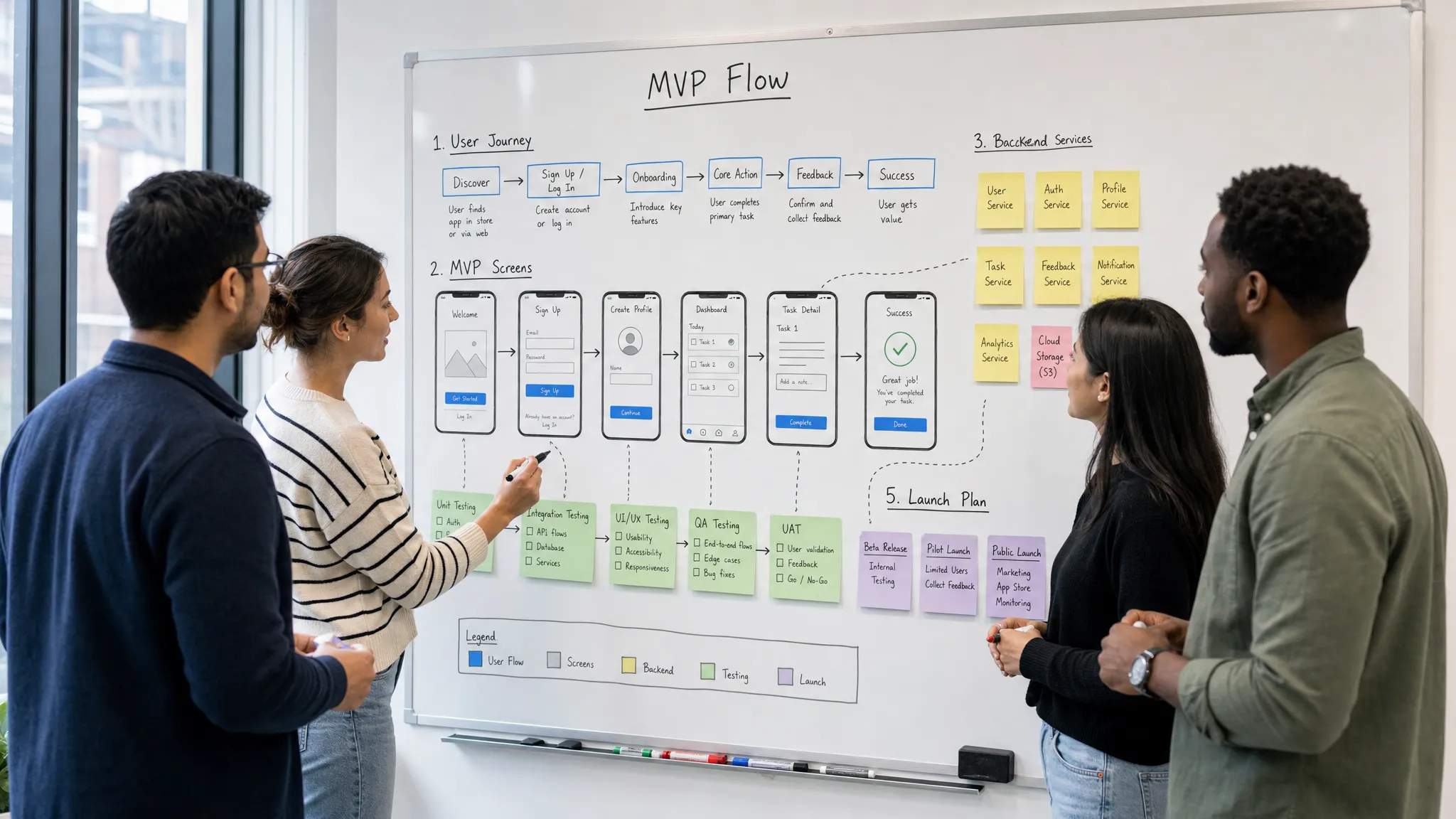
A waterfall handoff is risky for funded MVPs. If designers finish every screen before engineers review feasibility, the team may discover too late that a beautiful interaction is costly, fragile, or dependent on an integration that will not be ready. If engineers start building without enough UX clarity, they may make assumptions that later require rework.
The better approach is collaborative sequencing.
Product strategy defines the core loop and constraints. UX explores flows and prototypes. Engineering reviews complexity, dependencies, data requirements, and platform implications. Design then tightens the interface around what is both desirable and buildable. Development begins with technical foundations and high-confidence flows while the remaining edge cases are refined.
This overlap creates faster learning. It also helps founders make better tradeoffs. Instead of hearing “that is out of scope” late in the project, you can compare options early. A feature may have a lightweight version, a native version, a manual operations version, or a post-launch version.
For funded startups, those tradeoffs are not just technical. They are strategic. Every week saved before launch is more time to collect user evidence. Every avoided rebuild protects runway. Every clear scope decision improves team morale.
Native mobile quality still matters in an MVP
Some founders assume MVP users will forgive anything because the product is early. That is only partly true. Early adopters may forgive missing features, but they rarely forgive confusion, crashes, slow performance, or broken trust.
Native mobile quality matters because mobile behavior is intimate and habitual. Users install the app on a personal device. They grant permissions, receive notifications, and expect smooth interactions. If the product feels unstable, it can lose credibility before the value proposition gets a fair chance.
This is especially important for apps involving sensitive data, payments, health, productivity, or professional workflows. Trust is part of the MVP.
Apple’s App Review Guidelines and Google Play’s app quality guidance also make quality a launch requirement, not a luxury. Store approval, privacy disclosures, permission usage, stability, and policy compliance should be considered during development rather than rushed at the end.
Build for learning after launch
A funded MVP does not end at App Store release. Launch is the beginning of the evidence cycle.
Your app should be instrumented to answer the questions that matter most. Are users reaching the activation moment? Where do they abandon the journey? Which acquisition channels bring users who retain? Which features are ignored? Which errors create support tickets? What are users trying to do that the MVP does not yet support?
Analytics should be designed around product decisions, not vanity dashboards. For example, total downloads may matter for visibility, but activation rate, completion rate, retention, cohort behavior, and qualitative feedback usually tell you more about whether the MVP is working.
You also need operational readiness. Someone must monitor crashes, review analytics, triage feedback, prioritize fixes, and manage releases. Proactive maintenance and support can be the difference between a promising launch and a reputation-damaging one.
This is where CI/CD and release orchestration become valuable. A funded team should be able to ship fixes and improvements without turning every update into a stressful event. Post-launch iteration is part of the product, not an afterthought.
The funded MVP scope test
When deciding whether a feature belongs in your first mobile app release, use a simple scope test. A feature should earn its place if it directly supports user activation, validates a core business assumption, protects trust, enables operations, or is required for store approval and compliance.
If it does not meet one of those criteria, it may belong in the next release.
This does not mean the feature is unimportant. It means the MVP has a job to do first. Funded founders often have ambitious visions, and they should. But vision is easier to execute when the first release is focused enough to ship, measure, and improve.
For a broader sequence from discovery through launch and iteration, Appzay’s mobile application development roadmap for funded startups can help you place these decisions inside a full build plan.
Choosing the right mobile app design and development partner
A funded MVP needs more than available developers. It needs a team that can challenge assumptions, simplify scope, design for adoption, engineer for reliability, and manage the path to release.
When evaluating partners, look for evidence of integrated thinking. A strong partner should be comfortable discussing user journeys and backend architecture in the same conversation. They should ask about your funding milestone, go-to-market plan, operational constraints, and post-launch learning goals. They should also be able to explain tradeoffs clearly, without hiding behind jargon.
Ask potential partners how they approach:
- Product strategy before design begins
- UX prototyping and user testing
- Native iOS and Android development decisions
- API and cloud architecture
- CI/CD, QA, and release management
- App Store and Google Play preparation
- Post-launch maintenance and iteration
The right partner will not simply say yes to every idea. They will help you protect your runway by building the version that best serves your next company milestone.
Frequently Asked Questions
How much should a funded MVP include? A funded MVP should include the smallest complete experience that validates the core user behavior, supports trust, and can be launched reliably. It should not include every feature from the long-term vision.
Should design be finished before development starts? Design should be clear enough to guide development, but the best process includes engineering feedback before every detail is finalized. This prevents expensive rework and helps the team choose feasible solutions early.
Is native app development worth it for an MVP? Native development can be worth it when performance, platform-specific UX, device capabilities, reliability, or long-term scalability matter. The right choice depends on your product, users, and funding milestone.
What should founders measure after launching an MVP? Focus on activation, retention, core action completion, drop-off points, crash rates, support issues, and qualitative user feedback. These metrics are more useful than downloads alone.
When should a funded startup bring in an app development agency? Bring in a partner when you have a clear product direction, funding to execute, and a need for senior product, design, engineering, launch, and support expertise without building a full internal team immediately.
Turn your funded MVP into a launch-ready mobile product
A funded MVP deserves a build process that is focused, high-quality, and designed for learning. The goal is not to ship a bloated first version. It is to launch a mobile product that users can trust, investors can understand, and your team can improve quickly.
Appzay partners with funded founders to design, build, and launch premium iOS and Android apps from concept to App Store. If you are ready to turn your MVP into a polished mobile product with product strategy, UX design, native engineering, deployment, and post-launch support handled end to end, Appzay can help you move from idea to launch with confidence.