6/24/2026
When You Need an App Programmer vs a Full Product Team
Need an app programmer or a full product team? Learn how founders can choose the right build model by scope, risk, speed, and launch needs.
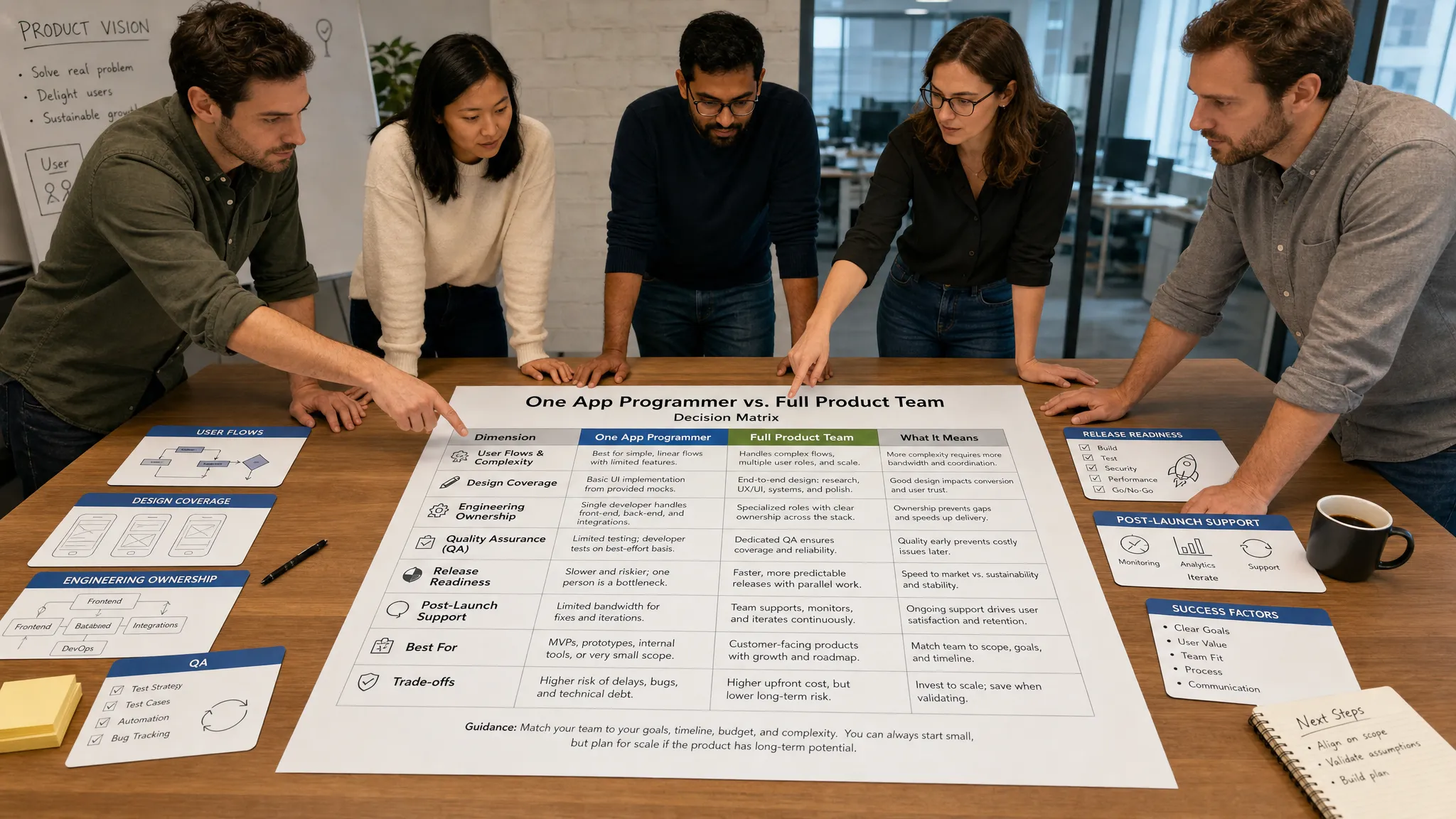
Hiring an app programmer can be the right move. It can also be the moment a startup accidentally turns a coding task into an unmanaged product build.
The difference is not about talent. A strong app programmer can be invaluable when the scope is clear, the designs are ready, and the technical decisions have already been made. But if your app still needs product strategy, UX design, backend architecture, testing, release planning, and post-launch iteration, a single programmer may be forced to cover roles that should belong to a full product team.
For founders, especially funded startups with investor expectations and a real launch window, the key question is not simply who can write code. It is what kind of risk you are trying to reduce.
If your main risk is execution capacity, hire a programmer. If your main risk is product clarity, user experience, scalability, launch readiness, or technical direction, you probably need a team.
What an app programmer is best suited to do
An app programmer, often called a mobile app developer or software engineer, is primarily responsible for turning defined requirements into working code. That can include building screens, implementing app logic, connecting APIs, fixing bugs, improving performance, and preparing technical pieces for release.
The best programmers do much more than type instructions into a codebase. They ask smart questions, flag technical risks, suggest simpler approaches, and help you avoid brittle shortcuts. Still, their work is most effective when the product direction is already defined.
A solo programmer is usually a good fit when you already have:
- A clear product scope with agreed features and priorities
- Completed UX and UI designs, ideally in a tool like Figma
- A technical lead, CTO, or senior engineer who can review architecture decisions
- Existing backend systems, APIs, brand assets, and product documentation
- A narrow assignment such as adding a feature, fixing a bug, or building a prototype
In this setup, the programmer is not being asked to discover what the product should be. They are being asked to build something specific.
That distinction matters. If you hire an app programmer before the product is defined, you may end up paying for code that later needs to be rewritten because the user flow, business model, or technical architecture changed.
What a full product team brings to an app build
A full product team is not just a larger version of a programmer. It is a group of disciplines working together to turn an idea into a usable, testable, scalable mobile product.
Depending on the app, a full team may include a product strategist, UX designer, UI designer, iOS engineer, Android engineer, backend engineer, QA specialist, DevOps or release engineer, and delivery lead. In smaller teams, one person may cover multiple responsibilities, but the important point is that the responsibilities are explicitly owned.
A product team helps answer questions a programmer should not have to solve alone. Who is the first user segment? What is the core loop? Which features belong in the MVP and which should wait? What happens when the app loses connectivity? How will authentication, payments, notifications, analytics, privacy disclosures, and App Store submission be handled?
For a deeper view of the lifecycle, Appzay’s guide to what end-to-end mobile app development services should include breaks down the stages from discovery and design through engineering, QA, launch, and support.
Here is the practical difference:
| Need | App programmer | Full product team |
|---|---|---|
| Product strategy | Works from existing direction | Helps define users, scope, value proposition, and MVP priorities |
| UX and UI | Implements provided designs | Designs flows, prototypes, screens, states, and interaction patterns |
| Engineering | Writes app code and connects services | Plans architecture across app, backend, cloud, QA, CI/CD, and release |
| Quality assurance | May test their own work | Builds a test plan across devices, edge cases, regressions, and launch criteria |
| App Store launch | May help package the app | Manages submission readiness, metadata needs, policy checks, and release process |
| Post-launch iteration | Fixes assigned issues | Uses feedback, analytics, and roadmap priorities to guide improvements |
The more unknowns your product has, the more valuable the team model becomes.
When a solo app programmer is enough
You do not always need a full team. In fact, hiring a product team for a small, isolated coding task can add unnecessary overhead. The right solo app programmer can move quickly, communicate directly, and solve a specific technical problem without turning every decision into a workshop.
A programmer is often enough when the work is contained and the cost of being wrong is low. For example, you might need an app programmer to build a clickable technical prototype, connect an existing app to a new API, fix crashes, improve loading speed, migrate a library, or add a self-contained feature to an established product.
This is especially true if someone on your side already owns product management. A technical founder, CTO, senior product manager, or experienced designer can provide the decisions a programmer needs to execute well.
Before hiring a programmer directly, make sure you can give them clear inputs. At minimum, you should have a prioritized feature list, user flows, acceptance criteria, design files, API documentation, target devices, and a definition of done. If you are not ready to provide those, your first need may not be programming.
Founders often benefit from taking a step back and learning how to design the app before writing code, because a few days of product clarity can prevent weeks of rework.
When you need a full product team instead
You need a full product team when the app is still a product problem, not just a coding problem.
That is common for funded startups. A founder may have capital, market insight, and a strong concept, but still need help translating that concept into the first shippable version. The challenge is not merely building screens. It is deciding which screens matter, how the system should behave, and how to launch in a way that supports learning, growth, and reliability.
A full product team is usually the better choice when:
- You are building a new MVP from concept to App Store
- You do not have a technical co-founder or senior product leader in-house
- The app needs both mobile and backend engineering
- User experience is central to adoption, retention, or monetization
- The product involves payments, subscriptions, marketplace logic, health data, location, messaging, or other sensitive workflows
- You need confidence across both iOS and Android rather than a quick one-platform experiment
- Investors, partners, or customers are expecting a polished launch
Mobile products also face platform rules that change over time. Apple’s App Review Guidelines and Google Play’s developer content policies can affect account creation, subscriptions, privacy, user-generated content, notifications, and data handling. A programmer can implement requirements, but a product team is better equipped to plan around these constraints before submission week.
Security is another reason team structure matters. Mobile apps that handle authentication, personal data, payments, or sensitive content should be designed with secure patterns from the start. Resources such as the OWASP Mobile Application Security Verification Standard show how broad mobile security considerations can become. A full team can distribute that responsibility across architecture, implementation, testing, and release controls.
A simple decision matrix for founders
Use this matrix to decide whether your immediate need is a programmer or a broader product team.
| Situation | Better fit | Why |
|---|---|---|
| You have finished designs, documented requirements, and a technical lead | App programmer | The work is execution-focused and decisions are already owned |
| You have an idea but no validated user flow or MVP scope | Full product team | You need product shaping before code |
| You need to fix bugs in an existing app | App programmer | The scope is narrow and measurable |
| You are launching a funded MVP on iOS and Android | Full product team | You need design, architecture, QA, release planning, and iteration |
| You need a quick proof of concept for internal review | App programmer | Speed and low-cost validation may matter more than polish |
| You need a scalable consumer or marketplace product | Full product team | Multi-role coordination reduces architecture and launch risk |
| You have a CTO but no mobile capacity | App programmer or small specialist pod | Your CTO can provide technical direction and review |
| You have no technical leadership | Full product team | Someone must own technical tradeoffs, delivery risk, and launch readiness |
The shortest rule is this: if you can confidently write the tickets, review the technical choices, test the work, and manage the release, a programmer may be enough. If you cannot, you need more than programming.
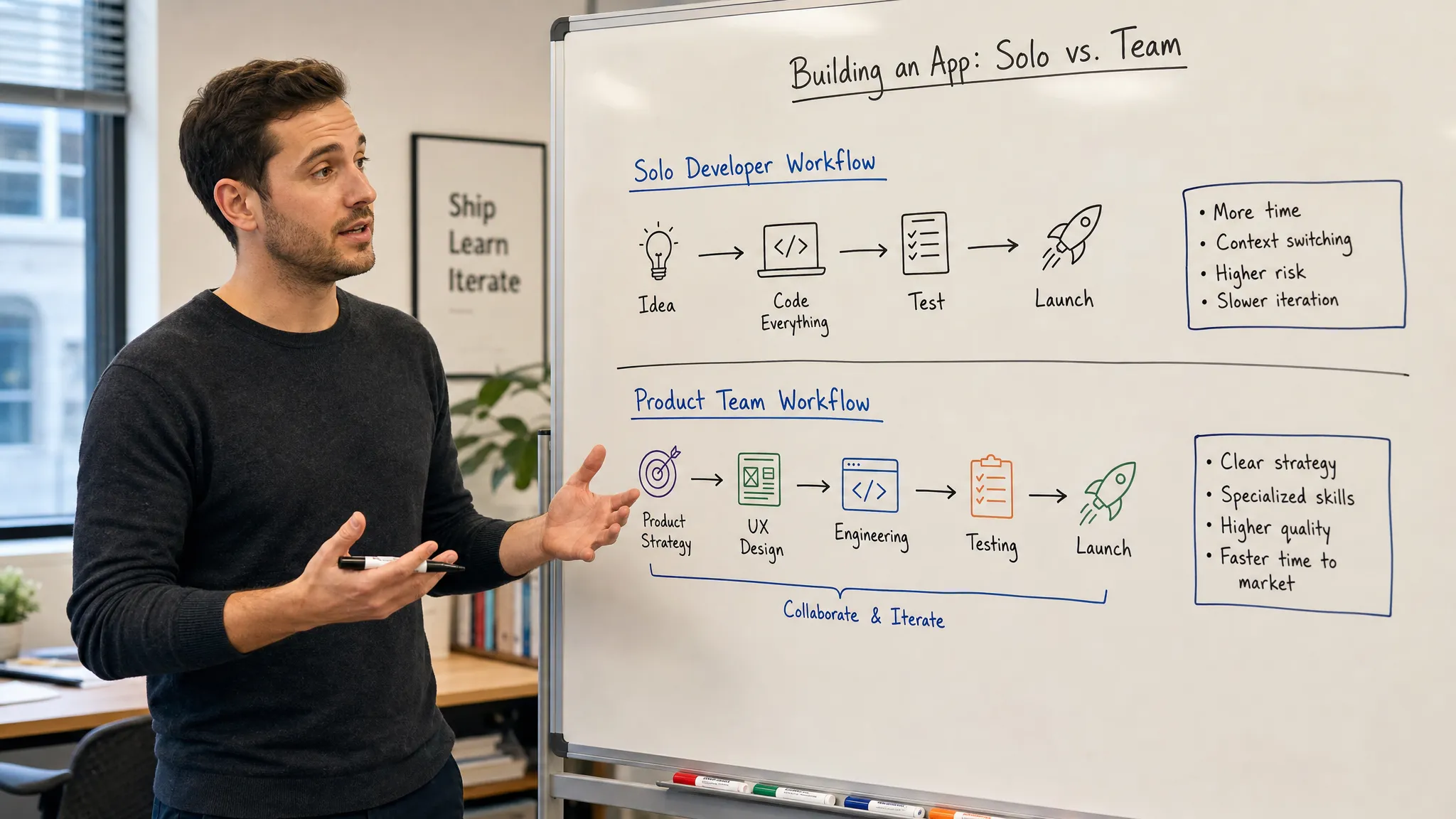
Cost, speed, and risk are connected
A solo app programmer usually looks cheaper at first because you are comparing one person’s rate against a team’s project cost. That comparison can be misleading.
The real cost is not only the hourly rate. It is the total cost of reaching a launch-quality product. If a founder hires a programmer but still needs to source design, write requirements, choose architecture, manage QA, coordinate backend work, prepare App Store materials, and fix post-launch issues, the hidden management cost can be significant.
A full team may cost more upfront, but it can reduce coordination gaps. It can also shorten the path from concept to usable product by sequencing discovery, design, development, testing, and release in the right order.
That does not mean a team is always faster. If your scope is small, a solo programmer may ship faster because there are fewer handoffs. But when the product has real complexity, speed comes from having the right responsibilities covered at the right time.
If you are comparing build models more broadly, Appzay’s breakdown of agency and in-house models by cost, speed, and risk can help you evaluate the tradeoffs beyond the programmer-versus-team question.
The hidden risk of hiring too narrowly
The most common mistake is hiring for the visible task instead of the actual bottleneck.
A founder may say, I need someone to build the app. But after the programmer starts, the real blockers appear. The onboarding flow is unclear. The payment model is not finalized. The backend API does not exist. The prototype looks good but does not handle empty states, error states, permissions, or offline behavior. The App Store listing needs privacy answers nobody has documented.
The programmer is then forced to wait, guess, or make product decisions without enough context. None of those outcomes is ideal.
This is how a project becomes slow even when the programmer is competent. The bottleneck was not coding speed. It was the absence of product ownership, design detail, architectural planning, and release process.
Here are common warning signs:
| Warning sign | What it usually means |
|---|---|
| You cannot explain the first user journey in plain language | Product strategy is not ready for development |
| You have screens but no edge cases or states | UX detail is incomplete |
| You need accounts, payments, notifications, and analytics but no backend plan | Architecture is underdefined |
| Nobody owns QA across devices and OS versions | Launch quality is at risk |
| Your developer is also expected to manage roadmap, design, testing, and release | You are hiring one role to cover a team’s responsibilities |
When several of these are true, a full product team is not overhead. It is risk management.
The hybrid option: one programmer plus targeted support
The choice is not always binary. Some startups need a hybrid model.
For example, a technical founder might hire a senior app programmer and separately bring in a mobile UX designer for a short sprint. An existing product team might add one native iOS or Android specialist for a defined milestone. A startup with a backend team might hire a mobile-focused product agency to own the app layer, release process, and store readiness.
The hybrid model works best when ownership is clear. Everyone should know who decides product scope, who approves design, who owns architecture, who writes and reviews code, who tests, and who decides when the app is ready to submit.
Without that clarity, hybrid models can become fragmented. You save money on paper but lose momentum through coordination problems.
How to brief an app programmer
If you decide a programmer is the right fit, set them up to succeed. Do not start with a vague request such as build me an app like this competitor. Start with the smallest valuable outcome and the exact behavior required.
A strong programmer brief should include the user goal, feature scope, design files, platform target, API documentation, acceptance criteria, testing expectations, timeline, and communication cadence. If there are technical constraints, such as an existing backend, preferred framework, or compliance concern, document those early.
The best briefs also define what is outside the scope. For example, if the programmer is not responsible for UX design, App Store screenshots, backend infrastructure, analytics setup, or product copy, say so. Clear boundaries prevent friction later.
How to brief a full product team
A full product team needs a different kind of brief. You do not need every screen defined before the first conversation. In fact, if you already had every decision locked, you might not need a full team.
Instead, brief the team on the business context. Explain the user problem, target audience, market insight, funding stage, constraints, desired launch window, success metrics, and known risks. Share any research, sketches, investor materials, competitor references, technical assets, or brand direction you already have.
Then evaluate how the team thinks. A serious product team should ask about tradeoffs, not just features. They should challenge scope, identify risk, discuss MVP sequencing, and explain how design, engineering, testing, and launch will connect.
If every answer sounds like yes, we can build that, be careful. Product teams create value by helping you decide what should be built, not just by agreeing to everything on a wishlist.
A practical rule for funded startups
For a funded startup, the wrong hiring model can waste more than money. It can burn runway, delay learning, and produce an MVP that is technically present but strategically weak.
If your app is central to the company, treat it as a product investment rather than a coding task. That does not automatically mean hiring a large team, but it does mean making sure every critical responsibility is covered.
Ask yourself one final question: if the app fails to gain traction, will the likely cause be missing code or weak product decisions?
If the answer is missing code, hire the best app programmer you can find. If the answer is unclear positioning, confusing UX, unstable architecture, poor onboarding, slow iteration, or a messy launch, bring in a product team.
Frequently Asked Questions
Can an app programmer build my entire app? Yes, sometimes. A highly skilled programmer can build a simple app end-to-end if the scope is small and the requirements are clear. For a more complex startup product, you will still need product strategy, UX design, backend planning, QA, launch preparation, and maintenance, whether those responsibilities are handled by the programmer or by other specialists.
Is a full product team always better than hiring one programmer? No. A full team can be unnecessary for bug fixes, small features, prototypes, or projects where product and technical leadership already exist. The best choice depends on the type of risk you need to reduce.
What if I already have app designs? Finished designs help, but they do not automatically mean you only need a programmer. You still need to confirm whether the designs include edge cases, empty states, error states, permissions, accessibility considerations, backend assumptions, and release requirements.
Should I hire an app programmer first to save money? It can save money if the work is well-defined. It can cost more if you are using the programmer to discover product requirements through trial and error. If you are uncertain about the MVP, invest in product definition before writing production code.
How do I know if a team has real product thinking? Look for questions about users, scope, technical tradeoffs, launch risks, success metrics, and post-launch learning. A team with product thinking will not only estimate features. They will help you decide what belongs in the first version and why.
Build with the right level of support
The right hire depends on where your app really is. If the product is already defined and you need focused execution, an app programmer may be exactly what you need. If you are turning a funded idea into a polished iOS and Android product, a full product team can reduce risk across strategy, UX, engineering, launch, and support.
Appzay partners with founders on end-to-end premium mobile app development, from product strategy and UX through native engineering, deployment, and ongoing support. If you want a technical partner that can help shape and ship the product, start with Appzay.