4/21/2026
App Development Agency vs In-House: Cost, Speed, Risk
App development agency vs in-house: compare cost, speed, and risk with a clear framework to choose the right build model for your startup.

If you are a funded startup, “Should we hire in-house or use an app development agency?” is not just an operational choice. It is a decision that affects runway, time-to-market, product quality, and how much risk you personally absorb as a founder.
This guide breaks the trade-offs down into what actually changes outcomes: cost, speed, and risk. It also gives you a practical decision framework and a few proven hybrid models that founders use to ship faster without locking themselves into the wrong org structure.
The three build models most startups actually use
Most teams are not choosing between two extremes. In practice, there are three common approaches.
1) Fully in-house team
You hire (or already have) product design, iOS, Android (or cross-platform), backend, QA, and DevOps or release engineering capability.
Best when:
- Mobile is the company’s core competency long term.
- You expect years of continuous iteration and platform depth.
- You have the leadership bandwidth to recruit and run a team.
2) App development agency (end-to-end)
A single partner covers product strategy support, UX, engineering, QA, release orchestration, and launch. You manage outcomes rather than individual contributors.
Best when:
- You need a reliable path to App Store and Play Store quickly.
- You want senior execution without building the org first.
- You cannot afford hiring delays and false starts.
3) Hybrid: agency now, in-house later (or “core in-house + agency pods”)
You keep a small internal core (often a PM and designer, sometimes a founding engineer) and use an agency to execute, then transition critical knowledge and ownership in phases.
Best when:
- You want long-term ownership, but not the short-term hiring drag.
- You need to prove product-market fit before scaling headcount.
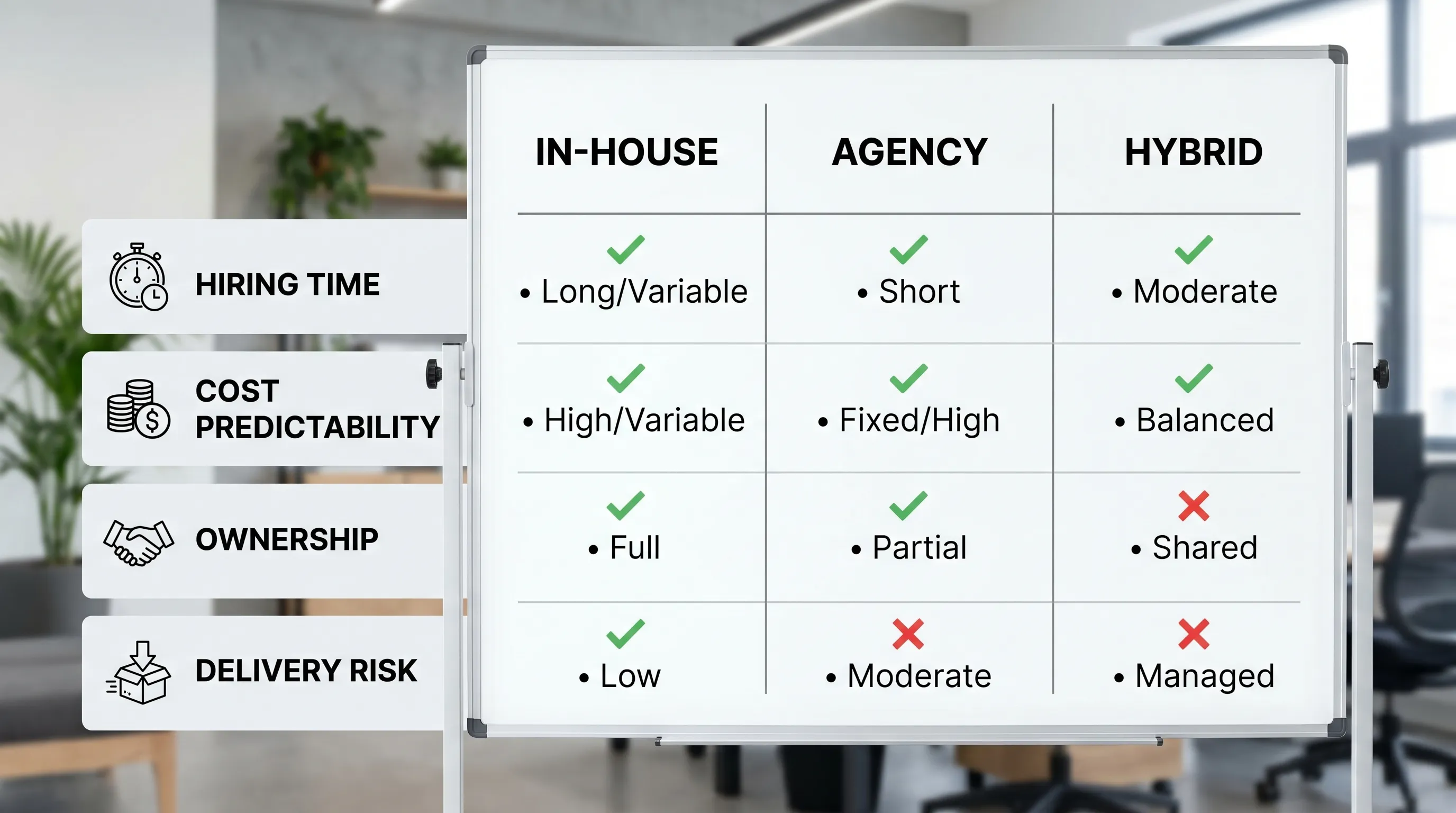
Cost: what you pay for is not the same as what it costs
Most founders underestimate in-house cost because they only count salaries. And they often overestimate agency cost because they compare it to salary alone.
A more accurate comparison is total cost of ownership (TCO): cash out + time cost + risk cost.
In-house cost drivers (the ones that surprise teams)
-
Recruiting and time-to-hire: job ads, recruiter fees, interview time, and weeks (or months) of delays.
-
Fully loaded compensation: salary plus payroll taxes, benefits, equipment, plus equity dilution if you are using options to compete.
-
Management overhead: if you do not already have a strong mobile tech lead, you will spend founder time making architecture and hiring decisions you are not staffed for.
-
Rework and attrition: one wrong hire can create compounding costs, including rewrite risk and delayed launch.
Agency cost drivers (and what you get instead)
An agency usually looks “more expensive” line by line because it bundles:
- Senior execution across disciplines
- QA and release discipline
- Delivery management
- Proven patterns for architecture, CI/CD, and store readiness
The real question is not “Is an agency cheaper?” It is: Does the agency reduce the cost of delay and the cost of mistakes enough to justify the spend? For funded startups, that is often the dominant factor.
A practical TCO view
Use this table to pressure-test the full picture.
| Cost component | In-house | App development agency |
|---|---|---|
| Recruiting time and fees | High upfront | Low (you are buying an assembled team) |
| Payroll and benefits | Ongoing fixed cost | Variable cost tied to delivery |
| Leadership and process | You must build it | Often built-in (if the agency is mature) |
| Tools and delivery infrastructure | You own setup and upkeep | Often included or accelerated |
| Rework risk | Depends on seniority you hire | Depends on agency quality and scope clarity |
| Knowledge retention | Strong if team is stable | Requires explicit documentation and handover |
| Cost predictability | Medium (hiring surprises) | Higher (defined scope and milestones) |
Speed: the hidden math is “time to a shippable team”
When founders compare speed, they often compare build velocity (lines of code, sprint output). The bigger lever is earlier: How long until you have a team that can ship a store-ready product predictably?
In-house: fast after you are staffed, slow until you are
An in-house team can be extremely fast once it is complete and stable, especially for ongoing iteration. But early stage teams typically hit speed bumps like:
- Hiring sequence issues (you hired a developer before you hired someone to lead architecture and quality)
- Onboarding time (domain, codebase conventions, release process)
- Missing roles (no QA, no release discipline, no design systems)
If you are aiming for an MVP that has to look and feel premium, speed depends on more than engineering output. It depends on product decisions, UX, instrumentation, QA, and release readiness.
Agency: faster to start, faster to ship when the scope is real
A strong agency compresses timelines by:
- Starting with discovery and UX prototyping that prevents expensive rework
- Parallelizing design, architecture, and infrastructure setup
- Shipping with established CI/CD and release orchestration
- Building toward App Store and Play Store constraints from day one
If you have investors expecting momentum, speed is not only “shipping code.” It is reducing uncertainty and showing progress that is hard to fake (a working prototype, a test build, a beta program, a submitted app).
Speed trade-offs at a glance
| Speed factor | In-house | App development agency |
|---|---|---|
| Time to start building | Slow to medium (hire first) | Fast (team is ready) |
| Time to first credible demo | Medium (depends on team completeness) | Fast (parallel workstreams) |
| Time to App Store and Play Store readiness | Medium (you learn constraints) | Fast if the partner has launch discipline |
| Long-term iteration speed | High once stable | High if partnership continues, otherwise requires handover |
Risk: you are choosing which risks you want to own
The cost and speed discussion is incomplete without risk. Mobile is unforgiving: performance, privacy, permissions, background behavior, and store policy can turn “done” into “blocked.”
In-house risks
Delivery risk
- One missing senior hire can cause architectural drift and repeated rewrites.
- Quality can be inconsistent without disciplined testing and release processes.
People risk
- The “bus factor” is real. If one key engineer leaves, you may lose months.
Launch risk
- App Store and Play Store rules punish ambiguity. Teams that do not practice reviewer-ready submissions and compliance hygiene often lose weeks late in the cycle.
Agency risks
Vendor dependency risk
- If your partner does not document decisions, you can end up with a black box.
Misaligned incentives
- If the agency optimizes for billable hours instead of outcomes, you get scope creep, not progress.
Fit risk
- Some agencies are “build-only.” If you need product thinking and release ownership, you must select for it.
A helpful mental model: partnering with specialists is common in other high-stakes domains. Founders routinely use trusted partners for things like legal, finance, or even property decisions. For example, if you were evaluating UAE off-plan opportunities, you might work with a partner in real estate investments rather than attempting to become an expert overnight. App delivery is similar: the right specialist partner reduces expensive unknowns.
The decision framework: when an agency wins, when in-house wins
Instead of debating opinions, decide based on constraints. Score each statement as true or false for your situation.
Signals an app development agency is the right move
You will likely benefit from an agency if:
- You need to ship a high-quality MVP quickly (and “quality” includes UX polish, performance, and store readiness).
- You do not yet have a senior mobile lead you trust to set standards and architecture.
- You want predictable milestones and outcomes while you validate product-market fit.
- Your biggest risk is delay (competitors, investor expectations, seasonal market windows).
Signals in-house is the right move
You will likely benefit from building in-house if:
- Mobile is the core product and you plan to iterate weekly for years.
- You already have strong technical leadership and hiring capacity.
- You need deep proprietary capability (unique device integrations, long-term platform R&D).
- Your priority is ownership and internal learning over speed.
A simple “fit scorecard” you can use in a founder meeting
| Factor | Choose in-house when… | Choose an agency when… |
|---|---|---|
| Stage | PMF is clear and you are scaling | You are still validating and need momentum |
| Leadership | You have a senior mobile lead | You need senior execution now |
| Runway pressure | You can afford hiring delays | Delay is the biggest threat |
| Scope clarity | Roadmap is stable and well-defined | You need discovery to clarify scope |
| Compliance and launch | You already ship to stores confidently | You want store readiness baked into delivery |
Hybrid models that often outperform either extreme
Many funded startups use a hybrid structure to get speed now and ownership later.
Model A: Agency as the delivery engine, internal core owns product
Your internal team owns:
- Product decisions and priorities
- User research and go-to-market
- Acceptance criteria and success metrics
Your agency owns:
- UX execution and interactive prototyping
- Engineering (iOS, Android, backend as needed)
- QA, CI/CD, release orchestration
This is often the best model for founders who want control without managing a full engineering org.
Model B: Agency builds V1 and the foundations, in-house scales V2
This works well when your first goal is to prove the product. You define handover milestones early:
- Architecture notes and system diagrams
- CI/CD setup documentation
- Testing strategy and quality gates
- Ownership transfer plan for repos, accounts, and release pipelines
If you want a clearer view of what “end-to-end” should include (beyond coding), Appzay’s breakdown of mobile app development services is a useful checklist.
How to reduce risk whichever path you choose
Even the “right” model fails without a few non-negotiables.
If you go in-house
Treat delivery operations as a first-class product feature. That means:
- Defining release processes early (not after the first rejection)
- Building test discipline into the definition of done
- Making performance and privacy part of product requirements
A practical way to structure this is to follow a phased roadmap like Appzay’s mobile application development roadmap for funded startups, then staff roles to the phase you are entering, not the phase you wish you were in.
If you go with an agency
Your best protection is evidence and clarity:
- Ask to see deliverables you will actually receive (prototype, architecture notes, test strategy, release plan)
- Align on ownership (repos, accounts, IP, documentation expectations)
- Prefer outcome-based milestones over open-ended staffing
If you want a deeper vendor evaluation lens, the CTO-style comparison approach in Mobile App Development Firms: How to Compare Like a CTO complements the agency vs in-house decision.
Frequently Asked Questions
Is it cheaper to hire in-house than to use an app development agency? It can be, but only after you account for total cost of ownership: recruiting, management time, rework risk, and the cost of delay. In early stages, agencies often reduce expensive false starts.
How do I estimate the cost of delay for my app launch? Tie delay to business outcomes: lost revenue windows, slowed fundraising momentum, competitor risk, or missed partnerships. For funded startups, a few weeks can change metrics that investors care about.
Can an agency build a scalable product, or will we need to rewrite later? Scalability depends on architecture decisions, testing discipline, and operational maturity (CI/CD, observability, release hygiene). A good agency can build scalable foundations, but you should require documentation and clear technical standards.
What is the biggest risk of going in-house too early? Hiring a partial team without senior technical leadership. You can end up with inconsistent patterns, fragile releases, and a slow rewrite cycle right when you need momentum.
What is the biggest risk of using an agency? Dependency and knowledge gaps if handover is not planned. Mitigate this by requiring clear artifacts, code ownership terms, and a transition plan from the start.
Build with the model that matches your runway, not your ego
If you are deciding between an app development agency vs in-house, optimize for the constraint that can kill the company: time, runway, or execution risk.
Appzay partners with funded startups end-to-end, from product strategy and UX to native iOS and Android engineering, CI/CD and release orchestration, App Store readiness, and ongoing maintenance. If you want a senior team that can ship and de-risk the path to the App Store, explore Appzay at appzay.com and start a conversation about your scope and timeline.