4/25/2026
How to Hire a Mobile App Dev Agency for Predictable Delivery
Hire a mobile app dev agency with predictable delivery. Learn how to vet delivery ops, milestones, contracts, quality gates, and launch readiness.

Predictable delivery is the difference between “we’re building an app” and “we’re shipping a product.” If you’re a founder or product lead hiring a mobile app dev agency, your real goal is not just code output, it’s reliable, observable progress that results in a store-ready release with minimal surprises.
This guide focuses on how to hire for predictability: the planning, delivery system, evidence, and contract mechanics that make timelines believable.
What “predictable delivery” actually means (and what it doesn’t)
When agencies promise “we’ll ship in 12 weeks,” they often mean a best-case scenario. Predictable delivery is more specific and more useful:
- Schedule predictability: you can forecast what will ship in the next 2 to 6 weeks with high confidence.
- Scope predictability: you have a controlled process for trading features up or down without chaos.
- Quality predictability: you don’t “discover” stability problems two days before launch.
- Cost predictability: burn is stable, and changes are explicit, approved, and documented.
Predictable does not mean fixed scope forever. It means the agency runs a delivery system where trade-offs are made early, transparently, and with evidence.
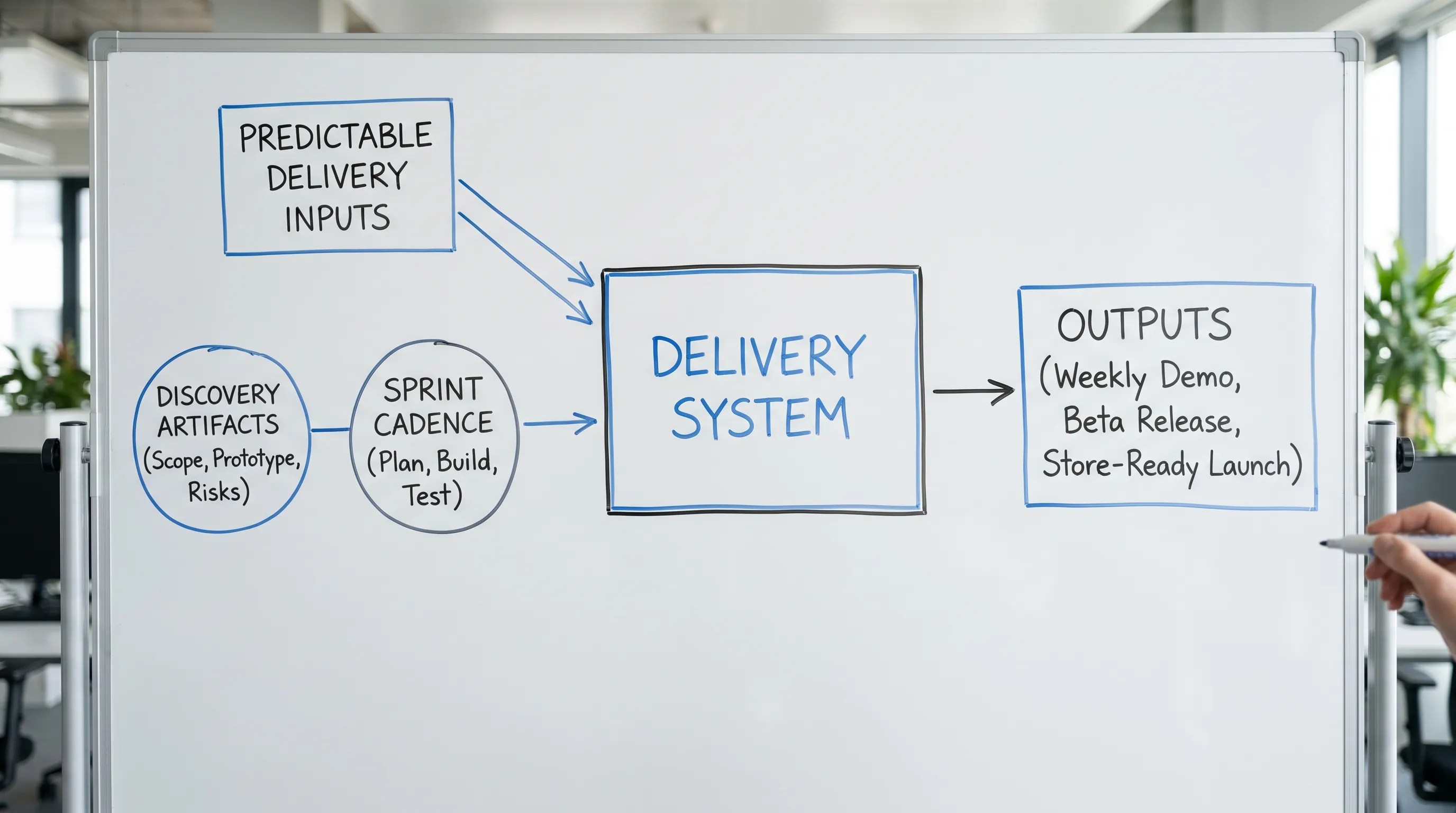
Step 1: Prepare the inputs that make delivery predictable
Most delivery risk is created before the first sprint. A mobile app dev agency can only be as predictable as the inputs you provide.
Bring these to the first serious conversation:
- A one-page product brief: target user, core job-to-be-done, and the single primary outcome your V1 must achieve.
- Non-negotiables: platforms (iOS, Android), authentication constraints, compliance requirements, or must-have integrations.
- Success metrics: activation, retention, conversion, latency, crash-free sessions, or any metric that defines “good enough to launch.”
- A prioritized V1: not a wishlist. A ranked backlog with “must ship” vs “can ship later.”
- Reference products: 2 to 4 examples of UX and feature expectations. If you’re building in travel or bookings, it can help to benchmark real flows and pricing patterns from established experiences like this hotel booking deals site.
If you want a shortcut, treat your V1 as a “thin end-to-end slice” (onboarding, a core action, a result, and basic settings), then expand.
Step 2: Shortlist agencies based on evidence of delivery, not vibes
Portfolios show taste. Predictability comes from operations.
Ask for proof of shipping that is hard to fake:
- Recent apps in production (not just Dribbble shots)
- A sample release process (how builds get to TestFlight / internal testing)
- Their QA approach (what they automate, what they test manually)
- Their definition of done (including performance and store-readiness)
- Who actually does the work (seniority, roles, and continuity)
A quick “predictable delivery” scorecard
Use this table to compare a mobile app dev agency beyond surface-level claims.
| What to evaluate | What good looks like | What to ask for |
|---|---|---|
| Planning realism | Milestones tied to scope and risk, not optimistic dates | A sample plan with assumptions and dependencies |
| Delivery cadence | Weekly demo, clear sprint goal, stable throughput | How they run sprints and handle spillover |
| Release engineering | CI/CD, repeatable builds, versioning discipline | A walkthrough of their pipeline and release checklist |
| Quality system | Automated tests where it matters, device matrix, crash monitoring | Their testing pyramid and tooling |
| Store readiness | Privacy, permissions, reviewer notes, metadata workflow | Their store submission packet template |
| Risk management | Risks logged early, mitigations tracked | A sample risk register or weekly status format |
If you want deeper criteria, it can help to use a CTO-style comparison framework. (Appzay has a related guide on how to compare mobile app development firms like a CTO.)
Step 3: Run an interview process that exposes how delivery actually works
A predictable agency can explain its delivery system clearly. Structure interviews to force specificity.
Questions that reveal schedule predictability
- “How do you estimate, and what do you do when estimates are wrong?”
- “What is your typical sprint length, and what percentage of sprint work is usually rolled over?”
- “Show me what a weekly status update looks like when a project is behind.”
- “How do you handle dependencies on our team (content, approvals, backend access)?”
Listen for language like “we adjust scope,” “we manage risk explicitly,” and “we keep a tight release train.” Avoid hand-waving.
Questions that reveal quality predictability
- “What does ‘done’ mean for a ticket (tests, review, performance, analytics, edge cases)?”
- “Do you ship from main branch, and how do you prevent last-minute integration issues?”
- “How do you prevent regressions when moving fast?”
- “What does your bug triage process look like during beta?”
A quality system is a delivery system. If quality is “we test at the end,” delivery becomes roulette.
Questions that reveal launch predictability
- “Who owns App Store / Play submission, and what do you need from us?”
- “How do you avoid store rejections related to privacy, accounts, or metadata?”
- “What is your rollback strategy if a release is unstable?”
If the agency can’t articulate store-readiness, timelines are fragile. (For iOS, you can also cross-check their answers with Apple’s official App Review Guidelines.)
Step 4: Use a paid discovery sprint to turn promises into a plan
For predictable delivery, a paid discovery sprint is often the highest-leverage step. It converts ambiguity into artifacts.
A strong discovery typically produces:
- A validated V1 scope (what ships, what explicitly does not)
- An interactive prototype or UX blueprint for the critical flows
- A technical plan (architecture direction, integrations, data model highlights)
- A delivery plan (milestones, staffing, risks, and decision gates)
- A release plan (beta strategy, store submission responsibilities, launch checklist)
If an agency skips discovery and jumps straight to a fixed quote, the “predictable timeline” is usually just hidden risk.
Step 5: Contract for predictability (not just protection)
Many contracts protect both sides legally, but do nothing to make delivery more reliable. You want commercial terms that enforce clarity.
Contract elements that improve delivery outcomes
| Contract element | Why it improves predictability | What to specify |
|---|---|---|
| Milestones with acceptance criteria | Prevents “almost done” ambiguity | Deliverables, demo requirements, and acceptance tests |
| Change control | Keeps scope changes from silently breaking timelines | How changes are proposed, estimated, approved |
| Definition of done | Aligns quality expectations early | Testing, code review, performance, analytics, docs |
| Release responsibility | Avoids last-week scramble | Who submits, who writes metadata, who prepares reviewer notes |
| Access and dependencies | Reduces schedule surprises | What you must provide, and by when |
| Post-launch support terms | Prevents launch-week chaos | Bugfix window, response times, maintenance model |
Two practical notes:
- If you need a firm date, consider contracting around a fixed V1 scope (or a fixed time-and-budget with a strict change process). “Fixed date + flexible scope” can work if your governance is tight.
- Make sure IP ownership, repo access, and handover artifacts are explicit, especially if you plan to hire in-house later.
Step 6: Set an operating cadence that makes progress visible
Even a great mobile app dev agency will drift without a shared operating model. Predictability is built in the weekly rhythm.
A healthy cadence looks like this:
| Cadence item | Purpose | Output |
|---|---|---|
| Weekly demo | Forces integration and keeps work user-facing | Working build, not slides |
| Weekly written status | Prevents hidden risks | Progress, blockers, risks, decisions needed |
| Backlog grooming | Keeps scope realistic | Updated priorities, clarified requirements |
| Release checkpoints | Avoids last-minute store issues | Privacy checklist, metadata draft, reviewer notes |
Also agree on a single source of truth (Linear, Jira, Notion, or similar) and insist that “status” is derived from the system, not from meetings.
Step 7: Watch for red flags that kill predictability
These signals often show up early:
- No one can explain how releases work (builds, signing, environments, rollbacks).
- QA is an afterthought or “we’ll test at the end.”
- Estimates are given without assumptions and without identifying risks.
- You’re sold senior leadership, but staffed with juniors and no clear technical owner.
- No demo until the end of the month (predictability requires frequent integration).
If you see these, address them immediately or move on. Delivery habits rarely change mid-project.
Frequently Asked Questions
What is the best engagement model for predictable delivery with a mobile app dev agency? For most startups, a paid discovery sprint followed by a milestone-based build phase (or a tightly managed time-and-materials model) is the most predictable. The key is explicit scope, change control, and frequent demos.
Should I require a fixed-price quote to get predictability? Not necessarily. Fixed-price can hide risk in assumptions. Predictability comes from clear acceptance criteria, a strong definition of done, and a transparent change process, regardless of pricing model.
How do I verify an agency can ship to the App Store and Google Play reliably? Ask them to walk you through their release pipeline, store submission packet, privacy and permission workflow, and how they handle rejections. You should also see evidence of recent production launches.
What deliverables should I expect before development starts? At minimum, a V1 scope, an interaction blueprint or prototype for core flows, an architecture direction, a milestone plan with assumptions, and a release plan for beta and store submission.
Want predictable delivery without building a whole in-house team?
If you’re hiring a premium mobile app dev agency because you need a reliable path from concept to App Store, Appzay specializes in end-to-end delivery for funded startups, including product strategy, UX, native iOS and Android engineering, CI/CD, and launch support.
Explore Appzay’s approach at appzay.com or review the delivery expectations you should hold any partner to in what end-to-end mobile app development services include.