4/16/2026
How to Choose an App Development Company for a Funded MVP
How to choose an app development company for a funded MVP: vet process, quality signals, contracts, and delivery ops to ship fast without rework.

A funded MVP is a high-pressure build. You are expected to ship fast, prove traction, and keep technical risk under control, often with a small internal team and a board watching milestones.
Choosing the right app development company is less about “who can code” and more about who can reliably turn your product assumptions into a stable, testable, store-ready release, with the least rework.
Below is a practical selection framework you can use to evaluate partners, compare proposals, and de-risk delivery.
Step 1: Get specific about what your funded MVP must prove
Before you judge vendors, define the MVP’s job. Otherwise you will end up comparing quotes for different products.
A funded MVP usually needs to prove one of these:
- Revenue feasibility (paid conversion, retention, LTV signals)
- Operational feasibility (can you deliver the core workflow reliably at scale)
- Regulated feasibility (privacy, security, auditability, compliance path)
- Distribution feasibility (App Store approval, ASO basics, paid acquisition readiness)
Write down, in one page:
- Target user and the “first 10 minutes” experience
- One primary workflow the MVP must nail
- Success metrics for the first 30 to 60 days (activation, retention, conversion, time-to-value)
- Your non-negotiables (native performance, offline mode, specific device features, security constraints)
- MVP boundaries (what is explicitly out of scope)
If a prospective partner does not push you to clarify this, you are already taking on risk.
Step 2: Pick the right engagement model (it changes what “good” looks like)
Many founder frustrations come from choosing a model that cannot deliver the outcome.
| Model | Best for | What you must manage | Common failure mode |
|---|---|---|---|
| In-house hires | Long horizon product orgs with time to ramp | Recruiting, onboarding, architecture, release ops | Slower time-to-first-release, inconsistent mobile expertise early |
| Staff augmentation | You already have strong mobile leadership | Planning, code review, QA gates, App Store operations | “Extra hands” ship features, but quality and ownership are unclear |
| End-to-end app development partner | Funded MVPs that must ship quickly with high quality | Vendor selection, alignment, milestones | Vendor builds what was asked, but not what users need, if discovery is weak |
For a funded MVP, an end-to-end partner is often the most pragmatic option when you want senior execution across product, UX, engineering, and release orchestration.
Step 3: Evaluate partners on evidence, not promises
A polished deck is easy. What you want is proof the team can ship, measure, and maintain a real mobile product.
3.1 Product strategy and UX maturity
Your MVP is not “version 1 of everything.” It is the smallest product that validates a thesis.
Ask for:
- Examples of MVP scope decisions they recommended (what they cut, and why)
- Their approach to interactive prototyping and early usability validation
- How they design for time-to-value, onboarding friction, and permissions
- How they translate goals into a measurable plan (events, funnels, KPIs)
What good looks like: they challenge assumptions, propose tradeoffs, and talk about outcomes, not screens.
3.2 Engineering approach and architecture judgment
For funded MVPs, the “wrong” architecture is usually the one that blocks iteration, not the one that is least scalable.
Ask:
- Which stack they recommend for your use case and why (native iOS/Android vs cross-platform)
- How they prevent platform divergence if building both platforms
- What their definition of “production ready” includes (tests, crash reporting, performance, security)
- A sample of their technical documentation (architecture notes, API contracts, runbooks)
What good looks like: they can explain decisions in plain language, can describe failure modes, and can show how they keep complexity proportional to MVP scope.
If you are still deciding between native and cross-platform, this decision guide may help you create sharper vendor questions: Native Mobile App Development: When It Beats Cross-Platform.
3.3 Delivery operations (the hidden difference between “builders” and “shippers”)
Many teams can build features. Far fewer can reliably ship to the App Store and iterate weekly without chaos.
Ask about:
- CI/CD and release orchestration (build automation, environment management)
- QA strategy, including device coverage and regression prevention
- How they handle beta distribution (TestFlight, internal testing) and release rollbacks
- Definition of done for each sprint
What good looks like: they can describe a repeatable pipeline that reduces manual steps and minimizes “it works on my machine” surprises.
3.4 App Store readiness and compliance fluency
If you are funded, delays from store rejections are expensive and embarrassing.
Ask:
- How they prepare App Store submission materials (privacy disclosures, metadata, reviewer notes)
- How they handle login-required experiences (demo credentials, reviewer flows)
- Their process for permissions, data handling, and policy compliance
For a deeper look at common rejection causes, use this as a reference point when interviewing vendors: App Store Submission Checklist: Avoid Rejections Fast.
3.5 Post-launch ownership (maintenance is part of MVP reality)
A funded MVP is not done at launch. It is when your real learning begins.
Ask:
- What proactive maintenance looks like (OS updates, dependency updates, crash triage)
- Their SLA expectations for critical issues
- How they handle analytics, instrumentation quality, and iteration planning
What good looks like: they talk about stability, monitoring, and iteration cadence as first-class work.

Step 4: Use a scorecard so your decision is defensible
A scorecard prevents “we liked them” from becoming the main selection criterion. Adapt the weights to your product.
| Category | What to look for | Suggested weight |
|---|---|---|
| MVP product thinking | Can they cut scope, define outcomes, and protect time-to-value | 20% |
| UX and prototyping | Interactive prototypes, usability validation, accessibility basics | 15% |
| Engineering quality | Architecture judgment, testing approach, code standards | 20% |
| Delivery and release ops | CI/CD, QA gates, predictable releases | 15% |
| App Store and compliance | Privacy, policies, submission readiness | 10% |
| Communication and leadership | Clear ownership, fast decisions, founder-level updates | 10% |
| Post-launch support | Monitoring, maintenance, iteration support | 10% |
Tip: ask each vendor to walk you through a “week in the life” of your project, including who you talk to, what artifacts you get, and how decisions are made.
Step 5: Run a selection process that reveals execution, not just sales
A lightweight but structured process usually surfaces the best partner quickly.
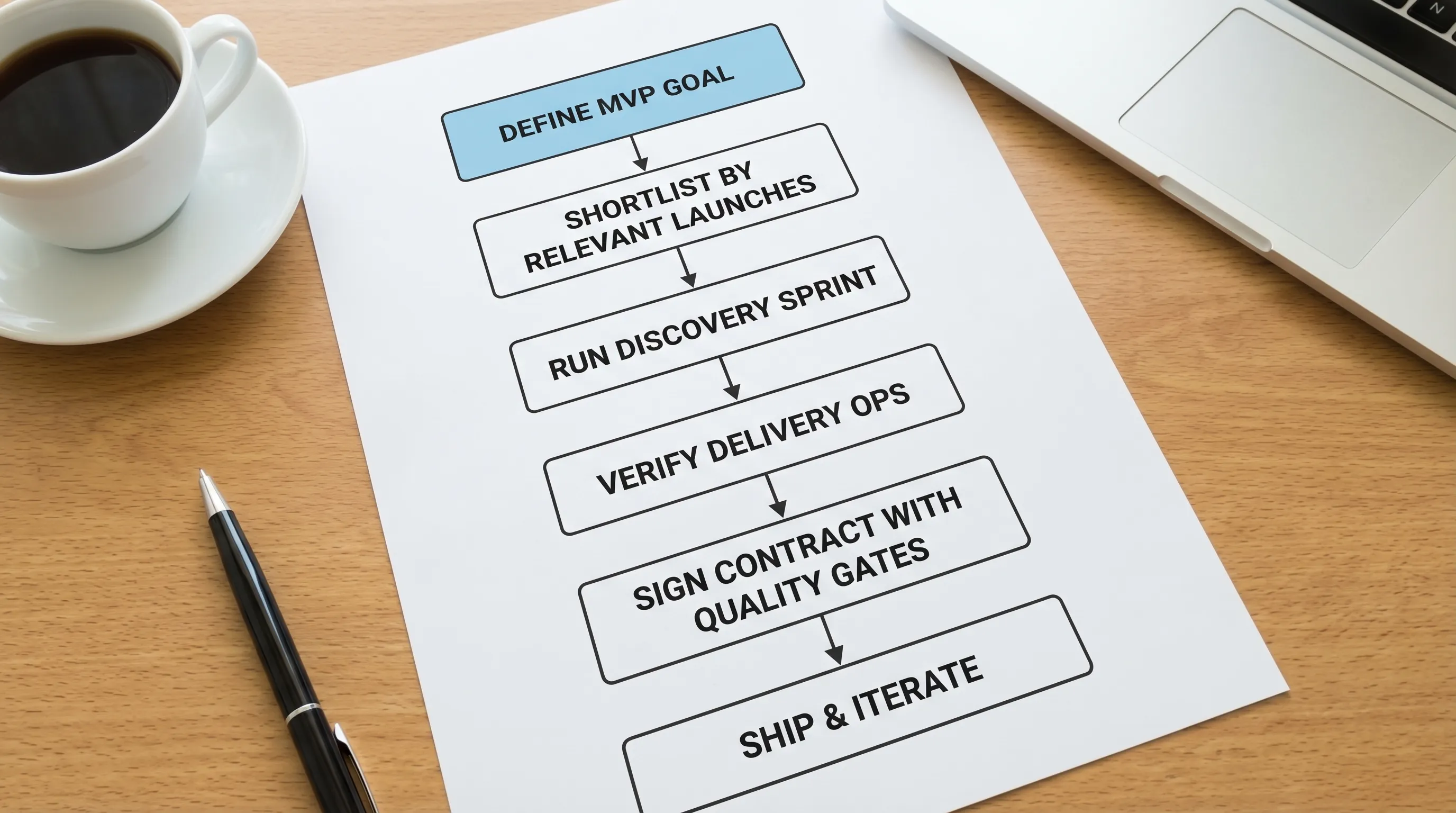
5.1 Shortlist with proof, not portfolios
Portfolios are useful, but you want relevance:
- Similar complexity (auth, payments, realtime, offline, device integrations)
- Similar delivery constraints (tight timelines, regulated space, multi-platform)
- Evidence they shipped and maintained, not just designed
5.2 Ask for a “delivery narrative”
Instead of requesting a generic proposal, ask for:
- A proposed MVP scope and what they would deprioritize
- Timeline with phases (discovery, UX, build, QA, store readiness)
- Risks and mitigations (their view, not yours)
- Team composition and who is senior day-to-day
5.3 Do a paid discovery sprint when the MVP is high stakes
For funded MVPs, a short paid discovery often pays for itself by preventing rework.
A good discovery sprint output might include:
- Product blueprint and prioritized scope
- UX flows and interactive prototype
- Architecture outline and integration plan
- Delivery plan with milestones and quality gates
This is also where you learn how the team thinks under constraints.
5.4 Reference checks that actually help
Ask references questions that reveal operational truth:
- What surprised you (good or bad) after week 4?
- How did they handle scope changes?
- How often did they ship builds you could test?
- Would you hire them again for a funded milestone?
Step 6: Negotiate the contract around risk, not only cost
The cheapest quote is often the most expensive when it causes a missed milestone.
Key items to clarify:
- IP ownership and repo access (who owns what, and when you receive it)
- Definition of done (tests, QA pass, performance baseline, store readiness)
- Change control (how scope changes are estimated and approved)
- Security and privacy expectations (data handling, access controls)
- Warranty period and post-launch support (what is included vs billed)
On pricing model:
- Fixed price can work if scope is truly stable, but MVPs rarely are.
- Time and materials can be healthiest if paired with clear milestones, weekly demos, and scope discipline.
Red flags that funded founders should treat as deal-breakers
- They cannot explain how releases work (builds, testing, App Store submission).
- They propose a “big upfront spec” and then disappear for weeks.
- They avoid talking about tradeoffs and only say yes.
- Senior people sell, junior people deliver, with no clear oversight.
- They do not mention testing, instrumentation, or post-launch stability.
A useful analogy: choose “end-to-end” partners who can scale with you
If you have ever watched consumer startups, you will notice a similar pattern outside software: teams that win often choose partners who can take a product from concept through production and scaling.
For example, in physical goods, a founder might select an end-to-end apparel development and manufacturing partner because early mistakes in materials, sampling, or production processes create expensive delays later. Mobile is similar. Early architectural shortcuts, weak QA, or shaky release operations can compound costs every sprint.
The takeaway: prefer partners who can own the full delivery chain, not just one slice.
What to look for in an app development company if your MVP is funded
If your goal is to ship a premium MVP quickly, you generally want a partner that can cover:
- Product strategy and UX, including interactive prototyping
- Native iOS and Android engineering when performance and polish matter
- Distributed systems architecture and cloud integration when your product depends on reliability
- CI/CD and release orchestration so shipping is repeatable
- App Store optimization basics and store submission readiness
- Proactive maintenance and support after launch
If you want a detailed breakdown of what “end-to-end” should include (and what to clarify in scope), this guide can help you evaluate proposals: Mobile App Development Services: What “End-to-End” Includes.
Frequently Asked Questions
How long should it take to build a funded MVP mobile app? Many funded MVPs can reach a testable beta in weeks, but timing depends on scope, integrations, and compliance. The key is shipping an instrumented, reliable core workflow early, then iterating.
Should I choose a fixed-price contract for an MVP? Fixed price can work when scope is tightly defined, but most MVPs change once you learn from users. Many teams prefer time and materials with clear milestones, weekly demos, and a strong change-control process.
How do I know if an app development company will deliver quality? Ask for evidence of testing practices, CI/CD, release processes, and post-launch support. Also request references and run a short paid discovery sprint to observe execution.
Do I need native iOS and Android for an MVP? Not always. Native is often worth it when performance, device features, or premium UX polish are central to your value. If you are unsure, ask vendors to justify the stack based on your specific product risks.
What should I own at the end of the engagement? You should typically own the source code and have access to repos, build pipelines, and documentation. Clarify IP ownership, handoff expectations, and post-launch support in the contract.
Build your funded MVP with an end-to-end team
If you are comparing vendors and want a second opinion on scope, stack, timeline, or release risk, Appzay partners with funded startups to design, build, and launch premium iOS and Android apps end-to-end.
Explore how we work at Appzay, or use our roadmap-style resources to align your internal stakeholders before you pick a partner.