7/6/2026
How to Build a Mobile App Portfolio That Wins Clients
Learn how to build a mobile app portfolio that wins clients with sharper case studies, proof, UX storytelling, and technical credibility.
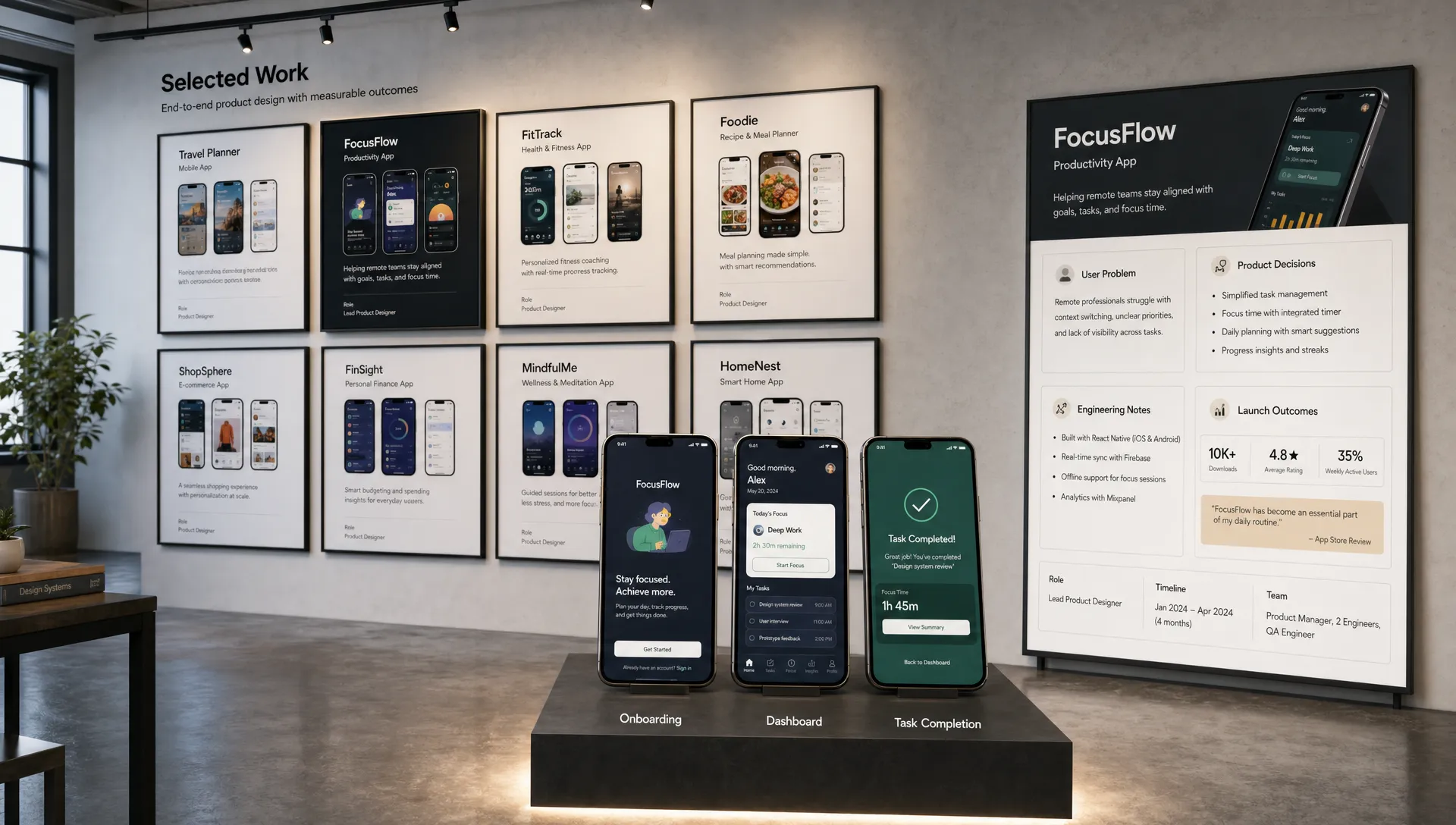
A mobile app portfolio is not a gallery of attractive screens. It is a trust-building sales asset that answers one question for a potential client: “Can this team turn my idea, budget, and market risk into a product users will actually adopt?”
That distinction matters. Founders, product leaders, and operators are not buying mockups. They are buying judgment, execution, technical reliability, and a smoother path from concept to App Store. A portfolio that wins clients makes those strengths visible before the first sales call.
The best mobile app portfolios do three things well. They show relevant outcomes, explain the product thinking behind the work, and prove the team can ship real software under real constraints. Here is how to build one that does more than look polished.
Start With the Client’s Real Buying Question
Before choosing projects or writing case studies, define what your ideal client is trying to de-risk.
A funded startup founder may worry about choosing the wrong MVP scope. A business owner may worry about replacing manual operations with an app their team will actually use. An enterprise buyer may worry about security, stakeholder alignment, and whether your team can support the product after launch.
Your mobile app portfolio should be structured around those concerns. Instead of saying, “We build beautiful apps,” it should imply, “We understand your business problem, we know how to shape a usable product, and we can get it launched without avoidable surprises.”
That means your portfolio should speak to outcomes before aesthetics. Visual quality still matters, but it should support the story rather than carry the whole pitch.
Build Case Studies, Not Screenshot Collections
Screenshots are useful, but they rarely explain why a client should trust you. A strong case study gives context: the problem, constraints, decisions, tradeoffs, and results.
Use a consistent structure so visitors can scan quickly while still finding depth when they need it.
| Portfolio section | What it proves | What to include |
|---|---|---|
| Client or product context | You understand the market | Industry, audience, business model, user problem |
| Challenge | You can handle complexity | Constraints, risks, legacy systems, tight timelines, compliance needs |
| Product strategy | You make smart scope decisions | MVP focus, core user flow, prioritization logic |
| UX and UI process | You design for behavior, not decoration | Wireframes, prototypes, onboarding choices, accessibility considerations |
| Engineering approach | You can ship reliably | Platform choice, APIs, architecture, testing, release process |
| Outcome | You create business value | Adoption, efficiency, launch milestone, retention, revenue, qualitative feedback |
If confidentiality limits what you can show, explain the challenge and your role at a higher level. A redacted case study with a clear decision-making story is usually stronger than a beautiful but unexplained mockup.
Choose Projects With a Clear Strategic Story
You do not need 20 projects to win clients. In many cases, three to five well-written case studies outperform a long archive. The goal is to show range without making the visitor work too hard.
Choose projects that demonstrate different forms of value. For example, one project might show consumer onboarding, another might show marketplace dynamics, and another might show a complex internal workflow. A vertical workflow product like SplashIQ’s pool service software is a useful reference point: the compelling story is not simply “we made screens,” but “we connected CRM, scheduling, field documentation, customer communication, and payments into one operational flow.”
That is the level of product thinking clients want to see. They want to know that you can understand the business behind the interface.
When selecting portfolio pieces, prioritize projects that show:
- A specific user problem and a clear app-based solution
- Your role in shaping the product, not only executing tasks
- Real constraints, such as budget, timeline, platform, or operational complexity
- A measurable or observable result after launch
- Relevance to the type of client you want next
If your best work is under NDA, create anonymized case studies. Replace brand names with industry descriptions, remove sensitive numbers, and focus on the process and lessons learned.
Show the App Experience Like a Product Journey
A mobile app portfolio should not present screens as isolated artboards. Mobile products are flows. Clients need to understand how a user moves from first open to repeated use.
For each project, show the core journey. That might include onboarding, account creation, search, booking, checkout, messaging, reporting, or task completion. Explain why the flow works and what friction you removed.
For example, instead of writing, “We designed a modern onboarding experience,” explain the decision behind it: “We reduced setup to three steps because the target users were completing the flow in the field and needed to reach the first useful action quickly.”
That kind of detail signals maturity. It shows that your design choices are connected to context.
If you are still defining the product before development, it is worth mapping the promise, core loop, and user flows before investing heavily in engineering. Appzay’s guide on how to design the app before you write code covers that early strategy work in more depth.
Make Technical Credibility Visible
Many portfolios over-index on UI and under-explain engineering. That is a missed opportunity, especially for clients investing serious capital into a mobile product.
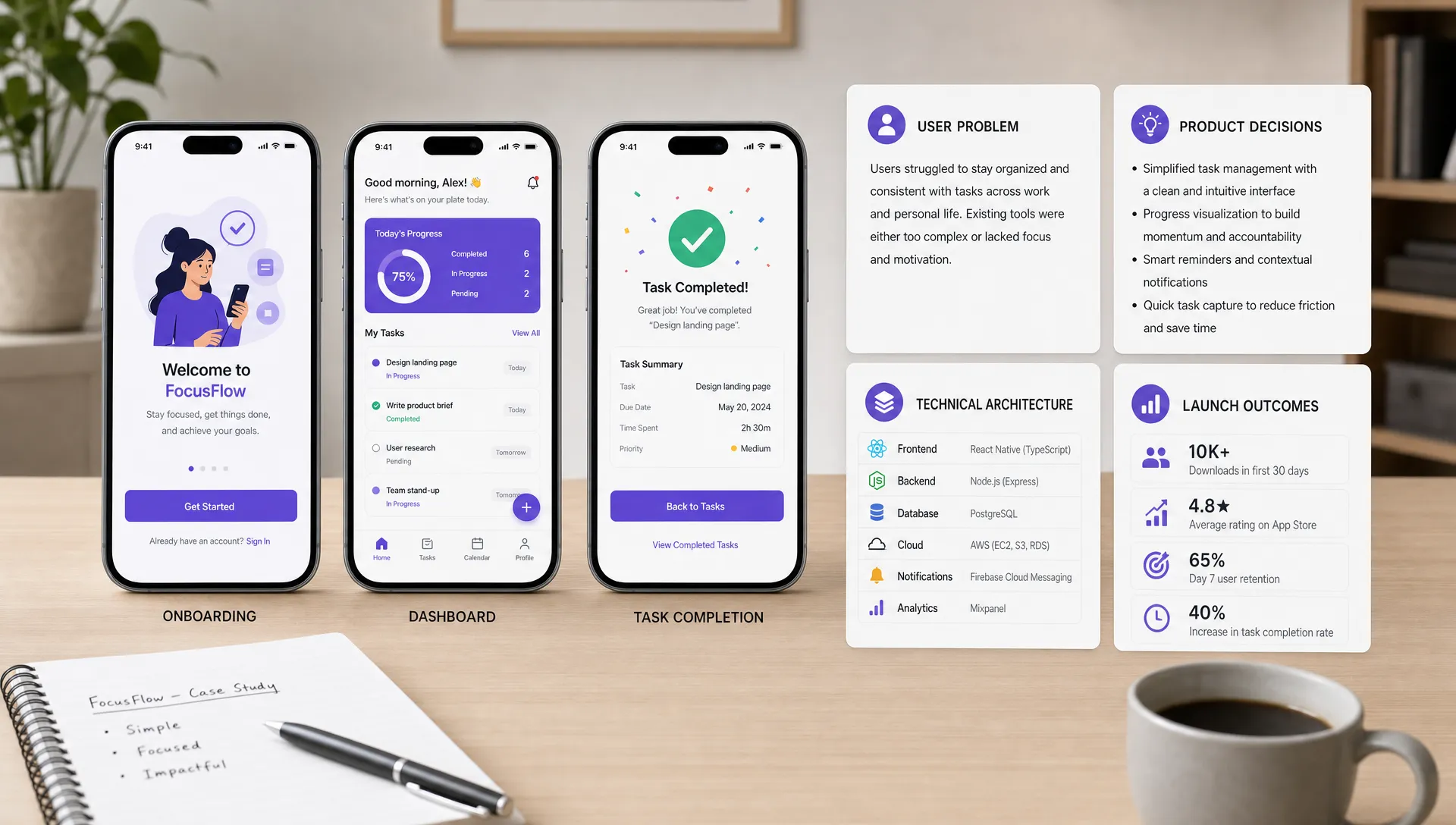
A buyer does not need to see every line of code, but they do need evidence that the app is maintainable, secure, performant, and ready for real users. Make your technical decisions understandable to non-technical decision makers.
| Client concern | Portfolio proof | Example detail to show |
|---|---|---|
| “Will this scale?” | Architecture summary | Backend services, cloud integration, data model, API strategy |
| “Will releases be painful?” | Delivery process | CI/CD, staged releases, QA environments, App Store review planning |
| “Will users trust it?” | Quality and security signals | Authentication, permissions, data handling, crash monitoring |
| “Will it work in real conditions?” | Context-aware engineering | Offline support, low-connectivity behavior, device testing |
| “Can we improve it after launch?” | Maintenance approach | Analytics, feedback loops, roadmap planning, support model |
The best technical sections are specific but not overwhelming. Avoid jargon dumps. Translate engineering choices into business impact.
For example, “We implemented offline-first field data capture” is more persuasive when followed by, “so technicians could complete jobs in low-connectivity areas and sync records later.”
Prove Business Value Without Inventing Numbers
Strong results help a portfolio sell, but never fabricate metrics. If you do not have permission to disclose numbers, use ranges, directional improvements, or qualitative evidence.
Useful outcome signals include activation rate, retention, task completion time, conversion rate, revenue influenced, operational hours saved, crash-free sessions, App Store rating, release frequency, or customer testimonials.
If the app has not launched yet, focus on validated progress. For example, you can show prototype testing insights, investor demo readiness, stakeholder approval, beta feedback, or successful App Store submission.
Here is a simple way to frame outcomes honestly:
| If you have... | Use this proof format |
|---|---|
| Public metrics | “Increased booking completion by 18% after launch.” |
| Private metrics | “Improved booking completion by a double-digit percentage.” |
| No numeric data | “Reduced a five-step manual process into one guided mobile workflow.” |
| Pre-launch work | “Validated the MVP flow with target users before engineering began.” |
| NDA restrictions | “Built a HIPAA-conscious intake flow for a healthcare operations team.” |
Clients can usually tell when a portfolio is inflated. Specific, honest proof builds more trust than vague claims like “10x growth” without context.
Write for Decision Makers, Not Other Designers
Your portfolio copy should be clear enough for a founder, investor, operations lead, or product executive to understand quickly. Avoid writing only for peers.
That does not mean dumbing things down. It means connecting every detail to the buyer’s priorities: speed, risk, usability, reliability, revenue, retention, operational efficiency, and customer trust.
Compare these two examples:
| Weak portfolio copy | Stronger portfolio copy |
|---|---|
| “We created a sleek mobile UI with custom components.” | “We redesigned the booking flow so users could complete a reservation in fewer steps on mobile.” |
| “We used a scalable backend architecture.” | “We separated scheduling, payments, and notifications into maintainable services to support future feature growth.” |
| “We delivered a premium design system.” | “We built reusable interface patterns so the product team could add new flows without redesigning from scratch.” |
The stronger examples are still polished, but they make the value obvious.
Show Your Process Without Turning the Portfolio Into a Textbook
Clients want to know what working with you will feel like. Your portfolio should give them a preview of your process, but it should not become a 40-page methodology document.
Focus on the moments where your process reduces risk:
- Discovery and product strategy that clarify the real MVP
- UX mapping that prevents costly rebuilds later
- Prototyping that gets stakeholder feedback before code
- Test-driven engineering that catches issues early
- Release planning that avoids App Store delays
- Post-launch support that keeps the product improving
This is especially important for funded startups. Investors and founders often need a partner who can move from ambiguous concept to launch-ready product without handoffs between disconnected teams. If that is your situation, Appzay’s guide to building a mobile application from idea to MVP to App Store gives a practical overview of the full journey.
Design the Portfolio Page for Conversion
A winning mobile app portfolio is also a conversion asset. Once visitors are convinced, make the next step obvious.
Each case study should lead naturally toward action. That might be a consultation, a product audit, a prototype review, or a short discovery call. The call to action should match the visitor’s stage of awareness.
A founder reading an MVP case study may not be ready to “hire now,” but they may be ready to discuss scope. A business owner reading an operations app case study may want to know whether their current workflow can be turned into a mobile product. Make that next step easy.
Also pay attention to the portfolio page experience itself. If it loads slowly, buries the best work, or feels hard to navigate on mobile, it undermines the very expertise you are trying to prove.
At minimum, your portfolio should include:
- A short positioning statement at the top
- Three to five featured case studies
- Clear filters only if you have enough projects to justify them
- Concise summaries for each project
- Deeper case study pages for serious buyers
- Proof signals such as testimonials, launch milestones, or ratings where available
- A clear call to action after each major section
Common Mistakes That Make a Mobile App Portfolio Less Persuasive
The most common mistake is treating the portfolio as a visual archive instead of a sales narrative. If the visitor has to guess what problem you solved, the case study is not doing its job.
Another mistake is showing too much work. A long list of mediocre or outdated projects can dilute your strongest proof. Lead with the work that matches the clients you want.
A third mistake is hiding your role. If you contributed to strategy, UX, engineering, launch, or support, say so clearly. If you collaborated with another team, explain where you fit. Ambiguity creates doubt.
Finally, avoid generic claims. Phrases like “world-class design,” “robust technology,” and “seamless experience” are only persuasive when supported by specifics.
Mobile App Portfolio Checklist
Before publishing or refreshing your portfolio, review it through a buyer’s lens.
- Does the first screen explain what kinds of mobile apps you build and for whom?
- Can a visitor understand the business problem behind each case study?
- Do you show user flows, not just isolated screens?
- Do you explain your product and technical decisions in plain language?
- Are outcomes specific, honest, and connected to client value?
- Is your role clear on every project?
- Do the featured projects match the type of client you want next?
- Is there a clear next step for a qualified lead?
If the answer is yes, your portfolio is no longer just proof of past work. It becomes a sales tool for future work.
Frequently Asked Questions
How many projects should a mobile app portfolio include? Most portfolios are stronger with three to five detailed case studies than with dozens of shallow examples. Choose projects that show your best strategic, design, and engineering work.
What if I do not have client apps yet? Build credible concept projects around real problems, but label them clearly. Show research, user flows, prototypes, and technical thinking. Do not present speculative work as paid client work.
Should a mobile app portfolio include code samples? Usually not on the main portfolio page. For technical buyers, you can include architecture summaries, engineering decisions, testing practices, or a private repository review during the sales process.
How do I show confidential client work? Use anonymized case studies. Remove brand names, sensitive metrics, and proprietary screenshots. Focus on the problem, your role, the process, and the type of outcome achieved.
What makes a mobile app portfolio different from a web design portfolio? Mobile apps depend heavily on flows, device constraints, performance, permissions, App Store requirements, and repeated user behavior. A strong mobile app portfolio should show how the product works over time, not only how it looks on one screen.
Turn Product Proof Into Client Trust
A mobile app portfolio that wins clients is clear, specific, and outcome-driven. It shows that you can think like a product partner, design for real user behavior, engineer for reliability, and support the path to launch.
If you are a funded founder building a mobile product and want a partner who can help take it from concept to App Store, Appzay provides end-to-end strategy, UX design, native iOS and Android engineering, launch support, and ongoing maintenance for high-quality mobile apps.