6/25/2026
How an App Store Optimization Agency Can Boost Downloads
Learn how an app store optimization agency improves visibility, conversion, reviews, and product signals to turn more store traffic into downloads.
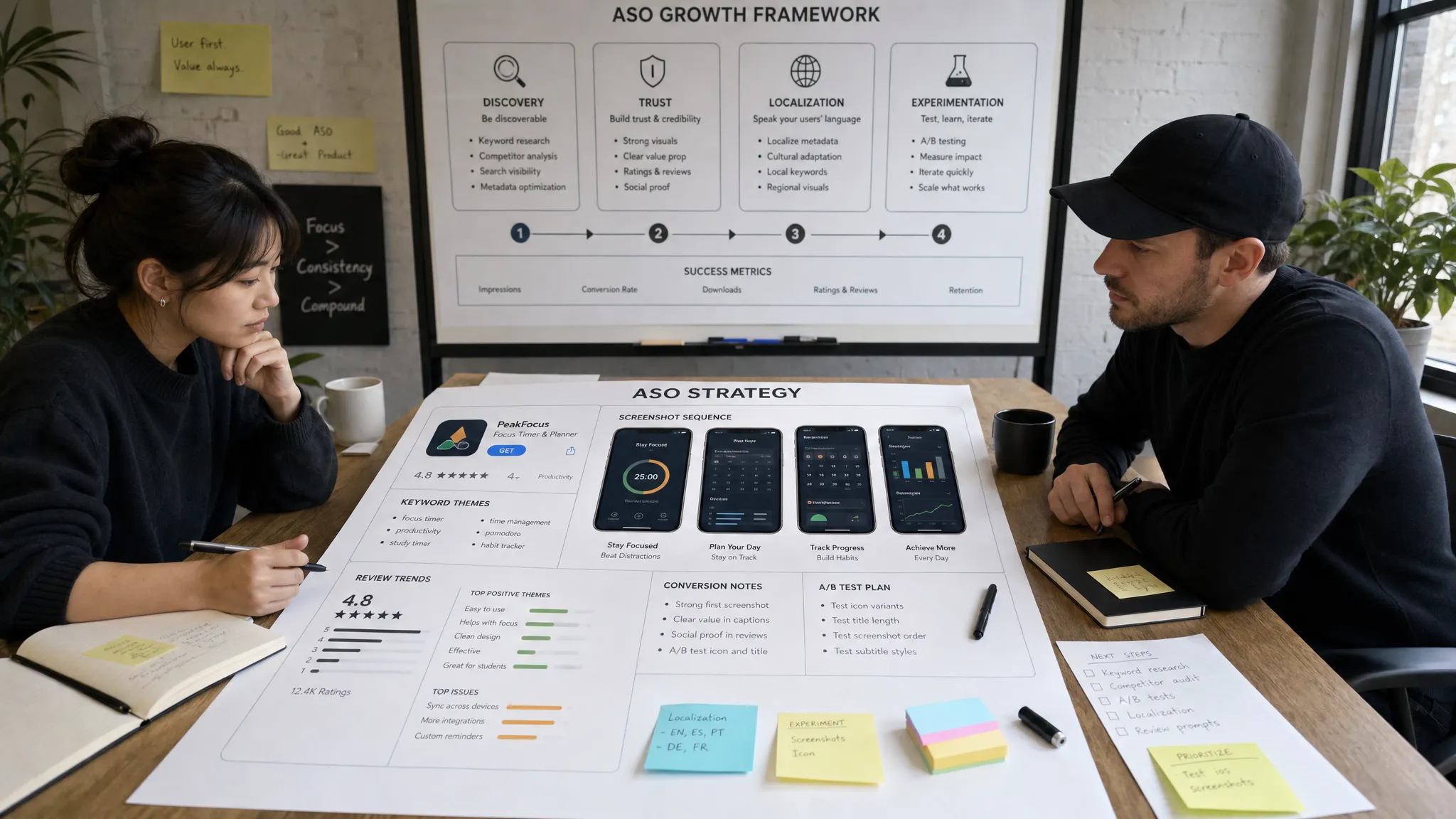
A great app can still struggle to grow if the right users never find it, or if they land on the store page and hesitate. That is where an app store optimization agency can make a measurable difference.
App Store Optimization (ASO) is often described as “SEO for apps,” but that definition is too narrow. For funded startups, ASO sits at the intersection of positioning, product strategy, creative testing, analytics, release planning, reviews, and technical quality. The best agencies do more than rewrite a title or swap screenshots. They help turn store traffic into qualified downloads, then use real data to keep improving.
Apple notes that search is one of the primary ways people discover apps in the App Store, and Apple Search Ads has historically reported that a large share of App Store visitors use search to discover apps. Google Play also gives developers detailed store listing tools and experiments because metadata, visuals, ratings, and localization all influence how users evaluate an app. In short, your store listing is not just a formality. It is a conversion page, a trust signal, and often the first product experience a user has.
Why downloads stall after launch
Many startups launch with a polished product, a strong landing page, and a paid acquisition plan, then discover that organic downloads do not grow the way they expected. The problem is rarely one single issue. It is usually a chain of small friction points across discovery, relevance, trust, and conversion.
A user might search for a problem your app solves, but your app may not appear for the terms they actually use. If they do find it, the screenshots may describe features instead of outcomes. The subtitle may be too vague. The first three lines of the description may not explain the value quickly enough. Reviews may be thin because the app has not built a review generation loop. Or the product may have technical issues that hurt retention, ratings, and long-term store performance.
This is why ASO should not be treated as a one-time launch checklist. A strong ASO program connects your market positioning with your app’s real user experience. If you want a deeper tactical foundation, Appzay’s guide to application store optimization that drives more downloads covers the core visibility and conversion levers in more detail.
What an app store optimization agency actually improves
An app store optimization agency helps increase downloads by improving two core outcomes: how often qualified users discover your app, and how often those users choose to install it. That sounds simple, but it requires coordinated work across several disciplines.
| ASO lever | What it improves | Why it affects downloads |
|---|---|---|
| Keyword strategy | Search visibility | Helps the app appear for relevant, high-intent searches |
| Title, subtitle, and metadata | Relevance and indexing | Communicates what the app does to both users and store algorithms |
| Screenshots and previews | Store page conversion | Shows the value of the app before users install |
| Ratings and reviews | Trust | Reduces hesitation and strengthens credibility |
| Localization | Market fit by region | Matches language, cultural context, and local search behavior |
| Store experiments | Learning velocity | Identifies which messages and creatives convert best |
| Product quality signals | Retention and satisfaction | Supports better reviews, fewer uninstalls, and stronger long-term growth |
The biggest mistake startups make is optimizing each item in isolation. A keyword strategy that attracts the wrong audience may increase impressions while lowering conversion. Beautiful screenshots that do not match the product promise may create disappointing installs. A high download count with poor retention can signal that acquisition is misaligned with the product.
A capable agency focuses on download growth that is sustainable, not just a short-lived spike.
The agency process: from diagnosis to download growth
1. Establish the real baseline
Before changing anything, a serious agency will audit your current store performance. That means looking beyond total downloads. They should separate impressions, product page views, conversion rate, install sources, keyword rankings, ratings, reviews, retention indicators, crashes, and country-level performance.
This baseline matters because the same download problem can have different causes. If impressions are low but conversion is strong, discovery may be the priority. If impressions are healthy but installs are weak, the listing likely has a positioning or creative issue. If installs are strong but reviews and retention are poor, ASO cannot be separated from product quality.
For founders, this diagnostic stage is valuable because it prevents random optimization. Instead of debating opinions about copy or screenshots, the team can identify the highest-leverage bottleneck.
2. Clarify positioning before choosing keywords
Keyword research is important, but it only works when the positioning is clear. A meditation app for executives, a sleep app for new parents, and a cognitive behavioral therapy app may overlap in broad wellness keywords, but they should not present themselves the same way.
An agency should map your app’s core use cases, competitors, user language, and commercial intent. The goal is not to chase every high-volume term. It is to find the phrases that match what your best users are already trying to solve.
For early-stage and funded startups, this is especially important because the app may be entering a crowded category. Winning attention often depends on narrowing the promise. If your product is “fitness for everyone,” it competes with giants. If it is “strength training plans for busy founders,” the audience is smaller, but the message can become sharper and more persuasive.
3. Build store metadata that balances users and algorithms
App store metadata has two jobs. It helps store algorithms understand where your app belongs, and it helps users decide whether your app is relevant. A strong agency writes metadata for both audiences.
On iOS, this includes elements such as the app name, subtitle, keyword field, promotional text, and description. On Google Play, it includes the title, short description, full description, tags, and other store listing elements. The rules and weight of each field differ by platform, so simply copying the same wording across both stores can leave growth on the table.
Good metadata is specific, readable, and aligned with the product. It avoids exaggerated claims, repetitive keywords, and vague phrases like “the ultimate app for everything.” It also stays compliant with Apple and Google policies. Overpromising may increase clicks temporarily, but it can also hurt trust, reviews, and approval quality.
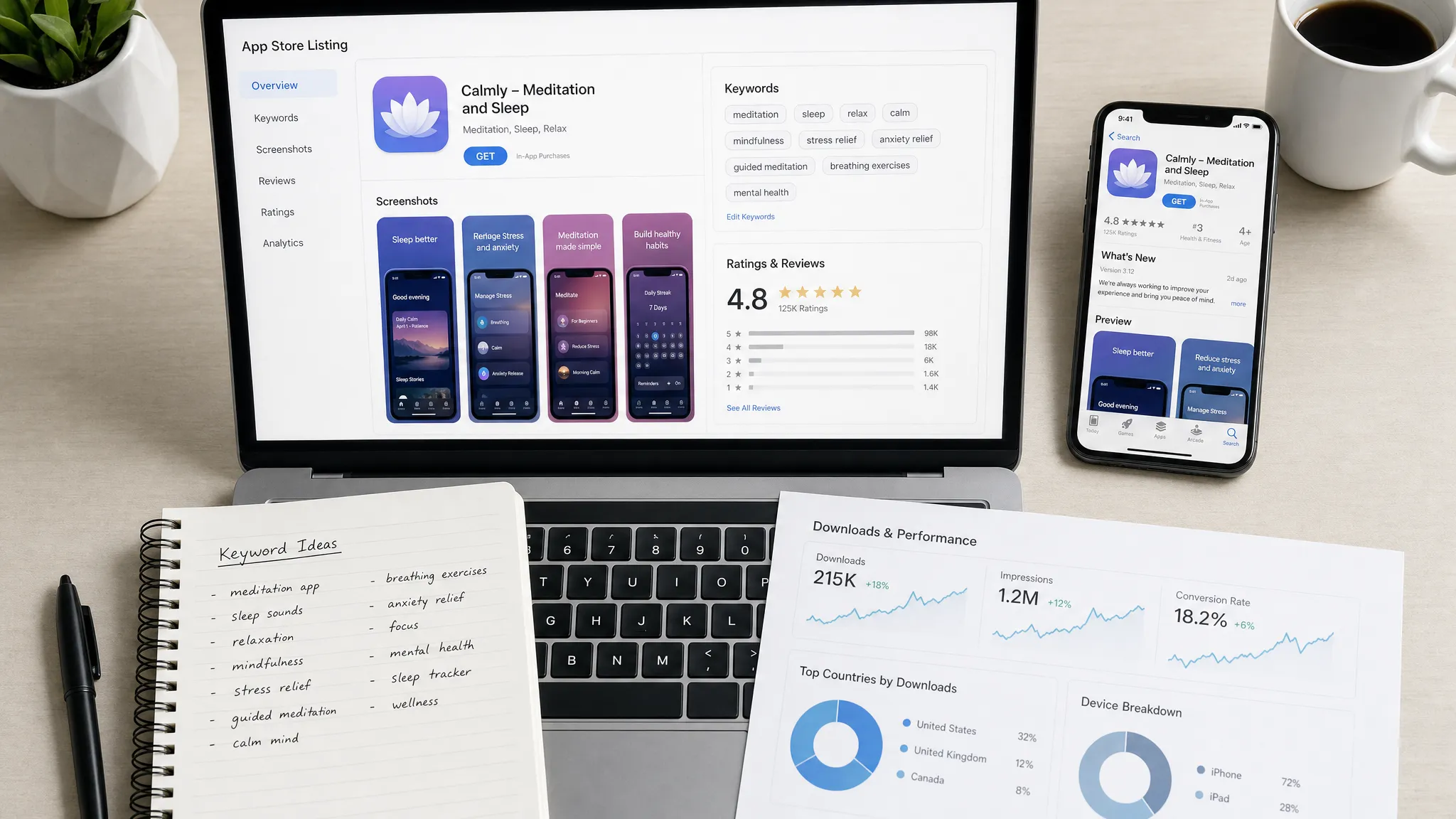
4. Turn screenshots into a conversion journey
Users often scan screenshots before they read the full description. That makes your visual story one of the strongest conversion levers on the page.
A strong screenshot sequence does not simply display app screens. It answers the user’s silent questions: What does this app help me do? How fast can I understand it? Why is it better than the alternatives? What will I see after installing?
An agency can help structure screenshots around outcomes, not just features. For example, instead of showing a dashboard with the caption “Advanced analytics,” the creative might say “See your weekly progress at a glance.” The first message is feature-led. The second connects the feature to a user benefit.
This is also where product and design quality matter. If the interface looks dated, confusing, or inconsistent, no amount of clever ASO copy can fully compensate. For startup teams still preparing for launch, Appzay’s guide to ASO app store optimization tips for startup launches is a useful companion because it connects launch planning with store positioning.
5. Improve trust through ratings and review operations
Ratings and reviews influence both user confidence and store performance. A user comparing two similar apps may choose the one with stronger reviews, clearer developer responses, and more recent positive feedback.
An agency should help you build an ethical review strategy. That means identifying the right moments to ask satisfied users for feedback, avoiding interruptions during critical tasks, responding professionally to negative reviews, and using review themes to improve the product.
This work must be handled carefully. Apple and Google have rules around ratings prompts, incentives, and misleading review practices. A reputable agency will not suggest buying reviews or manipulating ratings. Those tactics can damage trust and create platform risk.
The better approach is to make review generation part of the product experience. Ask after a meaningful success moment, such as completing a workout, finishing a project, saving money, booking a service, or achieving the core outcome your app promises. Then use negative reviews as product research. If users repeatedly mention onboarding friction, payment confusion, bugs, or missing features, those insights should feed the roadmap.
6. Use experimentation instead of guesswork
ASO becomes more powerful when it is run as a testing program. On Google Play, Store Listing Experiments allow teams to test variations of store assets. Apple also provides tools such as Product Page Optimization for testing different product page elements in App Store Connect.
An agency can design experiments around specific hypotheses. For example, one test might compare a benefit-led screenshot set against a feature-led set. Another might test whether social proof improves conversion in a competitive category. A localization test might evaluate whether country-specific messaging improves installs in a target market.
The key is to test meaningful differences, not tiny wording changes with no strategic purpose. A good agency will also avoid drawing conclusions too early. Tests need enough traffic and clean measurement to be useful.
7. Connect ASO with product quality
ASO cannot be fully separated from the app itself. If an app crashes, loads slowly, drains battery, or confuses users during onboarding, downloads may not translate into growth. Poor experiences can lead to bad reviews, higher uninstall rates, and weaker retention.
This is where founders should look for an agency that understands both store growth and product execution. The store page can win the install, but the app experience must validate the promise immediately. Appzay’s article on app optimization for speed, battery, and retention explains why technical performance plays a direct role in long-term app success.
For funded startups, this connection is critical. Investors and leadership teams usually care about efficient growth, not vanity downloads. If ASO attracts more users but the product cannot retain them, the growth loop breaks.
ASO agency vs in-house team vs freelancer
Not every company needs the same ASO support. The right model depends on your stage, internal skills, and growth goals.
| Option | Best for | Main advantage | Potential limitation |
|---|---|---|---|
| In-house team | Apps with mature growth operations | Deep product context | May lack specialized ASO testing experience |
| Freelancer | Narrow tasks like copy or screenshots | Flexible and cost-efficient | Often limited strategic or technical scope |
| ASO agency | Startups needing strategy, execution, and iteration | Cross-functional expertise and process | Requires alignment and access to data |
| App development partner with ASO expertise | Founders building or relaunching an app | Connects product, engineering, launch, and store growth | Best fit when ASO is part of a broader build or scale effort |
An app store optimization agency is most valuable when the download challenge is not just a copywriting problem. If your app needs positioning, conversion design, analytics, release coordination, localization, and product feedback loops, a broader agency approach can outperform isolated tactics.
Metrics that reveal whether ASO is working
Downloads are the headline metric, but they are not enough on their own. A professional ASO program should track the full path from discovery to install quality.
Important metrics include:
- Impressions by source and country
- Product page views
- Product page conversion rate
- Keyword rankings for priority terms
- Install volume by channel
- Ratings volume and average rating
- Review sentiment and recurring complaints
- Crash rate and technical quality indicators
- Activation, retention, and uninstall trends
The goal is to understand not only whether downloads increased, but why. If downloads rise because conversion improved, the store page is doing better work. If downloads rise but retention falls, the app may be attracting less qualified users. If impressions increase but conversion drops, keywords may be too broad or the creative may not match user intent.
A good agency will explain these tradeoffs clearly. They should not hide behind a single blended number.
When should a startup hire an app store optimization agency?
The best time to think about ASO is before launch, not after the app is already live. Store positioning affects product naming, onboarding, feature prioritization, preview assets, analytics setup, and release planning.
A startup should consider agency support when it is preparing for an App Store or Google Play launch, entering a competitive category, scaling paid user acquisition, expanding into new markets, or seeing weak conversion despite healthy traffic. It is also useful before a major redesign or relaunch, when the team has a chance to reposition the product and reset the store experience.
For funded startups, ASO can also reduce waste in paid acquisition. If your store page converts poorly, paid campaigns become more expensive because too many clicks fail to become installs. Improving the listing can make both organic and paid channels more efficient.
How to choose the right ASO partner
The right agency should ask about your business model, audience, retention, onboarding, category, roadmap, and technical constraints before recommending tactics. If the first suggestion is “add more keywords,” that is a warning sign.
Look for a partner that can connect strategy with execution. They should understand Apple and Google store differences, know how to evaluate competitors, write clear metadata, guide creative testing, interpret analytics, and collaborate with product and engineering teams.
Be cautious of agencies that guarantee specific rankings or promise overnight download growth. Store algorithms, competitor activity, seasonality, reviews, and product quality all affect performance. A credible agency can build a strong process and improve the probability of growth, but no one controls the stores completely.
For founders who need more than store listing advice, an end-to-end partner can be especially useful. Appzay works with startups across product strategy, UX design, native iOS and Android engineering, deployment, App Store optimization, and ongoing support. That combination helps ASO become part of the product lifecycle instead of a last-minute marketing task. You can explore the broader approach on Appzay’s mobile app development site.
Frequently Asked Questions
What does an app store optimization agency do? An app store optimization agency improves an app’s visibility and conversion in the App Store and Google Play. This usually includes keyword strategy, metadata, screenshots, reviews, localization, testing, and performance analysis.
How long does ASO take to increase downloads? Some changes, especially creative and conversion improvements, can show signals within weeks if the app has enough traffic. Keyword ranking, reviews, localization, and product-quality improvements usually take longer and require ongoing iteration.
Is ASO only for organic downloads? No. ASO also improves the efficiency of paid acquisition because users who click an ad still evaluate the app store page before installing. A stronger listing can improve conversion across both organic and paid traffic.
Can ASO help a brand-new app? Yes, but expectations should be realistic. New apps often have limited reviews, limited ranking history, and less performance data. ASO helps establish a stronger foundation for discovery, conversion, and launch learning.
Should my app development agency also handle ASO? It can be an advantage if the agency understands store growth and product execution. ASO is stronger when it connects to UX, performance, onboarding, analytics, release planning, and long-term product quality.
Build an app that is ready to be found, chosen, and downloaded
More downloads do not come from metadata alone. They come from a store presence that clearly communicates value, earns trust, matches real user intent, and reflects a product worth keeping.
If you are building or preparing to launch a funded startup app, Appzay can help connect the dots between product strategy, premium mobile development, App Store optimization, and post-launch support. Start with a product that is engineered to perform, then give it the store presence it needs to grow.