6/20/2026
Mobile App Architecture Choices That Scale Cleanly
Learn mobile app architecture choices that help funded startups scale cleanly, avoid rewrites, and ship reliable iOS and Android apps.
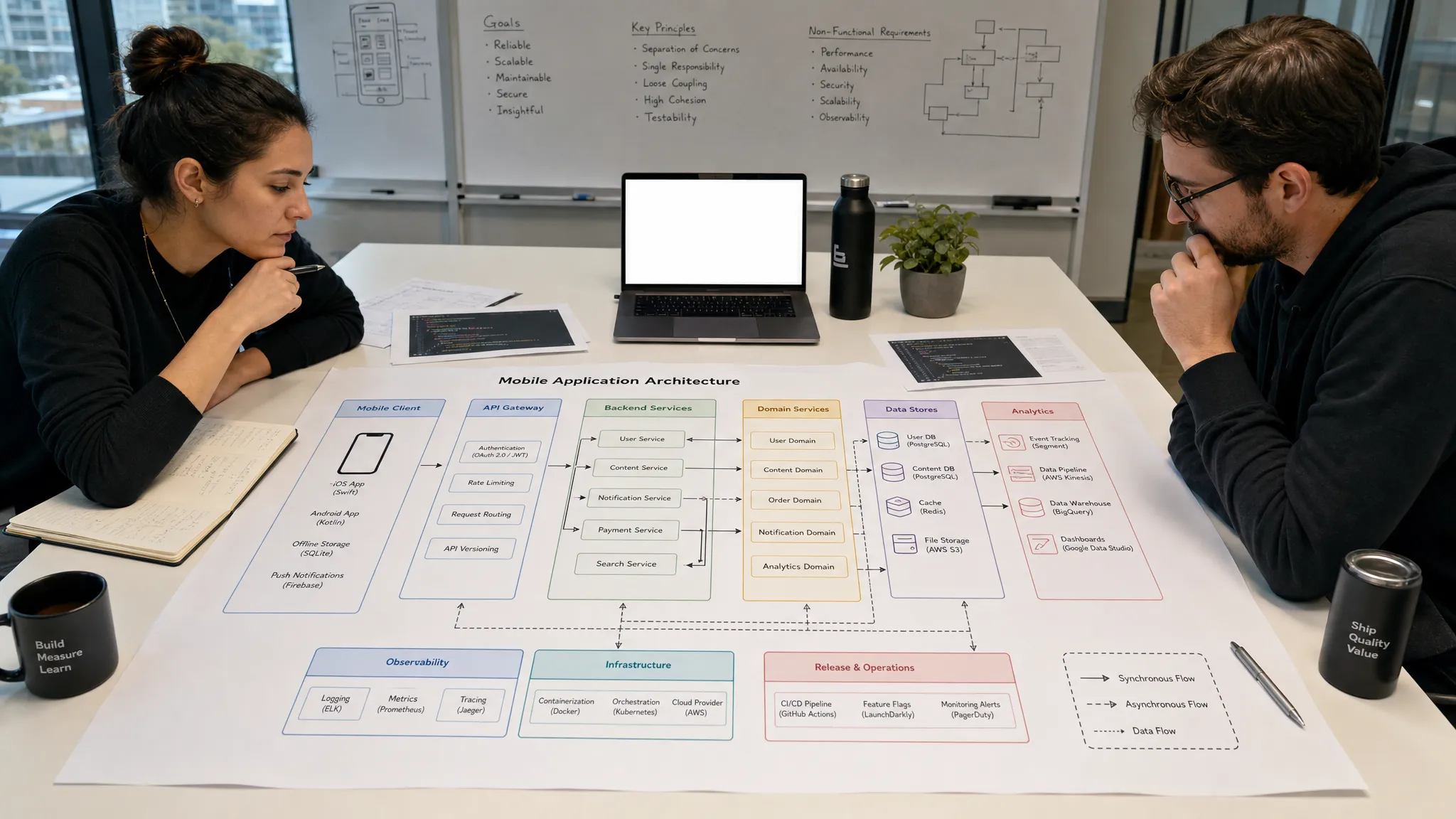
A mobile app can look polished on launch day and still become painful to extend six months later. The difference is rarely one framework choice. It is the set of architecture decisions that determine how safely your team can add features, handle more users, integrate services, and release updates without breaking the product.
For funded startups, mobile app architecture is not an abstract engineering concern. It affects runway, user retention, investor confidence, and how quickly the product can respond to market feedback. The goal is not to overbuild for an imaginary future. The goal is to choose a structure that can grow cleanly when the future arrives.
Clean scaling means your app can absorb change without turning every update into a risky rewrite. That requires strong boundaries, stable contracts, testable flows, and infrastructure choices that match your product stage.
What “scales cleanly” really means
Scaling is often reduced to traffic volume, but mobile products scale in several ways at once. A consumer app may need to support more users. A marketplace may need more transaction states. A wellness, fintech, or healthcare-adjacent app may need stronger trust, content controls, or compliance review. A B2B app may need roles, teams, permissions, and enterprise integrations.
A cleanly scalable architecture handles four kinds of growth:
| Type of scale | What changes | Architecture pressure |
|---|---|---|
| User scale | More sessions, devices, notifications, and data reads | Backend capacity, caching, rate limits, observability |
| Feature scale | More workflows, edge cases, and business rules | Domain boundaries, modular code, test coverage |
| Team scale | More designers, engineers, QA, and release owners | Clear ownership, CI/CD, documentation, review standards |
| Business scale | New markets, monetization models, integrations, or compliance needs | API contracts, data modeling, permissions, auditability |
The best architecture choices make these growth patterns less dramatic. Instead of asking, “Can this support one million users?” ask, “Can we add the next major capability without undoing the last three?”
Start with product boundaries before technical patterns
The cleanest mobile architecture begins with product thinking, not folders in a codebase. Before choosing MVVM, Clean Architecture, Redux-style state, microservices, or serverless functions, map the core domains of the product.
A domain is a part of the business with its own rules. In a fitness app, workouts, subscriptions, progress tracking, and coaching content may be separate domains. In a marketplace, listings, payments, identity, messaging, and dispute handling deserve clear boundaries. In a connected product or commerce experience, product education, ordering, content, customer accounts, and device-adjacent interactions may evolve at different speeds.
For example, an innovative wellness brand like Air Tea Company’s herbal vaporization experience blends product education, physical goods, and customer trust. If that type of business later adds mobile ordering, guided sessions, account preferences, or content personalization, those capabilities should not be tangled into one unstructured “user screen” module.
Good boundaries keep your app adaptable. Poor boundaries make every feature feel like surgery.
A useful early exercise is to define what each part of the product owns:
| Boundary question | Why it matters |
|---|---|
| What business rule belongs here? | Prevents duplicated logic across screens and platforms |
| What data does this domain own? | Reduces accidental coupling between unrelated features |
| What can change independently? | Helps teams ship updates without touching the whole app |
| What must stay consistent across iOS, Android, and backend? | Guides API contracts and shared product rules |
If your team is still shaping the product scope, it helps to connect architecture with feature planning. Appzay’s guide to scoping features the smart way explains how to break big ideas into clearer capability slices before they become expensive build decisions.
Choose a client architecture that separates UI from rules
Mobile apps fail to scale cleanly when screens become the center of the architecture. Screens change constantly. Business rules should not be trapped inside them.
A scalable mobile client usually separates these concerns:
| Layer | Responsibility | Common scaling benefit |
|---|---|---|
| Presentation | Screens, components, navigation, view state | UI can change without rewriting business logic |
| Application logic | Use cases, user actions, workflow orchestration | Flows become easier to test and reuse |
| Domain model | Business entities, validation, rules | Product behavior stays consistent across features |
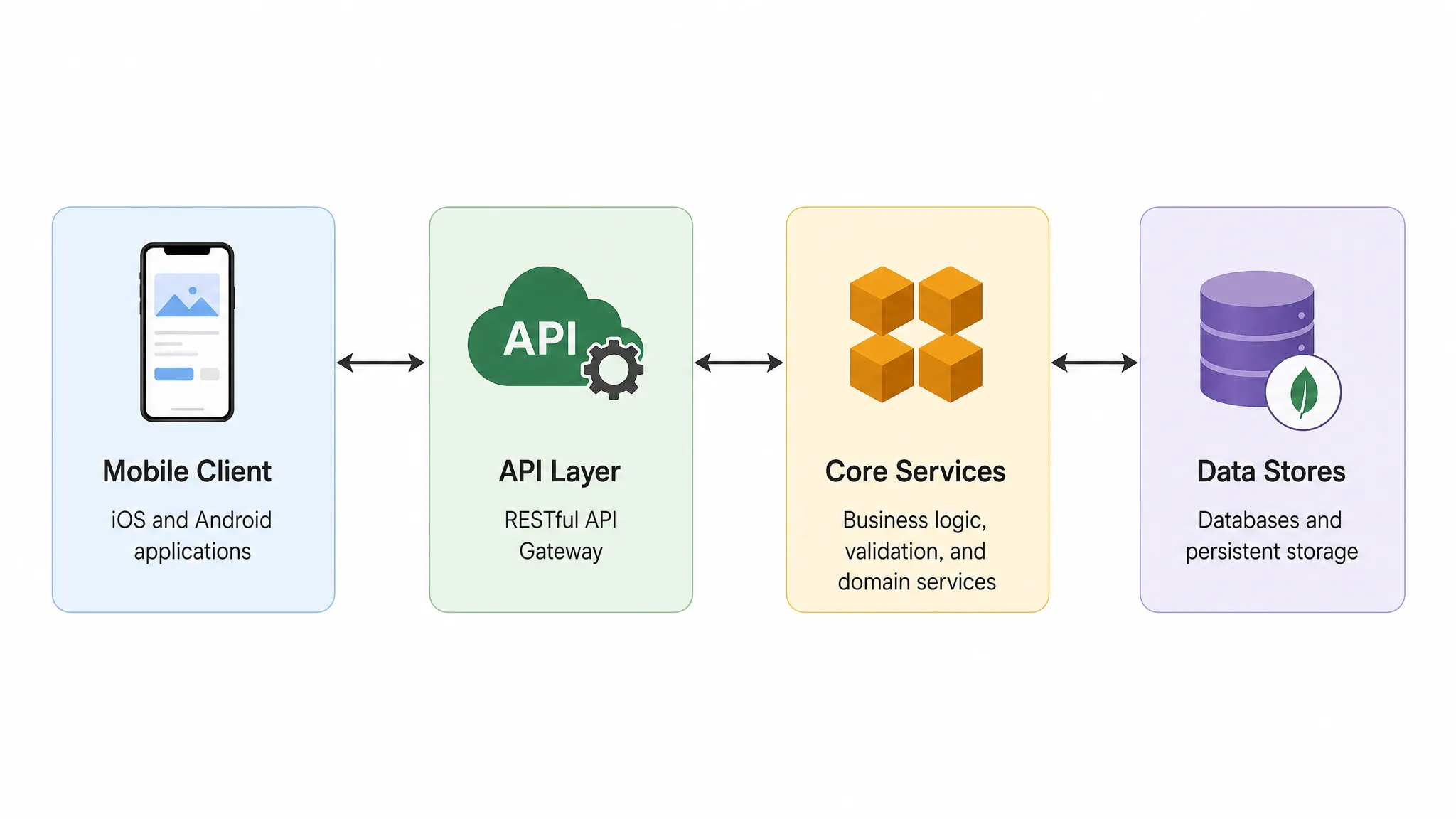
| Data access | APIs, caching, persistence, sync | Backend changes are isolated from UI code |
| Platform services | Push, camera, location, biometrics, payments | Native capabilities remain controlled and testable |
This structure does not require excessive ceremony. For a small MVP, the layers can be lightweight. The important part is direction: UI depends on application logic, application logic depends on domain rules, and data access sits behind interfaces rather than leaking everywhere.
That separation matters when the app grows. If onboarding, checkout, notifications, and account settings all call APIs directly from screens, then a backend change forces risky edits across the app. If screens talk to use cases and use cases talk to repositories or service interfaces, change is contained.
For native iOS and Android apps, this also makes platform differences easier to manage. The interface may feel native on each platform, while the underlying product rules remain aligned.
Be careful with “simple” backend choices
Early backend decisions often look harmless because the first product version has limited traffic and a small data model. The real question is not whether the backend can serve the MVP. It is whether the backend can evolve as the product discovers its real shape.
A modular monolith is often a strong starting point for startups because it keeps deployment simple while preserving domain boundaries. Serverless can be excellent for event-driven workloads, scheduled tasks, and bursty traffic. Microservices can help when domains have different scaling profiles or team ownership, but they add operational cost and should not be adopted just because they sound scalable.
| Backend approach | Best fit | Watch out for |
|---|---|---|
| Modular monolith | Early to mid-stage products with evolving domains | Poor internal boundaries can still create a big ball of mud |
| Serverless functions | Event-driven features, automation, variable traffic | Hard-to-follow business flows if functions multiply without structure |
| Microservices | Mature domains, independent teams, different scaling needs | More DevOps, monitoring, network complexity, and data consistency work |
| Backend-as-a-service | Fast prototypes, standard auth or data needs | Vendor constraints and migration complexity if the product becomes custom |
The right answer depends on your product, team, funding stage, and risk profile. If your mobile app depends heavily on cloud infrastructure, storage, authentication, or async processing, Appzay’s guide to cloud-based app development for scalable startups covers the backend layers that usually matter most.
Treat APIs as long-term contracts
Mobile APIs are harder to change than web APIs because users do not update instantly. Even if you release a new app version today, some users will stay on older versions for weeks or months. That makes API design one of the most important mobile app architecture choices.
A clean API strategy should plan for evolution. Additive changes are safer than breaking changes. Versioning should be deliberate, not improvised during a crisis. Error formats should be predictable. Idempotency matters for payments, booking, messaging, and any action where duplicate submissions can create real problems.
Strong mobile API contracts usually include:
- Stable request and response structures that avoid unnecessary breaking changes
- Clear error codes that the app can translate into helpful user states
- Pagination and filtering patterns before data sets become large
- Idempotency keys for sensitive actions such as checkout or account changes
- Feature flags or capability checks so backend and app releases can move safely
This is also where product and engineering need to align. If the business expects to test pricing, change onboarding, support new account types, or add subscriptions, the API should not hardcode assumptions that make those changes expensive.
Build for offline and sync only when the product needs it
Offline support sounds attractive, but it is not a checkbox. True offline-first architecture introduces conflict resolution, local persistence, sync queues, retry logic, and complicated edge cases. For some products, that investment is essential. For others, it slows the team down without improving the user experience.
The cleaner choice is to define the app’s offline promise clearly.
A banking or health record app may need reliable read-only access to critical information. A delivery app may need graceful recovery during weak network conditions. A social app may allow draft creation offline but require a connection to publish. A meditation or education app may cache content for uninterrupted use.
Each of those promises leads to different architecture decisions. Do not build offline infrastructure because it feels “scalable.” Build it because the user journey requires it.
Make data ownership explicit early
Data modeling is where many mobile apps quietly accumulate future rework. The app starts with a few user fields, then adds preferences, roles, subscriptions, activity history, notifications, support metadata, and analytics events. Without clear ownership, data becomes duplicated across tables, services, caches, and client state.
Clean scaling requires deciding which system owns each truth. The mobile app may cache data, but it should not become the source of truth for business-critical state. The backend should own rules like subscription status, inventory availability, eligibility, permissions, and transaction outcomes.
This is especially important for monetized products. If the client decides too much, users can see inconsistent pricing, access content they should not, or encounter impossible states after a failed payment. If the backend owns the business rule and the client owns presentation, the system remains easier to reason about.
A practical rule: if a decision affects money, access, security, compliance, or another user, it should generally be enforced server-side.
Design for release safety, not just code elegance
Architecture is not only about how code is organized. It is also about how safely that code reaches users.
Mobile releases carry more friction than backend deployments. App review, phased rollouts, device fragmentation, operating system differences, and user update delays all affect your architecture. A cleanly scaling app should support release control from the start.
Important release-oriented choices include feature flags, remote configuration, backward-compatible APIs, automated test coverage, crash reporting, and CI/CD pipelines. These practices reduce the cost of change because teams can detect problems earlier and limit the blast radius of a bad release.
This is where many startups underestimate operational maturity. A beautiful codebase without reliable release orchestration can still become fragile. A slightly less elegant codebase with strong testing, monitoring, and rollback strategies may scale more safely in the real world.
Avoid architecture choices that overfit the MVP
An MVP should be focused, but it should not be disposable by default. Some teams confuse speed with shortcuts that make the second version harder than the first.
Common overfitting mistakes include putting all logic in screens, skipping API design because there are only a few endpoints, building admin operations manually in the database, ignoring analytics until after launch, and hardcoding product assumptions that are likely to change.
The better approach is to build thin but clean. A thin capability has just enough functionality to test the product assumption. A clean capability has boundaries that allow it to expand later.
For example, a first version of referrals might only support one invite method. But the architecture should still recognize referral ownership, tracking, reward eligibility, and fraud prevention as distinct concerns. You do not have to build everything now, but you should avoid making the obvious future impossible.
Choose patterns based on change frequency
Not all parts of an app change at the same rate. Your architecture should reflect that.
User interfaces usually change quickly. Business rules change moderately as the product learns. Core identity, payment history, and audit data should change carefully. Analytics schemas may evolve often, but they need governance so reporting does not become unreliable.
A useful architecture review question is: “What will change most often, and what must remain stable?”
| Product area | Likely change frequency | Architecture implication |
|---|---|---|
| Onboarding screens | High | Keep UI flexible and driven by reusable components |
| Pricing experiments | Medium to high | Keep pricing rules backend-owned and configurable |
| Authentication | Low to medium | Prioritize security, stability, and proven providers |
| Analytics events | Medium | Define naming conventions and event ownership |
| Payments | Low change tolerance | Use strong testing, idempotency, and server-side validation |
| Content feeds | High | Plan for pagination, caching, ranking, and moderation hooks |
This lens keeps the architecture practical. You do not need maximum abstraction everywhere. You need the right flexibility in the places most likely to change.
Plan integrations as architecture, not add-ons
Payments, maps, analytics, messaging, AI services, customer support, and push notifications can all shape architecture. Treating them as late-stage plug-ins often creates security gaps, duplicated user data, and brittle workflows.
Integration planning should answer basic questions early. What data leaves your system? Which provider is the source of truth? What happens if the provider is down? How are webhooks verified? How are retries handled? What events should analytics capture? Who owns consent and user preferences?
This is particularly important for apps that monetize, personalize, or automate workflows. Appzay’s app integration guide goes deeper into planning payments, maps, analytics, auth, push, CRM, and AI integrations without creating avoidable rework.
Match architecture to the team that will maintain it
The best architecture for a five-person team is not always the best architecture for a fifty-person engineering organization. Startups need systems that are understandable, testable, and maintainable by the people who actually own them.
A highly distributed service architecture may look impressive, but if nobody has time to monitor it properly, it can slow the company down. A cross-platform codebase may promise efficiency, but if the product demands deep native performance or platform-specific polish, the trade-off may not be worth it. A custom backend may offer control, but if the product only needs standard authentication and simple data storage at first, it may not be the fastest path to learning.
Clean scaling is not about choosing the most advanced pattern. It is about choosing the pattern your team can operate confidently as the product grows.
A practical decision checklist for founders
Before committing to a mobile app architecture, founders and technical leaders should pressure-test the choices against real business needs.
Use these questions as a working checklist:
- What product domains need to evolve independently?
- Which rules must be enforced on the backend rather than the client?
- How will older app versions behave when the API changes?
- Which features need offline support, and what exact promise are we making?
- What integrations are business-critical, and how do we handle provider failures?
- What data needs auditability, privacy controls, or strict permissions?
- How will we test core flows before every release?
- What can be built thin now without blocking expansion later?
If the answers are vague, the architecture is probably not ready. If the answers are specific, the team can make simpler technical choices with more confidence.
How Appzay thinks about scalable mobile app architecture
At Appzay, architecture is treated as a product decision as much as an engineering decision. For funded startups, the challenge is rarely “build an app.” The harder challenge is building the right first version in a way that can support real users, future features, and investor-backed growth.
That is why a strong mobile build process connects product strategy, UX design, native iOS and Android engineering, cloud architecture, CI/CD, release planning, and ongoing maintenance. The architecture should support the user experience, the business model, and the team’s ability to keep shipping after launch.
Clean scaling does not mean predicting every future requirement. It means making today’s choices in a way that preserves tomorrow’s options.
Frequently Asked Questions
What is mobile app architecture? Mobile app architecture is the structure that defines how an app’s UI, business logic, data access, backend services, integrations, and platform capabilities work together. Good architecture makes the app easier to test, maintain, scale, and evolve.
Which mobile app architecture is best for startups? There is no universal best architecture. Many startups benefit from a modular client, stable API contracts, backend-owned business rules, and a backend approach that fits the product stage. The right choice depends on the product’s complexity, growth expectations, team size, and funding runway.
Should a startup use microservices from day one? Usually not. Microservices can help mature products with independent domains and teams, but they add operational complexity. A modular monolith or carefully structured cloud backend is often cleaner for early-stage products.
How do API decisions affect mobile app scaling? Mobile users may stay on older app versions, so breaking API changes can cause serious reliability issues. Stable contracts, versioning, predictable errors, and backward-compatible changes help mobile apps scale without forcing emergency updates.
Does scalable architecture make MVP development slower? Not necessarily. The goal is not to build every future feature. The goal is to build thin features with clean boundaries, so the MVP launches quickly without creating avoidable rewrite risk.
Build a mobile app that can grow without the rewrite
If your startup is preparing to build, rebuild, or scale a mobile product, the architecture choices you make now will shape every release that follows. Appzay helps founders turn funded app ideas into high-quality iOS and Android products with strategy, design, engineering, launch, and support handled end-to-end.
To plan a build that is polished at launch and practical to scale, start a conversation with Appzay.