6/15/2026
How to Pick a Mobile App Design Agency That Can Ship
Learn how to choose a mobile app design agency that designs usable flows, collaborates with engineers, and gets iOS and Android apps shipped.
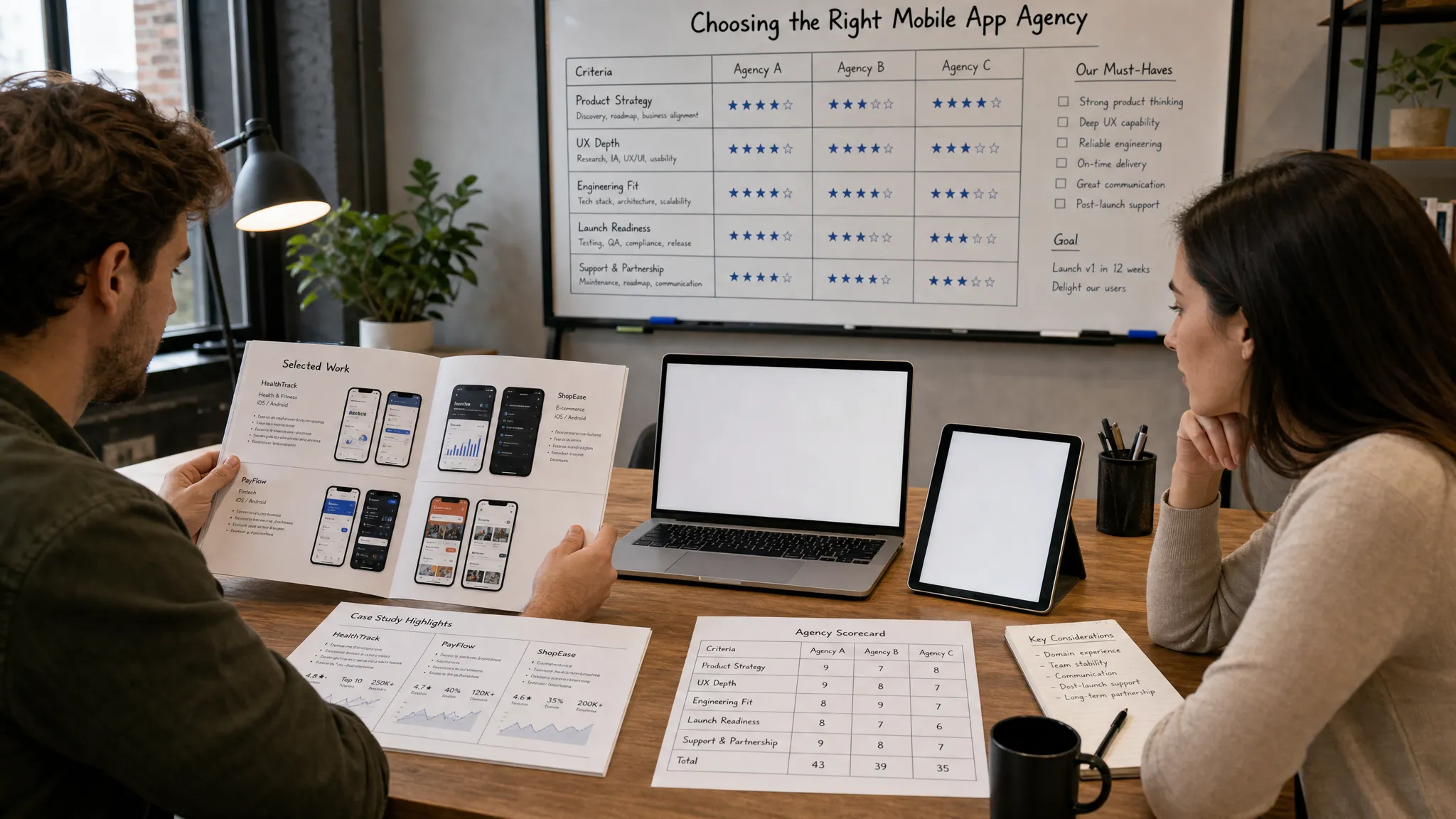
Choosing a mobile app design agency is not just about finding a team that can make attractive screens. For a funded startup, the real question is sharper: can this team help you get a usable, stable, review-ready product into users’ hands?
That distinction matters because mobile products fail in the gaps between disciplines. A beautiful onboarding flow can collapse when permissions are requested at the wrong moment. A polished prototype can hide missing empty states, offline behavior, accessibility issues, or backend assumptions. A slick Figma file can still take months to translate into production code.
The best mobile app design agency is not simply a visual partner. It is a product, UX, and delivery partner that designs with engineering, launch, and iteration in mind from day one.
Define what shipped means before you evaluate agencies
Before comparing portfolios, define what you need the agency to help you ship. For most startup mobile products, shipped does not mean a clickable prototype or a set of high-fidelity screens. It means a focused first version that reaches the App Store and Google Play, supports the core user journey, collects useful feedback, and can be improved without major rework.
A shipping-ready V1 should usually include:
- A clear product promise and primary user loop
- Build-ready mobile UX for iOS and Android
- States for loading, errors, empty content, permissions, and edge cases
- Technical collaboration on architecture, data, integrations, and constraints
- App Store and Google Play readiness, including metadata and review-sensitive flows
- Analytics and feedback loops for post-launch decisions
- A realistic plan for iteration after the first release
If an agency’s process ends at visual design, that may still be useful if you already have a strong internal mobile engineering team. But if you need a partner that can take you from idea to launch, evaluate for delivery evidence, not just design taste.
For a deeper breakdown of the full build path, Appzay’s guide to mobile app development services and what end-to-end includes is a useful reference point.
Screen-focused agencies vs shipping-focused agencies
A strong portfolio can be misleading if you only look at finished visuals. Instead, ask what happened before, during, and after those screens were designed.
| Evaluation area | Screen-focused agency | Shipping-focused mobile app design agency |
|---|---|---|
| Case studies | Shows polished UI screens and brand moments | Explains the product problem, constraints, tradeoffs, launch outcome, and iteration path |
| Discovery | Asks what screens you want | Asks what user behavior, business metric, and technical risks the app must solve |
| UX design | Produces flows for ideal use cases | Designs real-world states, permissions, errors, empty states, and repeat usage |
| Engineering fit | Hands off Figma files at the end | Involves engineers early to validate feasibility, platform constraints, and data needs |
| Launch readiness | Treats launch as someone else’s job | Designs for store review, onboarding, analytics, support, and first-release learning |
| Post-launch | Ends after design approval | Stays connected through QA, release feedback, and product iteration |
The difference is not cosmetic. It affects speed, budget, and product quality. Every unclear state or technical assumption that survives design becomes a more expensive decision during development.
Signal 1: they start with the core product loop
A mobile app does not retain users because it has many screens. It retains users because it helps them complete a valuable loop repeatedly.
For a marketplace, that loop might be search, compare, book, track, and review. For a health app, it might be log, understand, act, and return. For a sales productivity app, it might be capture, enrich, sync, and follow up.
A capable mobile app design agency should push you to define that loop before discussing colors, components, or animations. They should ask questions like:
- What moment makes the user feel the app is worth keeping?
- What is the fastest path to first value?
- What action should the user repeat weekly or daily?
- What failure states would break trust?
- What must be true for the app to succeed after launch?
If the agency jumps straight into moodboards without clarifying the core behavior, you may get a visually impressive product that does not activate or retain users.
This is also where strong agencies help founders reduce scope. They separate the essential V1 loop from nice-to-have features that can wait until real usage data exists.
Signal 2: they prototype risky moments, not just pretty screens
A clickable prototype is only valuable if it tests the right things. Many agencies prototype the most attractive parts of the interface, such as the home screen, profile page, or dashboard. Shipping-focused teams prototype the moments most likely to cause confusion, churn, or technical risk.
Those risky moments often include account creation, permissions, payment flows, onboarding, AI-generated outputs, map interactions, offline behavior, multi-step forms, or transitions between mobile and backend workflows.
For example, an AI-powered creative app should not only prototype the gallery or output screen. It should also test prompt input, user control, review and approval, error recovery, cost-sensitive workflows, and how teams manage generated assets. For AI-heavy creative workflows, founders should think about governance, model choice, and operational control early; platforms such as Virtuall’s operating layer for Creative AI show how production AI work increasingly depends on workflow control, not just an attractive interface.
A good agency will use prototypes to answer product questions before engineering begins. A weaker one will use prototypes mainly as sales artifacts.
Signal 3: they understand mobile constraints deeply
Mobile UX is not web UX on a smaller screen. It has platform expectations, device constraints, permission rules, background behavior limits, gesture patterns, accessibility needs, and store-review requirements.
An agency that can ship should design around these constraints early. That means they should understand how mobile decisions affect:
- Push notification timing and opt-in rates
- Location, camera, microphone, photo, and health permission flows
- Sign-in behavior, account deletion, and privacy expectations
- Offline states and weak-network recovery
- Battery impact from background activity
- Native platform conventions on iOS and Android
- Accessibility, touch targets, contrast, text scaling, and screen reader support
This does not mean designers need to write production code. It means they need enough mobile product experience to avoid designs that look good in isolation but become fragile, expensive, or non-compliant during development.
If your product includes complex mobile behavior, such as GPS tracking, background audio, health data, Bluetooth, payments, or AI integrations, bring engineering into the design process early. The design agency should welcome that, not resist it.
Signal 4: they produce build-ready design artifacts
A set of beautiful screens is not enough for a development team. Build-ready design explains how the product behaves.
Strong agencies produce handoff materials that reduce ambiguity for engineers, QA, and founders. The artifacts do not need to be overcomplicated, but they should be precise enough to prevent repeated clarification cycles.
| Artifact | Why it matters for shipping |
|---|---|
| Screen map | Shows how screens connect and prevents missing flows |
| Annotated user flows | Explains decisions, branches, and expected behavior |
| State coverage | Defines loading, empty, error, success, disabled, and permission-denied states |
| Component system | Keeps UI consistent and easier to implement across the app |
| Acceptance criteria | Makes design testable during development and QA |
| Analytics notes | Connects product events to activation, retention, and conversion metrics |
| Asset and copy handoff | Reduces delays from missing icons, images, labels, or microcopy |
This is where many projects lose weeks. Engineers start building, then discover that the design does not specify what happens when an API fails, a user skips onboarding, a subscription expires, or there is no data to show.
If you want to avoid that rework, ask agencies to show a real handoff example. Not a polished portfolio page, but the actual type of annotated design package they give to developers.
Appzay covers this pre-code planning process in more detail in how to design the app before you write code.
Signal 5: they collaborate with engineers before handoff
Design handoff should not be a single meeting at the end of the project. By then, too many decisions may already be expensive to change.
A shipping-focused agency includes technical review during design. Engineers should be able to comment on feasibility, identify hidden backend needs, flag platform differences, and suggest simpler ways to achieve the same user outcome.
This collaboration is especially important for startups because early product budgets are often tight. Small design choices can create large engineering consequences. A custom animation, real-time update, complex map interaction, or multi-role permission model might be worth building, but only if it directly supports the product’s primary value.
Good design agencies are not offended by constraints. They use constraints to produce a better first version.
Signal 6: they treat App Store readiness as part of UX
App Store and Google Play approval is not just an engineering or operations task. Many review issues are created by product and design decisions.
For example, permission prompts need clear context. Subscription screens need accurate messaging. Account deletion must be accessible when required. User-generated content may need reporting and moderation flows. AI features may need transparent handling of generated content. Health, finance, children’s, or location-based apps need extra care around privacy and claims.
A mobile app design agency that can ship should consider these requirements before development starts. It should also think about how the store listing connects to the in-app experience. Screenshots, onboarding, value proposition, and first-run UX should tell the same story.
If launch readiness is a major concern, review Appzay’s mobile app launch checklist for iOS and Android teams before you finalize agency selection.
Signal 7: they stay involved through QA and first release
Design quality is tested in production-like conditions. Real devices, slow networks, small screens, long names, empty accounts, repeated sessions, and accessibility settings expose issues that static mockups miss.
Ask whether the agency supports QA review before launch. A design partner that can ship should be willing to inspect builds, compare implementation against intended behavior, and help prioritize fixes. This does not mean pixel-policing every detail. It means protecting the usability of the core journey.
The best agencies also help interpret post-launch signals. If activation is weak, they look at onboarding and first-value flow. If retention is weak, they inspect the repeat loop. If conversion is weak, they review trust, copy, pricing presentation, or friction.
Design should not stop when development begins. It should remain part of product learning.
A practical scorecard for choosing the right agency
Use a scorecard so you are not swayed only by portfolio aesthetics, sales chemistry, or the lowest proposal. Adjust the weights based on your product, but for a funded startup trying to ship a mobile app, this is a sensible starting point.
| Category | Suggested weight | What to look for |
|---|---|---|
| Product strategy | 20% | Clear thinking about user outcomes, scope, MVP tradeoffs, and business goals |
| Mobile UX depth | 20% | Strong flows, platform awareness, accessibility, edge states, and repeat usage design |
| Engineering collaboration | 20% | Evidence of working with developers early, not just handing off screens |
| Launch readiness | 15% | Understanding of store review, onboarding, analytics, QA, and first-release risks |
| Communication | 15% | Clear process, weekly progress, documented decisions, and realistic timelines |
| Ownership and support | 10% | Clean handoff, source file ownership, post-launch support options, and continuity |
The goal is not to find a perfect agency. The goal is to find the agency whose strengths match your highest risks.
If your risk is unclear product-market fit, prioritize strategy and prototyping. If your risk is technical complexity, prioritize engineering collaboration. If your risk is an aggressive launch deadline, prioritize delivery operations and release experience.
Questions to ask before you sign
The fastest way to identify whether an agency can ship is to ask for evidence. Strong partners can show how they make decisions, not just what the final product looked like.
| Question | Strong answer |
|---|---|
| How do you decide what belongs in V1? | They describe user outcomes, risk, feasibility, and launch learning, not just feature preference |
| Can you show a design handoff example? | They show annotated flows, states, components, and acceptance criteria |
| When do engineers review the design? | They involve engineering during discovery, prototyping, and before final handoff |
| How do you handle platform differences? | They explain where iOS and Android should follow native conventions and where parity matters |
| What happens if user testing reveals a major issue? | They have a process for revising scope and flows before development cost increases |
| Do you support QA and launch review? | They stay involved through implementation feedback, build review, and launch readiness |
Listen for specificity. Vague answers like we follow best practices or our designs are developer-friendly are not enough. Ask for examples.
Red flags that an agency may not be able to ship
A design agency does not need to be perfect, but certain patterns should make you cautious.
- They cannot explain the business or user goal behind portfolio projects
- They focus heavily on visual trends but lightly on flows, states, and constraints
- They promise a full app design before understanding technical complexity
- They avoid conversations with engineers or treat development as a separate concern
- They do not ask about analytics, launch, store review, or post-launch iteration
- They cannot show examples of developer-ready handoff documentation
- They define success as design approval rather than a working product in users’ hands
The biggest red flag is a process that makes you feel progress is happening while the hard questions remain unanswered.
Should you choose design-only or end-to-end?
A design-only agency can be the right choice if you already have a trusted mobile engineering team, a technical leader who can review feasibility, and a clear process for turning design into production. In that case, the design agency should still collaborate closely with engineering.
An end-to-end partner is usually a better fit when you need one team to connect product strategy, UX, native or cross-platform engineering, backend architecture, CI/CD, App Store readiness, and post-launch support. This is often the case for funded founders who need speed but do not want to assemble a fragmented team of separate vendors.
The key is accountability. If design, engineering, QA, and launch are split across multiple teams, someone must own the complete outcome. Without that ownership, each team may do its part well while the product still misses the release window.
Frequently Asked Questions
What does a mobile app design agency do? A mobile app design agency helps define user flows, information architecture, wireframes, prototypes, visual design, interaction patterns, and developer-ready design assets for mobile products. The best agencies also consider technical feasibility, launch readiness, and post-launch iteration.
How do I know if an app design agency can actually ship? Look for case studies that explain the product problem, constraints, engineering collaboration, launch process, and post-launch results. Ask to see handoff documentation, QA involvement, and examples of how their design decisions affected the final app.
Should I hire a mobile app design agency before developers? Often, yes, but only if the design process includes technical review. Designing before coding can save significant rework, but designs should be validated against platform constraints, backend needs, integrations, and launch requirements before development begins.
What deliverables should I expect from a mobile app design agency? Expect a screen map, user flows, wireframes, interactive prototypes, high-fidelity UI, design system components, state coverage, copy notes, assets, and developer handoff documentation. For production work, acceptance criteria and analytics notes are also valuable.
Is an end-to-end agency better than a design-only agency? It depends on your team. If you have strong internal mobile engineering and product leadership, design-only can work. If you need one accountable partner to move from concept to App Store, an end-to-end agency is usually safer.
Pick the agency that reduces launch risk
A great mobile app design agency does more than make the product look premium. It helps you make better product decisions, avoid technical rework, prepare for store review, and get a focused first version into the hands of real users.
If you are building a funded mobile product and want one partner across product strategy, UX design, iOS and Android engineering, release orchestration, and post-launch support, Appzay can help you move from concept to App Store with a process designed for shipping, not just presenting.