5/29/2026
Build a Delivery App MVP That Actually Ships Orders
Build a delivery app MVP that ships real orders. Get the ordering, dispatch, tracking, payments, and support features needed to launch fast.
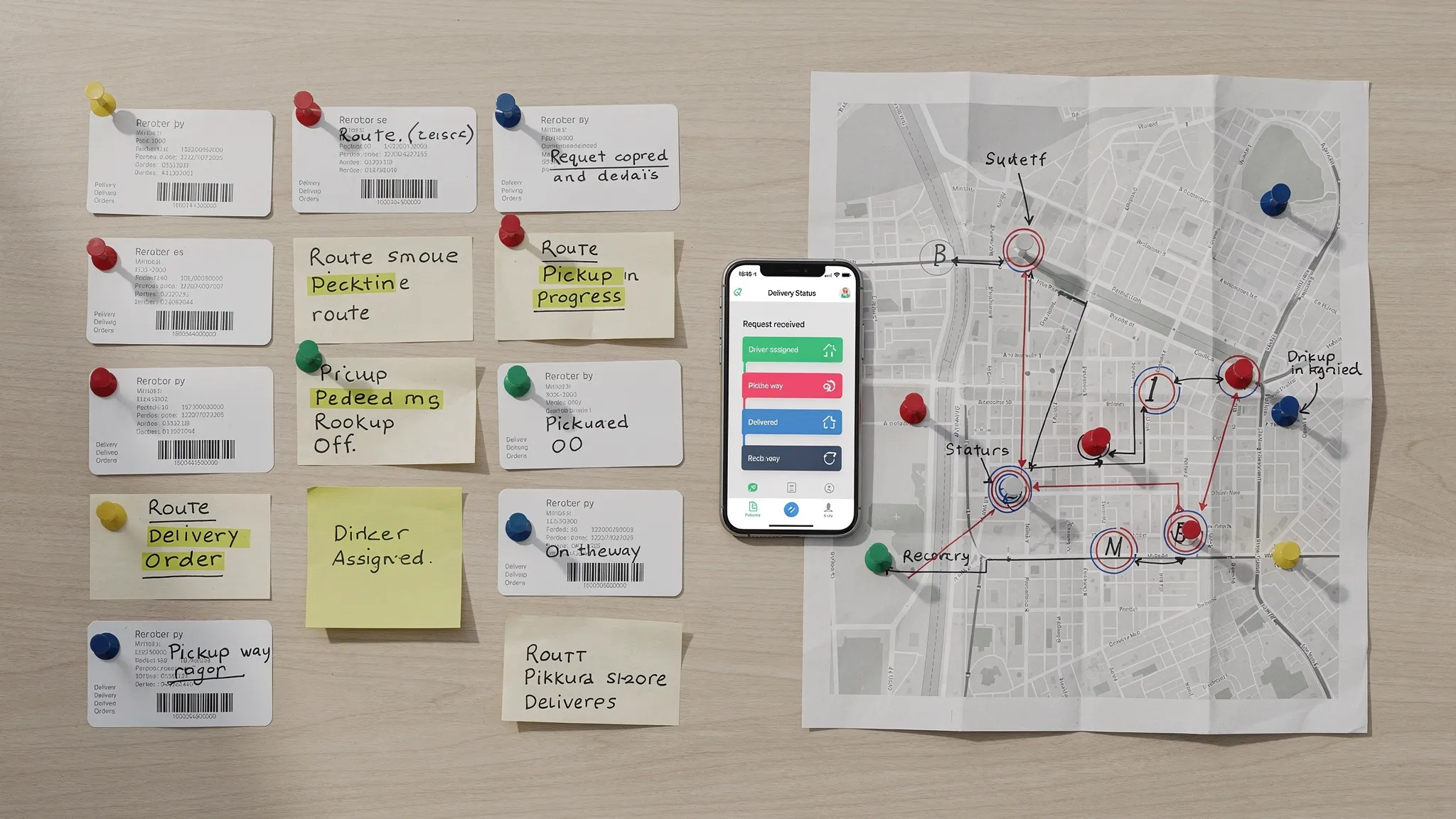
A delivery app MVP has to coordinate something most software products can avoid: real-world movement. A customer places an order, a courier or fleet operator accepts work, a merchant or warehouse prepares the item, payment is captured, location changes every minute, and exceptions can happen at any step.
That is why the best delivery app MVP is not a smaller clone of DoorDash, Instacart, Uber Eats, or a complex logistics suite. It is the smallest reliable product that proves one complete delivery loop: request, accept, fulfill, track, deliver, pay, and recover from problems.
For funded startups, this distinction matters. Every extra feature consumes runway, but every missing operational feature increases launch risk. The delivery app features below are the ones most MVPs need to feel credible, test demand, and operate safely from day one.
Start with the delivery model before choosing features
Delivery apps are not one category. A restaurant delivery marketplace, same-day courier platform, grocery fulfillment app, pharmacy logistics tool, and B2B field delivery product all share patterns, but their MVP scopes are different.
Before writing a feature list, answer these questions:
- Who creates demand: consumers, businesses, internal staff, or recurring accounts?
- Who fulfills deliveries: your own fleet, contractors, merchants, third-party couriers, or a hybrid model?
- What is being delivered: meals, parcels, groceries, parts, documents, prescriptions, equipment, or scheduled services?
- How time-sensitive is the job: instant, scheduled, same-day, next-day, or route-based?
- Who owns payment, refunds, tips, fees, taxes, and reconciliation?
- What proof of delivery is required: photo, PIN, signature, barcode scan, recipient confirmation, or geofence check?
These answers shape the MVP. If the product promise is on-demand food delivery, live courier tracking may be critical. If the promise is B2B scheduled materials delivery, proof of delivery, account permissions, and dispatch visibility may matter more than a polished consumer marketplace.
If you are still deciding how lean your first version should be, Appzay's guide to a mobile app MVP that can still win is a useful companion to this feature breakdown.
The core loop every delivery app MVP must prove
A delivery MVP succeeds when it completes the same core loop repeatedly with minimal manual rescue. The interface may differ by industry, but the underlying system is similar.
| Stage | User promise | MVP capability | Risk if missing |
|---|---|---|---|
| Request | The user can place a valid delivery order | Service area, address capture, item or shipment details, price estimate | Bad orders, failed coverage, support overload |
| Accept | The system can confirm the job | Merchant acceptance, warehouse confirmation, or dispatcher approval | Orders sit unfulfilled or expectations are unclear |
| Assign | A courier or driver gets the job | Manual or automated dispatch, courier availability, job details | Slow fulfillment and unreliable ETAs |
| Move | The user can see progress | Status updates, tracking, notifications | Users contact support because the app feels opaque |
| Handoff | Delivery can be completed with evidence | Proof of delivery, delivery notes, final status | Disputes, fraud, and operational confusion |
| Recover | Problems can be handled | Cancellation, refund, issue reporting, admin override | Small exceptions become launch-critical incidents |
| Learn | The team can improve the system | Analytics, crash reporting, delivery metrics | Founders guess instead of iterating from evidence |
The MVP does not need sophisticated automation at every stage. It does need visibility and control across the full loop.
Customer-facing delivery app features
The customer experience is where demand is tested. Whether the user is a consumer ordering dinner or an operations manager requesting jobsite supplies, the app must make the request feel simple, trustworthy, and trackable.
Simple onboarding and account recovery
A delivery app should reduce friction before the first order. Email, phone number, social sign-in, or magic link authentication can all work depending on your audience. What matters is that users can create an account, recover access, and return to previous orders without support intervention.
For MVPs, avoid collecting unnecessary profile information upfront. Capture what is required to fulfill the delivery, then progressively ask for more when the user reaches a relevant moment.
Address capture and serviceability checks
Address quality is one of the biggest hidden risks in delivery. Your MVP should include address search or autocomplete, saved addresses, apartment or suite fields, delivery instructions, and a way to validate whether the address is within your service area.
If the product has zones, cutoff times, delivery windows, or location-based pricing, show that before checkout. Nothing frustrates users faster than building a cart only to learn delivery is unavailable at the end.
Order or delivery request creation
This is the heart of the customer experience. For a marketplace, the MVP may include store browsing, menu or catalog items, cart management, quantities, substitutions, and special instructions. For a courier app, it may be a pickup address, drop-off address, package size, urgency, and handling notes.
Keep the first order flow narrow. A clean MVP usually supports one strong use case rather than every category you might add later. If your first vertical is lunch delivery, do not add grocery substitutions, corporate catering, and scheduled bulk orders in V1 unless they are essential to the business model.
Transparent pricing, payments, and receipts
Users should understand what they are paying before they confirm. Show item price, delivery fee, service fee, taxes, tips if relevant, discounts if used, and the final total. For B2B apps, this may be account billing, invoice references, purchase order numbers, or internal cost centers instead of consumer card checkout.
Payment integration should be part of the MVP if the app is responsible for transactions. Even if operations are manually managed behind the scenes, the user-facing payment experience should feel stable, secure, and reversible through refunds or adjustments when needed.
Order status and tracking
Every delivery app MVP needs progress visibility. This does not always mean a live animated map. At minimum, users should see meaningful statuses such as order received, accepted, assigned, picked up, en route, arriving soon, delivered, canceled, or delayed.
Live courier location can increase trust when the user is waiting in real time, but it also adds battery, privacy, background location, and accuracy considerations. If you include it, design it intentionally. If you defer it, use clear status updates and realistic ETA ranges instead.
Push notifications and delivery updates
Notifications are not a growth hack in a delivery app. They are part of the product experience. Users need timely alerts when the order is accepted, a courier is assigned, the delivery is approaching, a problem occurs, or the delivery is complete.
For MVPs, keep notifications transactional and user-controlled. Over-notifying early users can harm trust, while under-notifying pushes them into support channels.
Support, cancellations, and refunds
Delivery has edge cases. Drivers cannot access buildings, merchants run out of items, users enter the wrong address, traffic delays deliveries, and payments fail.
A credible MVP needs a simple support path tied to the order. That could be in-app issue reporting, a support form, order-specific help categories, masked contact options, or a manual support workflow through the admin panel. The goal is not to automate every case. The goal is to make every case traceable.
Courier and driver app features
The courier app is often where delivery MVPs succeed or fail. A beautiful customer app cannot compensate for drivers who cannot understand assignments, navigate efficiently, or report problems quickly.
Secure courier access and profile basics
Couriers need secure login, role-based access, and a basic profile. Depending on the model, operations may also need vehicle type, service zone, availability, identity verification status, or internal team assignment.
For an MVP, onboarding and compliance checks can be partially manual if the volume is controlled. But once a courier is active, the app experience should be simple and reliable.
Availability and assignment flow
The driver side needs a clear way to go online, receive jobs, review pickup and drop-off details, accept or reject work, and understand time expectations. Dispatch can be automated, manual, or hybrid in the MVP.
Many startups overbuild dispatch algorithms too early. In the first version, a dispatcher-facing admin console plus simple courier assignment can be enough to learn what the real operational bottlenecks are.
Navigation and job details
Couriers should not have to switch between messy notes and multiple tools to complete a delivery. The MVP should show pickup location, drop-off location, contact rules, delivery notes, package or order details, and navigation handoff to a map app.
If your product depends on route density or multi-stop routes, support that intentionally. Otherwise, single-job execution is usually the better MVP path.
Status updates and proof of delivery
Drivers should be able to update order status with as few taps as possible. Common actions include arrived at pickup, picked up, arrived at drop-off, delivered, failed delivery, and issue reported.
Proof of delivery is especially important for trust and dispute resolution. Choose the proof method that fits your model: photo, signature, PIN, barcode scan, QR scan, recipient name, or delivery note. Do not include all of them unless each is required.
Issue reporting for real-world exceptions
A delivery MVP needs a fast way for couriers to report problems. Examples include restaurant delay, item unavailable, wrong address, customer unreachable, access problem, damaged item, unsafe location, vehicle issue, or app error.
This is not just a support feature. It gives your operations team structured data about what breaks in the delivery loop.
Earnings or shift visibility when relevant
If couriers are contractors or paid per job, they may need delivery history, estimated earnings, tips, bonuses, or payout status. If couriers are internal employees, a simpler shift and job history view may be enough.
Do not copy gig-economy features blindly. Build the compensation visibility your actual courier model requires.
Merchant, dispatcher, and admin features
The admin side is rarely glamorous, but it is one of the most important parts of a delivery app MVP. Without it, your team cannot recover from exceptions, support users, or operate the business during beta.
| Role | MVP feature | Why it matters |
|---|---|---|
| Merchant or warehouse | Order inbox, accept or reject, preparation status, item notes | Prevents orders from entering a fulfillment black hole |
| Dispatcher | Job board, courier assignment, status changes, manual override | Keeps operations moving when automation fails |
| Support | Order lookup, customer and courier context, issue tags, refund path | Reduces time spent diagnosing problems |
| Finance or ops | Payment status, delivery fees, refunds, basic export | Supports reconciliation and margin visibility |
| Product team | Funnel, delivery timing, failure reasons, repeat usage | Shows what to improve after launch |
If your delivery product targets B2B operations, this layer becomes even more important. For example, teams building logistics tools for construction, field service, or multi-site operations can learn from how enterprise operators think about governed operating systems for construction enterprises. The takeaway for a delivery MVP is simple: software should reflect real decision rights, approvals, accountability, and exception handling, not just screens.
Backend and integration features you should not cut
Some of the most important delivery app features are invisible to users. They determine whether the product is scalable, supportable, and launch-ready.
| Foundation | MVP requirement | Founder decision |
|---|---|---|
| Authentication | Secure customer, courier, merchant, and admin roles | Which roles exist in V1 and who owns account creation |
| Maps and geocoding | Address lookup, distance estimates, routing handoff, zones | Whether live tracking is required or status tracking is enough |
| Payments | Card checkout, wallet support if needed, refunds, receipts | Who is merchant of record and how fees are calculated |
| Notifications | Push, email, or SMS for operational updates | Which events require real-time alerts |
| Real-time status | Order state machine, courier updates, admin visibility | Which statuses are user-facing versus internal |
| Admin console | Manual override, support tools, operational controls | What the team must be able to fix without engineering |
| Observability | Crash reporting, logs, API monitoring, delivery funnel events | Which failures trigger alerts before users complain |
| CI/CD and releases | Repeatable builds, environment separation, test gates | How quickly the team can ship fixes safely |
A delivery app also needs clear integration boundaries. Payment processors, mapping providers, analytics tools, notification services, POS systems, ERP systems, CRMs, and fleet tools can all become dependencies. Plan them as product decisions, not afterthoughts. Appzay's app integration guide covers how to approach payments, maps, analytics, and other mobile integrations without creating fragile architecture.
Delivery app features to defer until after validation
A strong MVP is not feature-poor. It is intentionally sequenced. The table below shows common feature requests that are often better after the first learning cycle.
| Advanced feature | MVP call | Add when |
|---|---|---|
| Complex route optimization | Defer unless route density is the core value proposition | You have enough delivery volume and data to optimize meaningfully |
| Loyalty programs and referrals | Defer for most MVPs | The core delivery experience is reliable and repeat usage is proven |
| Advanced promos and coupon rules | Keep simple | Marketing needs controlled experiments and fraud rules are clear |
| Full merchant self-service onboarding | Start with managed onboarding | Merchant acquisition volume becomes a bottleneck |
| In-app courier-customer chat | Use structured issue flows or masked contact first | Support data shows conversations are frequent and valuable |
| AI-based ETA prediction | Start with simple ETA windows | You have sufficient historical delivery data |
| Multi-city configuration | Launch one market or tightly defined region first | Unit economics and operations work in the first market |
| Driver gamification | Defer | Courier supply, quality, and retention are proven constraints |
The important distinction is between cutting complexity and cutting trust. You can defer gamification. You should not defer order visibility, support, payment clarity, or operational control.
UX details that make a delivery MVP feel premium
Delivery apps are judged in stressful moments. The user is hungry, waiting, coordinating a worksite, sending something urgent, or trying to avoid a failed handoff. Small UX decisions can dramatically reduce anxiety.
A launch-ready MVP should do the following:
- Use status labels that match how users think, not internal technical events.
- Make address entry forgiving, especially for apartments, offices, campuses, and job sites.
- Show ETA ranges honestly instead of pretending to know the exact minute.
- Design loading, empty, error, delayed, and offline states before development.
- Keep courier actions large, clear, and usable in the field.
- Ask for location and notification permissions at the moment users understand the benefit.
This is where product strategy, UX design, and engineering need to work together. A wireframe may look complete, but if it ignores weak networks, background location behavior, cancellation flows, or payment failure states, the MVP will feel unfinished in real use.
For more on planning flows before engineering, see Appzay's guide on designing an app before writing code.
Metrics to instrument from day one
A delivery app MVP should launch with analytics and monitoring already in place. You do not need a complex data warehouse in V1, but you do need enough signal to know whether the product is working.
| Area | Metric | Question it answers |
|---|---|---|
| Demand | Order started, checkout completed, first order completed | Are users willing to use the delivery flow? |
| Operations | Acceptance time, assignment time, pickup time, drop-off time | Where does fulfillment slow down? |
| Reliability | Failed deliveries, cancellations, refunds, support tickets per order | What breaks most often? |
| Experience | Repeat order rate, notification opt-in, user ratings or feedback | Do users trust the service enough to return? |
| Technical quality | Crash-free sessions, API errors, app start time, failed payment attempts | Is the product stable enough to scale? |
| Economics | Average order value, delivery cost, fee revenue, refund rate | Can the model become financially viable? |
The first 30 to 90 days after launch should be about learning from these signals and shipping targeted improvements. Appzay's article on monitoring reliable mobile products explains how to track crashes, performance, API health, core journeys, and store feedback in a practical way.
Example MVP scopes by delivery model
Not every delivery product needs the same first release. Use these examples as starting points, not templates to copy blindly.
| Delivery model | Include in MVP | Defer |
|---|---|---|
| Local restaurant or retail delivery | Customer ordering, merchant acceptance, courier assignment, payment, status updates, support | Loyalty, advanced promos, multi-merchant ranking, complex batching |
| Same-day courier or package delivery | Pickup and drop-off request, price estimate, courier dispatch, tracking, proof of delivery, payment | Marketplace browsing, subscriptions, AI dispatch, multi-stop optimization |
| B2B field or jobsite delivery | Account login, scheduled requests, internal approvals if needed, dispatch console, proof of delivery, admin reporting | Consumer marketplace UX, public reviews, gamified driver features |
| Grocery or inventory-based delivery | Catalog, substitutions, picker workflow or merchant prep, delivery windows, payment, notifications | Large category expansion, dynamic personalization, complex loyalty |
| Regulated delivery such as pharmacy | Identity, permissions, compliance workflow, secure handoff, audit trail | Any feature not reviewed against legal and operational requirements |
The right MVP is the one that proves your highest-risk assumption. For some startups, that is customer demand. For others, it is courier supply, merchant adoption, unit economics, or operational repeatability.
A practical build sequence for a delivery app MVP
A delivery MVP is easier to build when the team works in vertical slices instead of isolated screens. Each slice should connect the customer experience, backend state, courier or admin action, and analytics.
- Define the first market, user role, delivery category, and success metric.
- Map the smallest complete delivery loop from request to proof of delivery.
- Prototype customer, courier, and admin flows, including edge states.
- Design the backend state machine, integrations, permissions, and data model.
- Build a vertical slice with one real order path before expanding features.
- Run internal QA, field testing, beta deliveries, store submission, and monitored rollout.
Store readiness should not wait until the final week. Privacy disclosures, payment behavior, account flows, background location usage, notification permissions, and app stability can all affect App Store and Google Play review. Appzay's app launch checklist can help teams prepare for a smoother first release.
Frequently Asked Questions
What is a delivery app MVP? A delivery app MVP is the smallest launch-ready version that proves a complete delivery loop. It should let users request or place an order, allow operations to fulfill it, provide status visibility, handle payment if required, capture proof of delivery, and recover from common issues.
Do I need separate customer, courier, and merchant apps for an MVP? Not always. Many delivery MVPs need a customer app, a courier app, and a web-based admin or merchant console. If operations are simple, merchant or dispatcher workflows can start as an internal admin tool instead of a separate mobile app.
Should real-time GPS tracking be in the first version? Include live tracking if it is central to the user promise, such as on-demand food or urgent courier delivery. If the delivery is scheduled or B2B, structured status updates and proof of delivery may be enough for V1.
How long does it take to build a delivery app MVP? A focused mobile MVP often takes 8 to 16 weeks, but the real timeline depends on integrations, payment complexity, courier workflows, backend architecture, compliance needs, and how many user roles must be built.
Which integrations are essential for a delivery app MVP? Most MVPs need maps or geocoding, payments, notifications, analytics, crash reporting, and backend APIs. Some models also require POS, ERP, CRM, inventory, identity verification, or fleet management integrations.
Should I build a delivery app natively or with React Native? It depends on the product. React Native can be a strong fit for many MVPs that need shared iOS and Android delivery flows. Native development may be better for apps with heavy background location, advanced performance needs, deep platform features, or highly specialized courier workflows.
What is the biggest mistake founders make when scoping delivery app features? The most common mistake is building marketplace polish before operational reliability. A delivery MVP needs dispatch control, status accuracy, exception handling, and support visibility before it needs advanced personalization or growth features.
Build a delivery app MVP that can actually launch
A delivery app is not just a mobile interface. It is a coordinated system of users, couriers, merchants, payments, locations, notifications, support workflows, and operational decisions. The MVP should be lean, but it cannot be fragile.
Appzay helps funded startups design, build, and launch premium iOS and Android apps from concept to App Store. If you are planning a delivery product, our team can help you define the right MVP scope, design the core user flows, architect the backend, implement mobile apps, prepare CI/CD, and support launch readiness.
If you want a delivery app MVP that is focused, scalable, and built for real-world operations, talk to Appzay.