4/23/2026
Mobile Development Agency Guide: Process, Roles, Deliverables
Mobile development agency guide for 2026: understand the process, key roles, and must-have deliverables to ship iOS/Android apps with less risk.

Hiring a mobile development agency is not just buying code, it is buying a delivery system: product decisions, design execution, engineering quality, release operations, and post launch reliability. When expectations are vague, teams lose months to rework, unclear ownership, or “almost ready” builds that fall apart at App Store submission.
This guide breaks down what a strong agency engagement looks like in 2026, with a practical view of process, roles, and deliverables you can use to evaluate partners and run a clean build.
What a mobile development agency should own (and what you should own)
A good agency can accelerate execution, but it cannot replace founder level clarity on the problem, users, and success criteria. The cleanest projects split ownership like this:
- Agency owns delivery mechanics and technical outcomes: UX execution, engineering, testing, CI/CD, release readiness, and day to day project momentum.
- Client owns product truth: goals, user/customer access, domain constraints, brand, legal/compliance decisions, and final sign off on scope tradeoffs.
When either side tries to absorb both sets of responsibilities, you see predictable failure modes:
- Agency “guesses” product requirements, then rebuilds after stakeholder feedback.
- Client micromanages implementation details, slowing velocity while still carrying product risk.
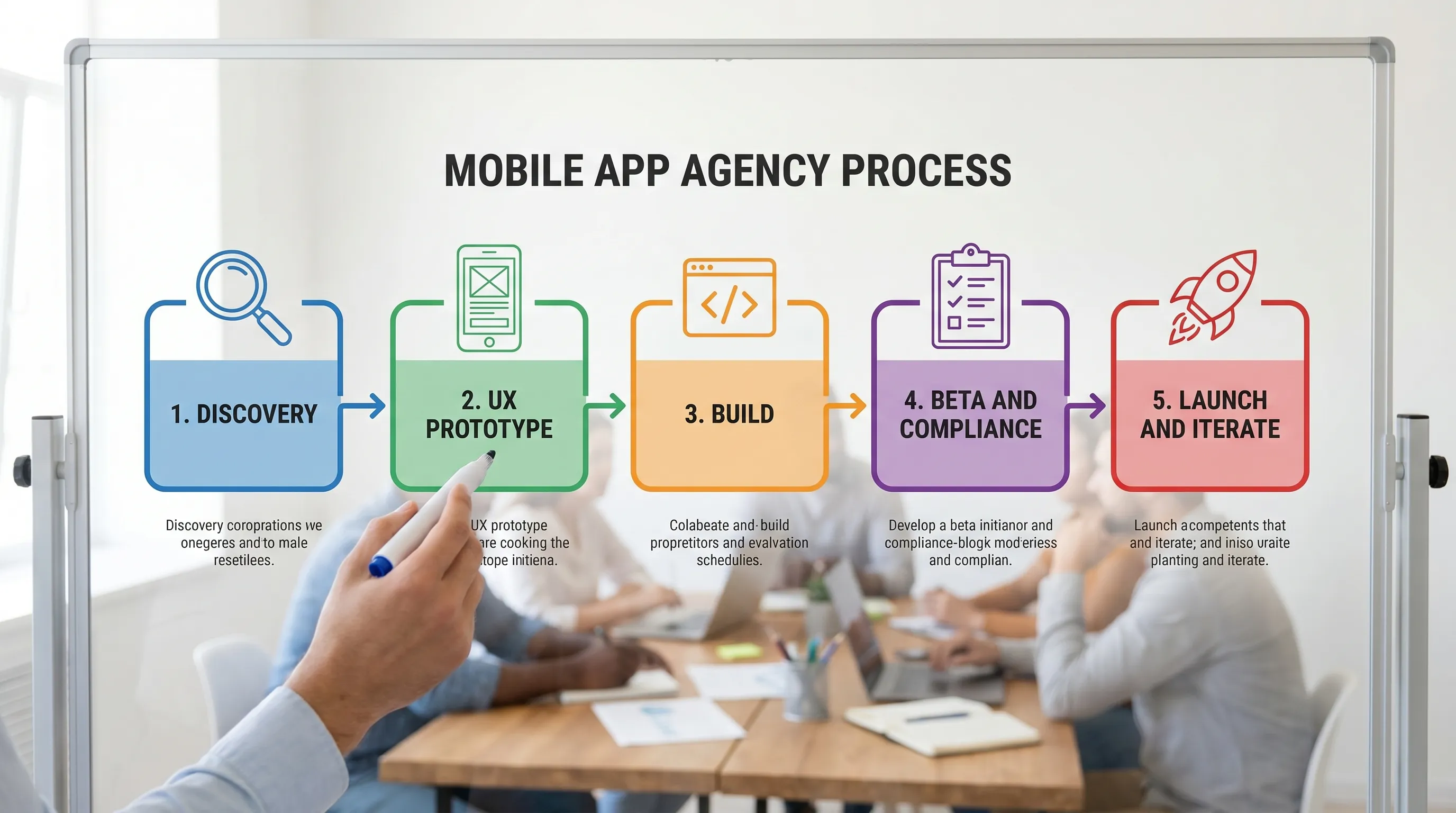
The mobile development agency process (end to end)
Most high quality engagements follow the same phases, even if they use different names. The difference is how explicit the decision gates and deliverables are.
Phase 1: Discovery and product alignment
Goal: Turn an idea into a buildable plan with clear tradeoffs.
A capable agency will push for specificity, because vagueness is the most expensive requirement.
Typical deliverables
- Problem statement, target users, and primary job to be done
- MVP scope definition (what is in, what is out, what is later)
- Risks and assumptions list (plus how to validate)
- High level backlog with rough sizing
- Technical spike plan (if there are unknowns like video, offline, BLE, payments, ML)
Decision gate: Everyone agrees on the MVP success metric and the “must ship” feature set.
Phase 2: UX design and interactive prototyping
Goal: Prove the app experience before committing to build cost.
Strong agencies prototype the critical paths early, because mobile UX is easiest to fix before implementation.
Typical deliverables
- Information architecture and key user flows
- Interactive prototype for critical journeys
- Design system foundations (type, spacing, components)
- Accessibility and platform conventions plan (iOS vs Android patterns)
Decision gate: Stakeholders can click through the MVP flows and agree the UX is “build ready.”
Phase 3: Architecture and build planning
Goal: Decide how the product will scale technically and operationally.
This phase is where many teams save (or lose) months later. You want alignment on:
- Native vs cross platform approach
- Backend responsibilities and API boundaries
- Data model, offline strategy, caching
- Auth, permissions, privacy model
- CI/CD approach and release workflow
Typical deliverables
- Architecture notes (diagrams, key decisions, tradeoffs)
- Repo setup and coding standards
- CI pipeline outline and environments plan
- Test strategy (unit, integration, UI, smoke tests)
Decision gate: The team agrees on the tech approach, and the first sprint can start without “architecture limbo.”
Phase 4: Implementation (sprints) with quality gates
Goal: Ship working increments with predictable progress.
A mature agency runs delivery as a system, not a sequence of heroics. Look for:
- Sprint planning tied to user facing milestones
- Weekly demos with real devices (not only simulators)
- Continuous integration, code review, and automated checks
- A definition of done that includes testing and instrumentation
Typical deliverables
- Incremental builds you can install (TestFlight and/or internal testing tracks)
- Source code and pull requests with review history
- Updated backlog and release burndown
- Basic analytics events and error monitoring hooks (as applicable)
Phase 5: QA, beta, store compliance, and submission
Goal: Reduce rejection risk and launch instability.
App review is a product and compliance exercise as much as an engineering one. Apple and Google both expect clear privacy disclosures, correct permission usage, and accurate metadata. Keep the official guidelines in scope early, not the week you submit.
Useful references:
Typical deliverables
- Regression test pass results and device coverage plan
- App Store and Play Store metadata draft (descriptions, keywords, screenshots plan)
- Privacy disclosures support (what data is collected, why, and where it is used)
- Submission packet (demo credentials, reviewer notes, test steps)
Decision gate: A release candidate build exists, with a known issue list and a go/no go owner.
Phase 6: Launch, monitoring, and iteration
Goal: Turn a shipped app into a growing product.
Post launch work should be planned, not improvised. Even early stage apps need basic operational readiness.
Typical deliverables
- Release plan and rollout strategy (phased rollout when appropriate)
- Crash and performance monitoring plan
- Backlog of launch learnings and iteration priorities
- Maintenance plan (OS updates, dependency upgrades, bug fixes)
Agency roles (who does what)
Your outcomes depend on whether the right roles exist, even if some are combined. Early stage teams often compress roles, but you still need someone explicitly accountable for each responsibility.
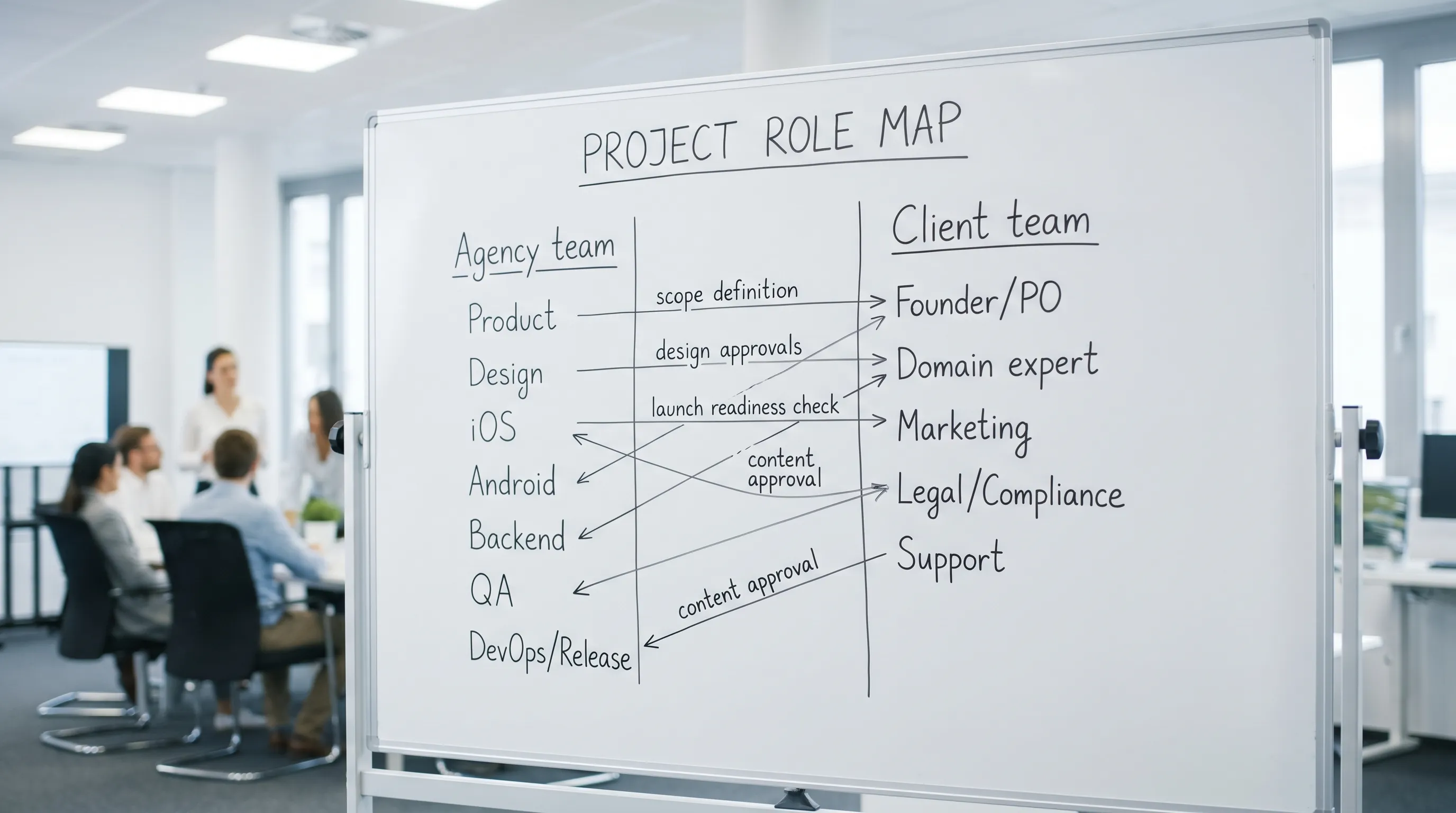
Core roles on the agency side
- Product lead or delivery lead: translates goals into backlog, keeps scope realistic, drives decisions.
- UX/UI designer: owns flows, interaction design, visual system, and handoff quality.
- iOS engineer and Android engineer (or cross platform engineers): build app features and platform integrations.
- Backend engineer or API owner (if included): builds services, data models, integrations, and security controls.
- QA owner: defines test strategy, manages regressions, verifies release candidates.
- Release/CI owner: ensures builds, signing, environments, and store submissions are reliable.
Core roles on your side (often missing, but critical)
- Founder or Product Owner: final authority on scope tradeoffs and priorities.
- Domain expert: validates workflows and edge cases (especially in healthcare, fintech, logistics, marketplaces).
- Marketing or growth owner: messaging, screenshots, launch plan, attribution readiness.
- Legal/compliance point person: privacy policy, terms, regulated flows, UGC rules.
- Support/ops owner: handles user issues, escalations, and feedback loops.
A simple responsibility matrix you can use
| Area | Agency typically drives | Client typically owns | Approval moment |
|---|---|---|---|
| MVP scope | Options, estimates, tradeoffs | Business priority | End of discovery |
| UX flows | Prototypes, interaction details | Brand fit, domain correctness | Prototype review |
| Engineering approach | Architecture decisions, CI/CD | Budget and timeline constraints | Architecture sign off |
| Data/privacy | Implementation plan, disclosures support | Legal stance, privacy policy | Store submission prep |
| Launch readiness | Checklists, release candidate | Go/no go | Release meeting |
| Post launch | Stabilization plan | Roadmap priorities | Week 1 and week 4 reviews |
Deliverables that actually reduce risk (what “good” looks like)
Not all deliverables are equally valuable. The best ones reduce uncertainty, prevent rework, and make quality measurable.
Discovery deliverables (reduce scope risk)
| Deliverable | Why it matters | What to look for |
|---|---|---|
| MVP definition | Prevents endless expansion | Clear “in/out/later” boundaries |
| Assumptions and risks | Makes unknowns explicit | Each risk has an owner and a validation plan |
| Milestone plan | Protects time to market | Milestones tied to user value, not internal tasks |
Design deliverables (reduce UX rework)
| Deliverable | Why it matters | What to look for |
|---|---|---|
| Interactive prototype | Validates flows early | Covers critical journeys and edge cases |
| Component library basics | Speeds consistent UI | Buttons, forms, states, typography defined |
| Handoff specs | Prevents implementation drift | States, spacing, and behaviors are unambiguous |
Engineering and release deliverables (reduce technical risk)
| Deliverable | Why it matters | What to look for |
|---|---|---|
| Architecture notes | Avoids “mystery system” | Key decisions and tradeoffs documented |
| CI/CD pipeline | Makes shipping repeatable | Automated builds, tests, and signing workflow |
| Test strategy | Prevents fragile releases | Minimum test coverage expectations are written |
| Store submission packet | Reduces rejection delays | Demo steps, credentials, reviewer notes prepared |
How to run the engagement so it stays predictable
Even with a great agency, process breakdown happens when decision making is slow or feedback is inconsistent.
Use a tight feedback cadence
Weekly is the practical minimum for founder feedback. If stakeholders only review monthly, you are functionally approving work that is already too expensive to change.
A clean cadence looks like:
- Short weekly demo on real devices
- One decision making meeting for scope tradeoffs
- Asynchronous review for design and copy
Define “done” in a way that protects launch quality
If “done” means “it works on my phone,” you will pay later. A healthier definition includes:
- Feature meets acceptance criteria
- Error states handled
- Analytics events added (only what you truly need)
- Tests updated where appropriate
- Release notes updated for the next build
Keep store compliance in scope from day one
Two common late stage surprises are privacy disclosures and account requirements. Apple and Google both enforce privacy and permission standards, and account deletion or data handling rules can affect UX.
If your agency brings up these topics early, that is a good sign, it means they ship.
Where a mobile development agency interfaces with marketing
Launch outcomes are influenced by more than the app binary. Your store listing, landing pages, onboarding emails, SEO, and paid acquisition all shape whether users even arrive.
If you need help beyond the app itself, it can make sense to partner with a specialized web and marketing team, for example a Brooklyn web design and SEO agency to support landing pages, local SEO, and content marketing around your launch.
What Appzay focuses on (and how to use this guide with any agency)
Appzay positions itself as a premium, end to end partner for funded startups, covering product strategy and UX design, native iOS and Android engineering, distributed systems architecture, CI/CD and release orchestration, App Store optimization, plus proactive maintenance and support.
Whether you work with Appzay or another team, you can use the checklists and tables in this guide as your evaluation rubric:
- Ask to see examples of deliverables like architecture notes, CI/CD outlines, and release checklists.
- Confirm who owns App Store and Play Store submission, not just “helping.”
- Make sure there is a real plan for QA and post launch stabilization.
Frequently Asked Questions
What is the typical timeline with a mobile development agency? It depends on scope and complexity, but most teams move through discovery and prototyping first, then build in sprints, then beta and store submission. Ask for milestone based planning instead of a single date.
Which roles are non negotiable for a successful app build? You need clear ownership for product decisions, UX, engineering, QA, and release operations. On your side, you also need a single Product Owner who can make tradeoffs quickly.
What deliverables should I request before development starts? At minimum, an MVP scope definition, an interactive prototype for critical flows, an initial backlog, and architecture notes that explain major decisions.
How do I know if an agency is ready for App Store submission? Ask for their submission checklist, examples of reviewer notes, and how they handle privacy disclosures, demo credentials, and release candidate management.
Should I choose native or cross platform development? It depends on performance needs, device integrations, and team goals. A good agency should recommend an approach based on constraints, then validate with a small technical spike if needed.
Who should own the source code and store accounts? You should own them. Your company should control App Store Connect and Google Play Console, and your repos should live in your organization (with the agency granted access).
Build with a delivery system, not just a dev team
If you are evaluating a mobile development agency, use this guide as a working agreement: process phases, explicit roles, and concrete deliverables that reduce risk.
If you want a partner that can take a funded idea from concept to App Store with strong engineering and release discipline, explore Appzay’s end to end approach at Appzay.