6/14/2026
Business Mobile App Development That Supports Real Growth
Business mobile app development should drive revenue, retention, and efficiency. Learn how to plan, build, and scale apps for real growth.
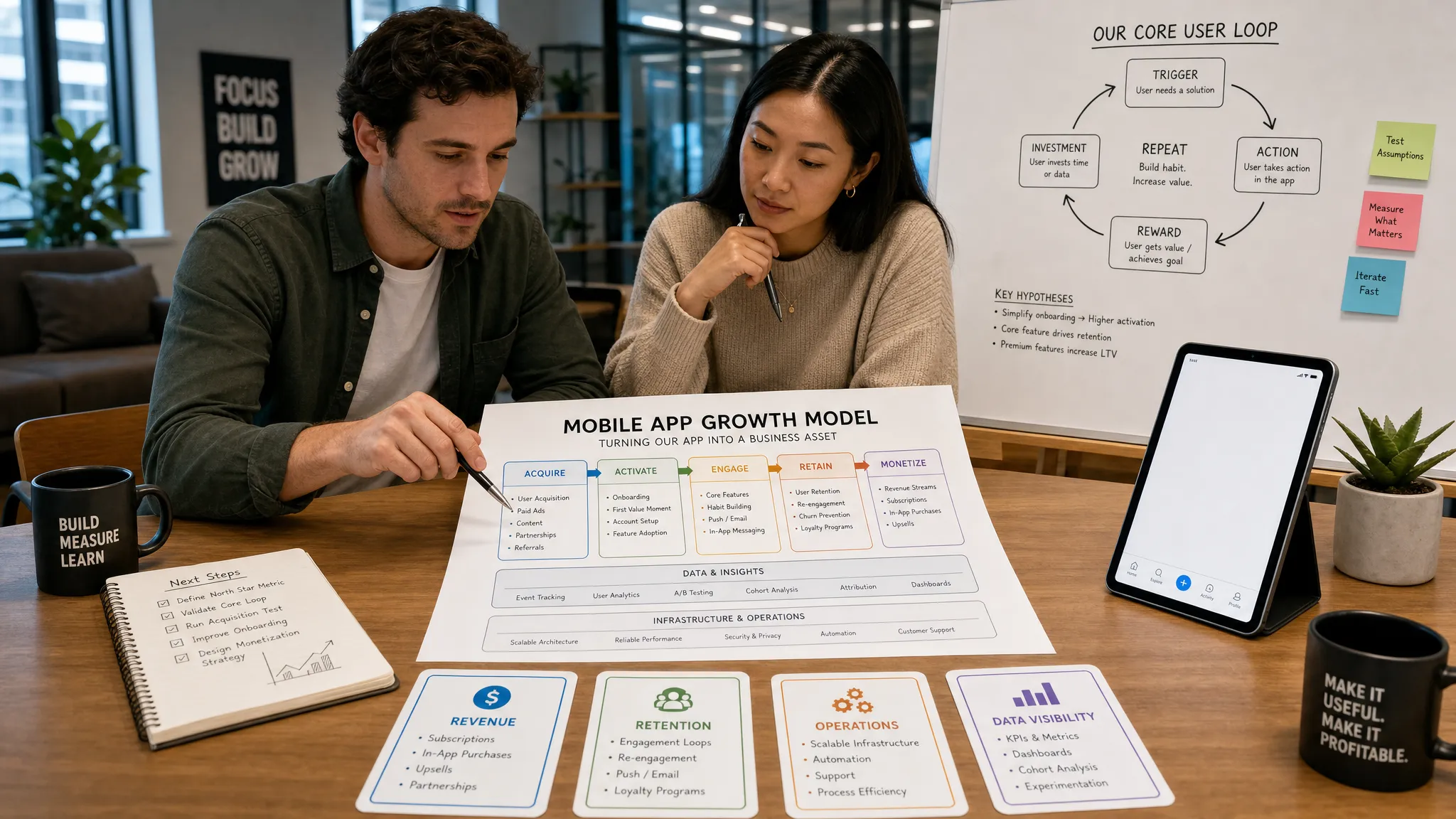
A polished app can help your brand look modern, but that is not the same as growth. For a business, mobile should improve how customers buy, how teams operate, how data moves, and how quickly the company can learn from real usage.
That is why business mobile app development should begin with a growth thesis, not a feature wishlist. The goal is not simply to “have an app.” The goal is to build a mobile product that supports measurable outcomes such as higher conversion, better retention, faster operations, lower support load, stronger customer relationships, or new revenue streams.
For funded startups and growth-focused companies, the difference matters. A mobile app can become a durable business asset, but only when strategy, UX, engineering, launch operations, and post-launch iteration are planned together.
What Makes Business Mobile App Development Different?
Consumer apps often compete for attention. Business apps must earn repeated use by making something important easier, faster, safer, or more profitable.
That may mean a customer-facing app that increases repeat purchases, a field operations app that helps staff complete work on site, a booking app that reduces manual coordination, a companion app that improves the value of a physical product, or a mobile CRM workflow that helps sales teams act faster.
In each case, the app is not just a digital channel. It becomes part of the company’s operating system.
Strong business mobile app development asks questions such as:
- What business metric should this app move?
- Which user behavior creates that result?
- What mobile moment is currently broken, slow, or unavailable?
- Which integrations are necessary for the app to create real value?
- What needs to be measured after launch?
- How will the product evolve once usage data arrives?
A business app that cannot answer those questions may still ship, but it is unlikely to support real growth.
Start With the Growth Model, Not the Screen List
Many teams begin planning an app by listing features: login, profile, dashboard, chat, payments, notifications, admin panel. Those pieces may be necessary, but they do not explain why users will open the app or why the business will benefit.
A better starting point is the growth model. Define how the app will contribute to the business before deciding what to build.
| Growth goal | What the app must enable | Example app capability |
|---|---|---|
| Increase revenue | Make buying, booking, upgrading, or reordering easier | Mobile checkout, subscriptions, saved preferences |
| Improve retention | Give users a reason to return at the right moment | Personalized reminders, progress tracking, loyalty features |
| Reduce operational cost | Replace manual coordination or repetitive support | Self-service flows, status updates, automated intake |
| Improve team productivity | Help employees complete tasks in the field or on the move | Offline forms, route views, quick approvals |
| Strengthen data visibility | Capture accurate events from real workflows | Analytics, audit trails, CRM or ERP sync |
| Expand service capacity | Support more customers without proportional headcount | Scheduling, dispatch, account management |
This framing prevents overbuilding. If a feature does not support the primary growth model, it may belong in a later release.
For example, a B2B services company may not need a complex social feed, but it may need account-based access, real-time booking status, contract-specific pricing, and support escalation. A field service company may need offline reliability and photo capture more than animated onboarding. A healthcare or fintech startup may need trust, security, consent, and compliance-oriented UX before advanced personalization.
The best business apps feel focused because their scope is tied to an actual business outcome.
Find the Expensive Mobile Moment
Every useful business app solves an expensive moment. “Expensive” does not always mean financially expensive. It may mean slow, frustrating, error-prone, manual, or risky.
The expensive moment might be a customer abandoning a booking because the web flow is hard to use on mobile. It might be a sales rep forgetting to update CRM notes after an in-person meeting. It might be a driver losing connectivity during a delivery. It might be a support team answering the same order-status question hundreds of times per week.
Business mobile app development becomes much clearer when you identify this moment and design the first version around it.
In transportation, for example, a business app might support airport transfer booking, chauffeur coordination, corporate account management, and live itinerary updates for companies offering 24/7 airport, corporate, and event transportation. The app’s value would not come from having many screens. It would come from reducing coordination friction at the exact moments customers and operators need clarity.
The same principle applies across industries. A useful mobile product is usually built around one high-value loop:
- A user has a need.
- The app makes the next action obvious.
- The system completes or coordinates the task.
- The user receives confirmation, status, or value.
- The business captures data that improves the next interaction.
If that loop is strong, the product has a foundation for growth. If that loop is weak, adding more features rarely fixes the problem.
Design for Adoption Before You Design for Expansion
A business app only supports growth if people actually use it. That sounds obvious, but adoption problems often begin in early design decisions.
For customer-facing apps, adoption depends on trust and speed. Users need to understand what the app does, why it is worth installing, and how quickly they can complete the task they came for. Long onboarding, unclear permission requests, hidden pricing, forced account creation, or slow loading can create immediate drop-off.
For internal business apps, adoption depends on workflow fit. If employees feel the app adds admin work, they will avoid it or create workarounds. The app should reduce friction in the real environment where it will be used, whether that is a warehouse, a sales call, a vehicle, a retail floor, a clinic, or a job site.
Good mobile UX for business growth usually prioritizes:
- Fast access to the primary action
- Clear status and next steps
- Minimal typing when scanning, selection, or defaults can work
- Thoughtful permission timing
- Strong empty, loading, offline, and error states
- Accessibility and platform-consistent patterns
- Trust signals around payments, privacy, and sensitive data
Design quality is not just visual polish. It is the removal of friction from the business-critical behavior.
Build the Technical Foundation for Growth
Growth creates pressure. More users, more data, more integrations, more edge cases, and more release complexity. If the app’s technical foundation is fragile, growth can make the product worse instead of better.
This is why the engineering phase should not be treated as simple implementation of static designs. The team needs to make deliberate decisions about architecture, backend ownership, data models, API contracts, authentication, security, observability, and release workflows.
For many business apps, the mobile client is only one part of the system. The app may need to connect with payment processors, mapping tools, CRMs, ERPs, scheduling systems, analytics platforms, cloud storage, push notification services, and internal admin tools. Poorly planned integrations are a common reason apps become expensive to maintain.
A scalable business app typically needs:
- Stable API contracts between mobile and backend systems
- Clear separation between UI, business logic, and data layers
- Secure authentication and role-based access when needed
- Server-side handling of secrets, permissions, and critical rules
- Analytics events tied to business decisions, not vanity tracking
- CI/CD pipelines for repeatable iOS and Android releases
- Monitoring for crashes, performance, API failures, and key journeys
- A plan for data migrations and app version compatibility
If your app needs cloud infrastructure, real-time data, background jobs, or complex integrations, it is worth planning those choices early. Appzay’s guide to cloud-based app development goes deeper into how scalable backend decisions affect mobile products.
Native, Cross-Platform, or Hybrid: Choose Based on Growth Constraints
The right technology stack depends on the product’s constraints. There is no universal answer.
Native iOS and Android development can be the right call when performance, platform-specific UX, hardware access, complex background behavior, or premium polish are central to the product. Cross-platform frameworks can be a strong fit when speed, shared logic, and consistent delivery across platforms matter more than deep platform specialization.
For a business app, the decision should be based on the riskiest interaction. If the product depends on real-time location, intensive media processing, advanced Bluetooth, offline sync, or strict native performance, stack choice becomes a strategic decision. If the app is primarily form flows, dashboards, content, account management, and standard integrations, cross-platform may reduce time to market without sacrificing the business outcome.
The mistake is choosing a stack because it sounds trendy or cheap. The better approach is to define the product’s growth constraints, then pick the stack that supports them over the next 12 to 24 months.
Measure Growth With Product and Operational Metrics
Once the app launches, the question changes from “Did we ship?” to “Is it working?”
This is where many business apps underperform. Teams track downloads or signups, but they do not measure whether the app is improving the underlying business. Downloads may matter, but they are not enough.
Useful growth measurement connects product behavior to business outcomes.
| Metric category | What to measure | Why it matters |
|---|---|---|
| Activation | First successful booking, order, sync, task, or setup | Shows whether users reach first value |
| Conversion | Trial to paid, quote to booking, cart to purchase | Connects mobile usage to revenue |
| Retention | Repeat opens, repeat orders, weekly active accounts | Reveals whether the app creates ongoing value |
| Efficiency | Time to complete task, manual tickets avoided, fewer calls | Shows operational impact |
| Reliability | Crash-free sessions, API failures, failed payments, sync errors | Protects trust and revenue |
| Engagement quality | Feature completion, notification opt-ins, core loop frequency | Helps prioritize roadmap decisions |
Instrumentation should be planned before launch, not added after the team realizes it is flying blind. The first release should include enough analytics and monitoring to answer whether the core loop is working, where users drop off, and which failures affect revenue or operations.
For reliability planning, Appzay has a detailed guide on monitoring app essentials that explains what product and engineering teams should track after release.
Plan the Roadmap Around Learning Cycles
Real growth rarely comes from one large launch. It comes from tight learning cycles after the app reaches real users.
A practical roadmap for business mobile app development should move through focused phases.
| Phase | Main objective | Key deliverables |
|---|---|---|
| Discovery | Align the app with a business outcome | Growth thesis, user segments, core loop, success metrics |
| UX and prototype | Validate the highest-risk flows before coding | Wireframes, clickable prototype, edge states, user feedback |
| MVP build | Ship the smallest complete version that can prove value | iOS and Android app, backend, integrations, analytics, QA |
| Launch readiness | Reduce store, operational, and reliability risk | Test builds, store assets, rollout plan, support workflow |
| Growth iteration | Improve based on real data | Experiments, optimizations, feature expansion, maintenance |
This structure helps teams avoid two common extremes. One extreme is shipping a thin prototype that cannot prove business value. The other is spending months building a large feature set before validating whether the core loop works.
The right MVP is not the smallest possible app. It is the smallest credible app that can test the growth thesis.
Avoid the Most Common Business App Growth Traps
Business apps tend to fail for predictable reasons. The product may be visually attractive, but the underlying strategy or system is incomplete.
Watch for these traps:
- Building for executives instead of actual users
- Treating the app as a marketing asset rather than an operating channel
- Copying the website into mobile form without redesigning the workflow
- Adding too many features before proving the primary loop
- Underestimating integrations, permissions, offline states, and support tools
- Delaying analytics until after launch
- Planning launch but not post-launch iteration
- Ignoring App Store and Google Play requirements until the end
- Choosing the cheapest build path without considering maintenance cost
These mistakes are costly because mobile products are interconnected. A design decision can affect engineering complexity. An integration decision can affect launch timing. A missing analytics event can slow growth learning. A weak onboarding flow can hide the value of an otherwise strong product.
The solution is not more process for its own sake. It is integrated planning across product, design, engineering, and release operations.
What to Expect From a Growth-Focused Development Partner
A development partner for a business app should do more than turn tickets into code. The right partner should help clarify the product strategy, challenge risky assumptions, design mobile-first workflows, make technical trade-offs visible, and prepare the app for launch and iteration.
For founders and business leaders, that means looking for evidence of end-to-end thinking. Can the team discuss user flows and backend architecture in the same conversation? Do they plan QA, CI/CD, App Store readiness, and monitoring from the beginning? Can they explain why a feature belongs in V1 or later? Do they understand how mobile product decisions affect revenue, retention, and operations?
Appzay works with funded startups and growth-focused teams to design, build, and launch premium iOS and Android apps from concept to App Store. That includes product strategy, UX design, native mobile engineering, cloud integration, release orchestration, App Store optimization, and proactive support. If you are evaluating what an end-to-end partner should include, this guide to mobile app development services can help you compare options.
Frequently Asked Questions
What is business mobile app development? Business mobile app development is the strategy, design, engineering, launch, and improvement of mobile apps that support business outcomes such as revenue growth, retention, operational efficiency, customer self-service, or team productivity.
How is a business app different from a consumer app? A business app is usually tied to a measurable workflow or commercial outcome. It may serve customers, employees, partners, or field teams, and it often needs integrations, security, analytics, admin workflows, and reliable operational performance.
What should be included in a business mobile app MVP? A strong MVP should include the smallest complete user loop that can prove value. That usually means onboarding, the primary action, backend support, essential integrations, analytics, QA, security basics, and launch readiness. Advanced features should wait until the core behavior is validated.
How long does it take to build a business mobile app? Timelines vary based on scope, platforms, integrations, design complexity, and compliance needs. A focused MVP may take a few months, while more complex apps with custom backend systems, multiple user roles, or real-time operations may take longer.
Should a business app be native or cross-platform? The best choice depends on the product’s requirements. Native can be better for high-performance, hardware-heavy, or platform-specific experiences. Cross-platform can work well for many business workflows when speed, shared logic, and consistent iOS and Android delivery are priorities.
Build a Business App That Can Actually Grow
A business app should not be judged by how many features it contains. It should be judged by whether it helps the company acquire, serve, retain, and learn from users more effectively.
If you are planning a mobile product and want it built around real growth, Appzay can help turn your concept into a launch-ready iOS and Android app with strategy, UX, engineering, deployment, and support handled end to end.
Start by clarifying the business outcome, then build the mobile experience that can move it. When you are ready to scope the product, visit Appzay to discuss your app idea.