4/24/2026
Application Development Agency: What to Ask Before You Sign
Hiring an application development agency? Ask these questions on scope, quality, IP, security, process, and pricing before you sign.
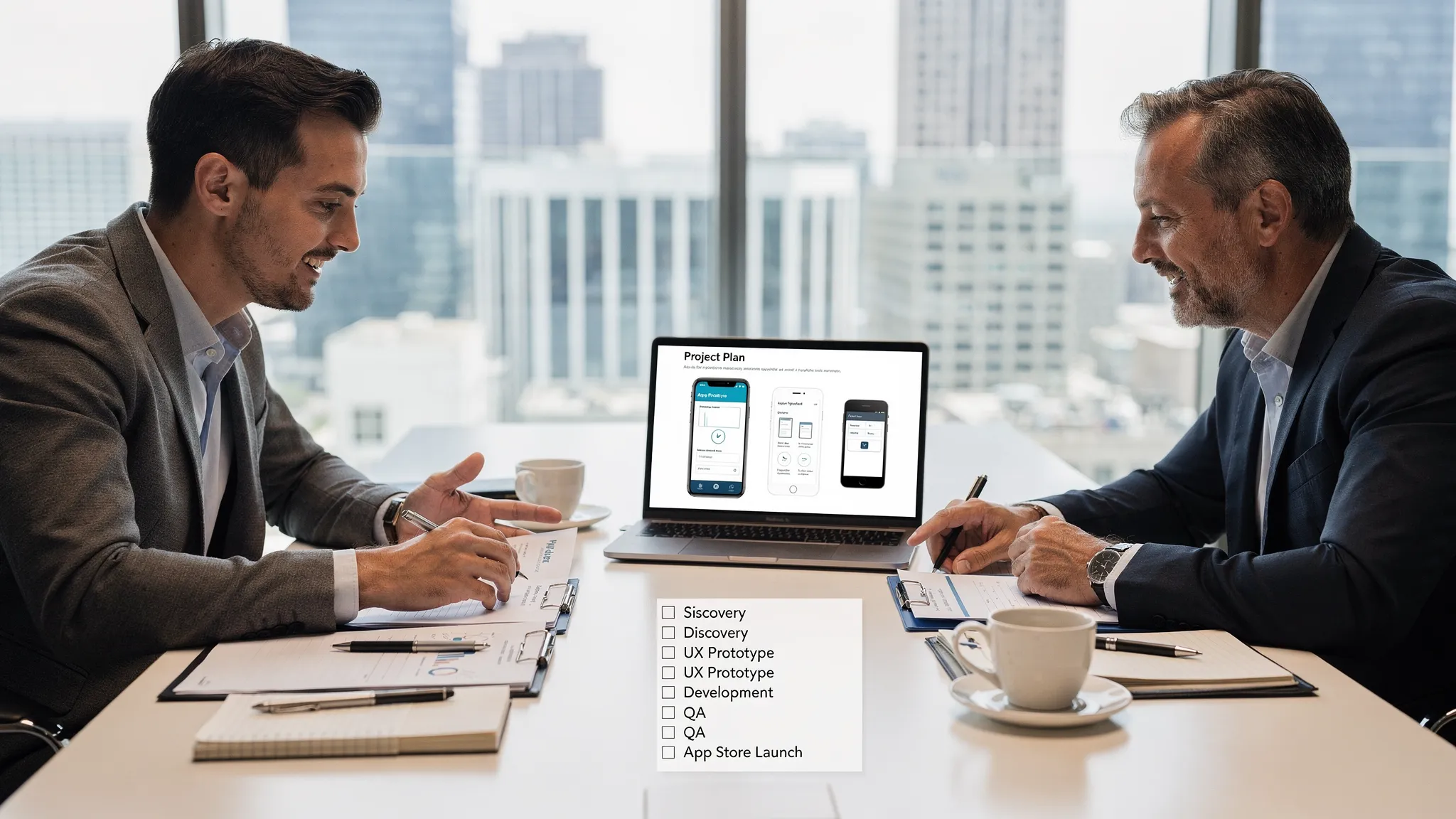
Signing with an application development agency is one of those founder decisions that feels reversible until it is not. By the time the repo is messy, the release is slipping, or App Store review is blocking you, your leverage is gone and your runway is shorter.
This guide is a practical question set you can use in sales calls, paid discovery sprints, and contract review. The goal is not to “catch” an agency, it is to surface delivery risk early and translate promises into artifacts, responsibilities, and acceptance criteria.
First, align on what “success” means (or every quote is meaningless)
Before you evaluate any agency, force clarity on outcomes. Most bad agency engagements start with a vague scope and optimistic assumptions.
Ask:
- What is the V1 user journey (start to finish) and what is explicitly out of scope? If the agency cannot restate your V1 in plain language, they cannot reliably estimate it.
- What does “done” mean for V1? Push for measurable acceptance criteria: store-ready builds, analytics events implemented, crash-free baseline, performance targets, onboarding complete, etc.
- What are the top 3 risks you see in this product? A serious partner will talk about edge cases (auth, offline, payments, moderation, privacy, device fragmentation) instead of only features.
- What are the assumptions baked into your estimate? Example assumptions: “API is ready,” “design is provided,” “single locale,” “no offline,” “no UGC.” These should become written constraints.
If you want a quick litmus test, ask the agency to summarize your app in one sentence and list the first five screens they would build. You will instantly see whether they think in product flows or in generic “modules.”

Questions that reveal whether they can actually ship
Most agencies can “build.” Fewer can ship repeatedly with predictable quality.
Discovery and planning
A discovery sprint is where estimates become plans and unknowns become tracked risks.
Ask:
- What are the concrete deliverables of discovery? Look for artifacts like a scope brief, interactive prototype, architecture outline, risk register, milestone plan, and a release checklist.
- How do you validate technical unknowns? Strong teams propose spikes for risky areas (Bluetooth, video, background tasks, on-device ML, complex animations).
- How do you handle scope changes after discovery? You want a mechanism (change requests tied to timeline and cost), not informal Slack negotiation.
Team, seniority, and continuity
You are not hiring a brand, you are hiring specific people and their operating system.
Ask:
- Who is on the core team, by name and role, and how many projects are they assigned to? “Part-time” leadership across many clients often means delayed decisions.
- Who owns technical decisions and code review? Push for a clear accountable lead.
- What happens if a key engineer leaves? Look for redundancy (shared ownership, documentation, onboarding plan) rather than “it never happens.”
- Can you show anonymized examples of recent pull requests and how you review them? You are evaluating standards, not just output.
Architecture and build approach
In 2026, the “native vs cross-platform” choice is still important, but the bigger differentiator is whether the team can keep the app maintainable through constant OS updates and product iteration.
Ask:
- Why is your proposed stack the right fit for our constraints? The answer should reference your app’s UX polish needs, device features, performance hotspots, and hiring reality.
- How do you separate concerns (UI, domain logic, data, native boundaries)? This predicts long-term velocity.
- What is your backend stance? Even if you have an API team, your mobile partner should think about contracts, versioning, reliability, rate limits, and observability.
- What is your upgrade policy? Ask how they handle iOS/Android major releases and dependency updates without “rewrite month.”
Quality, testing, and performance
“QA at the end” is a common failure mode. Quality has to be an everyday system.
Ask:
- What tests do you write by default (unit, integration, E2E), and where do you draw the line? You want a testing strategy that matches your risk profile, not dogma.
- What is your definition of done for a ticket? Look for: tests where appropriate, instrumentation, accessibility basics, code review, and a documented acceptance demo.
- How do you measure performance? Ask for performance budgets (app start, scroll smoothness, memory) and how they verify them.
- What is your release process? Expect CI builds, automated checks, staged rollouts where applicable, and rollback strategy.
Questions about security, privacy, and store compliance (the hidden schedule killers)
App Store and Google Play policy issues tend to appear late unless you plan for them early.
Ask:
- How do you approach privacy disclosures and permissions? You want progressive permissioning and a clear data inventory.
- What is your baseline mobile security standard? A credible reference point is the OWASP Mobile Application Security Verification Standard (MASVS).
- How do you handle secrets and credentials across environments? If you hear “we’ll keep it in a doc,” treat that as a red flag.
- How do you prepare for store review? Ask for a submission packet checklist and reviewer notes process. Apple’s App Review Guidelines are the baseline, but good agencies also learn from prior rejections.
- Who owns compliance for regulated areas (payments, health, kids, UGC)? The agency can implement and advise, but you want clarity on legal responsibility and content policy decisions.
Questions about ownership, IP, and handover (protect your leverage)
Founders often discover too late that they do not control the essentials: developer accounts, analytics, domains, repos, build pipelines.
Ask:
- Who owns the source code and when do we receive it? You should have repo access from day one.
- What accounts must be in our name? Typically Apple Developer, Google Play, cloud providers, analytics, crash reporting, and domain.
- What is your documentation standard at launch? Expect at least: setup instructions, architecture notes, release runbook, and key decisions.
- What does “handover” include, and how many hours are allocated? Handover is a deliverable, not an afterthought.
- What third-party licenses are you using and how are they tracked? This matters for security, upgrades, and legal exposure.
Questions about pricing, milestones, and contract terms
Pricing model matters less than whether the contract makes reality operable.
Ask:
- Is this fixed price, time and materials, or a hybrid? What assumptions does it rely on? Fixed price without a tight scope often turns into change-order friction.
- What are the milestone deliverables, and how are they accepted? Acceptance criteria should be testable (build runs, flows complete, logging present), not subjective.
- How do you handle delays caused by us (feedback, assets, API readiness)? You want a clear dependency list and a process for re-baselining.
- What is included post-launch, and what is not? Clarify maintenance, OS updates, incident response expectations, and SLAs if any.
- What are the termination terms and transition support? A fair contract anticipates change and provides a clean exit path.
The “proof” questions (how to validate claims quickly)
Agencies will say they are senior, fast, and end-to-end. Evidence beats adjectives.
Ask for:
- A walkthrough of a recent project from discovery to store launch (what went wrong, how they handled it).
- A sample release checklist and what is automated vs manual.
- A demo of their CI/CD pipeline at a high level (even screenshots), including how they manage signing, environments, and approvals.
- References you can speak to where the scope and complexity are comparable.
A useful analogy: if you have ever sourced physical inventory for a business, you probably asked about grade, manifest accuracy, shipping terms, and what happens when a pallet shows up damaged. Software delivery has the same risk profile, just with different artifacts. If your product touches e-commerce or logistics, even your operations partners will have their own due diligence norms, for example when buying bulk pallets for resale or distribution. Treat your agency selection with the same discipline.
A simple interview agenda you can reuse
Use this structure to keep calls focused and comparable across vendors.
| Segment | Time | What you are trying to learn | What to ask for |
|---|---|---|---|
| Product recap | 5 min | Do they understand the V1 | One-sentence summary, top 5 screens |
| Delivery plan | 10 min | Can they run a predictable process | Phases, milestones, change control |
| Engineering depth | 10 min | Will this be maintainable | Architecture outline, PR/review examples |
| Quality and release | 5 min | Can they ship reliably | Testing approach, CI/CD overview |
| Ownership and contract | 5 min | Do you keep leverage | Repo access, account ownership, handover |
| Next step | 5 min | How to de-risk | Paid discovery proposal and deliverables |
What a good agency answer sounds like (and what to watch for)
A good answer is usually specific, bounded, and tied to artifacts.
-
Good: “We will deliver an interactive prototype, a scope brief with explicit exclusions, and a release plan. We will set up CI in week one and require code review on all PRs.”
-
Risky: “We’re flexible, we’ll figure it out as we go.”
-
Good: “You will own the Apple and Google developer accounts. We work inside your repos from day one.”
-
Risky: “We can publish under our account, it’s easier.”
-
Good: “Here are the top three technical risks and how we will validate them in discovery.”
-
Risky: “No major risks, it’s a standard app.”
Frequently Asked Questions
What should I look for in an application development agency besides portfolio screenshots? Look for evidence of delivery operations: discovery deliverables, architecture clarity, testing discipline, CI/CD, store readiness habits, and clean ownership of repos and accounts.
Should I do a paid discovery sprint before signing a full build? Often yes. A paid discovery sprint converts unknowns into a plan, reduces estimation error, and gives you real artifacts you can keep, even if you do not continue.
How do I know if the team writing my code is senior enough? Ask who reviews PRs, request anonymized PR examples, and ask how they handle upgrades, performance issues, and production incidents. Senior teams have repeatable systems, not just confidence.
What contract terms matter most for a mobile app build? Clear milestone deliverables with acceptance criteria, IP and repo ownership, account ownership, change request process, post-launch scope, and termination plus transition support.
Who should own the Apple Developer and Google Play accounts? You should. Your company should own publishing accounts and critical infrastructure accounts so you control releases, compliance, and long-term continuity.
Ready to vet an agency with fewer surprises?
If you are looking for a premium, end-to-end partner to design, build, and launch a high-quality iOS and Android app, Appzay can help you run a structured discovery and deliver a store-ready product with strong engineering foundations.
Explore Appzay at Appzay and use the questions in this guide to drive a clear, artifact-based evaluation before you sign.